Types of hospital beds: ward, ICU, bariatric, low, specialty and examination beds explained
From the five-function ICU bed to the air-fluidised sand bed and the examination couch: what each type of medical bed is, who it is for and where to read more.

Short answer
The main types of hospital beds are manual and electric ward beds, ICU beds, bariatric beds, low (hi-low) beds, enclosed safety beds, paediatric cots and infant cribs, delivery beds, orthopaedic traction beds and specialty therapy beds such as air-fluidised and rotating beds. Examination couches and operating tables support patients too, but standards treat them as separate devices. Choose by patient group, care task and safe working load.
There are more types of hospital beds than most procurement lists admit. A ward bed, an ICU bed, a bariatric bed, a low bed, an enclosed safety bed, a delivery bed and an air-fluidised "sand bed" are all sold as a medical bed, yet they differ in drive system, safe working load, platform size and the standard they are tested to. Mixing them up is how a tender ends up with beds that cannot do the job the ward needed.
This guide is a hub. It defines each type of patient bed in a few lines, gives the numbers that separate one from another, and links to our deeper articles and to the Keling models that fit each category. Where Keling does not make a type, we say so and describe it neutrally.
What is a medical bed, and what are hospital beds called?
A medical bed is a bed designed for diagnosis, treatment or care of a patient, with a mattress support platform that can usually be adjusted and a structure tested to medical-equipment safety rules. Hospital beds are also called patient beds, ward beds, nursing beds, care beds or, in US home-care language, DME beds.
Three reference points define the category:
- IEC 80601-2-52:2026 covers medical beds for adults, electric and manual. Published in May 2026, it replaced IEC 60601-2-52:2009 and its 2015 amendment. It excludes speciality mattresses, stretchers and examination tables.
- IEC 80601-2-89:2025 covers medical beds for children and for adults with atypical anatomy, generally beds with an internal length up to 1,800 mm.
- US FDA classification: an AC-powered adjustable hospital bed is a Class II device under 21 CFR 880.5100; hydraulic and manual adjustable beds are Class I.
Anything that is mainly for examination or transport, such as an exam couch, a stretcher or a surgical table, is not a hospital bed under these standards, even if people call it a "clinic bed" or "surgery bed".
Types of hospital beds at a glance
Most facilities need only four or five of the types below. The table gives a one-line definition of each and where to read more.
| Type | What it is | Typical setting | Keling option / further reading |
|---|---|---|---|
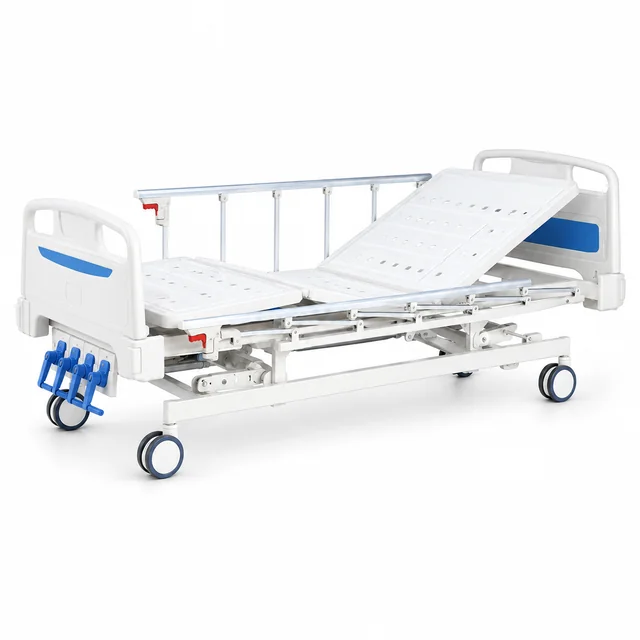
| Manual ward bed | Crank-adjusted bed, 1 to 5 functions | General wards, rural clinics | KL-BC108, KL-BC109 |
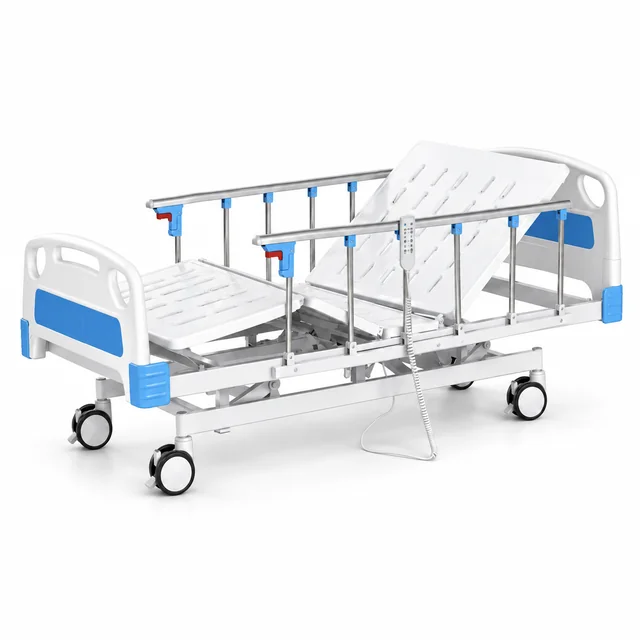
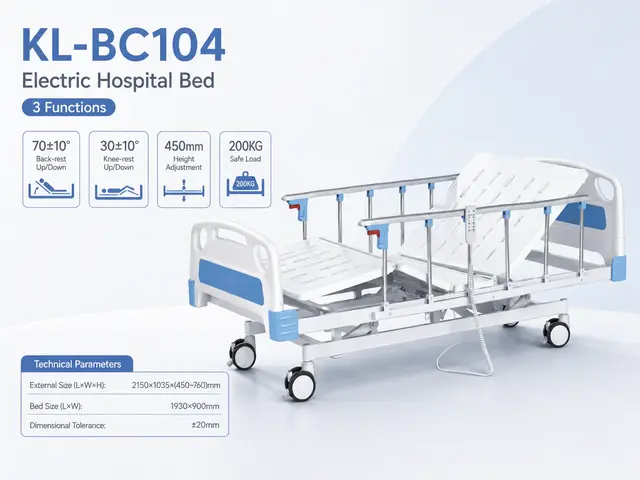
| Electric ward (med surg) bed | Motorised backrest, knee-rest and usually height | Medical and surgical wards | KL-BC104, KL-BC103 |
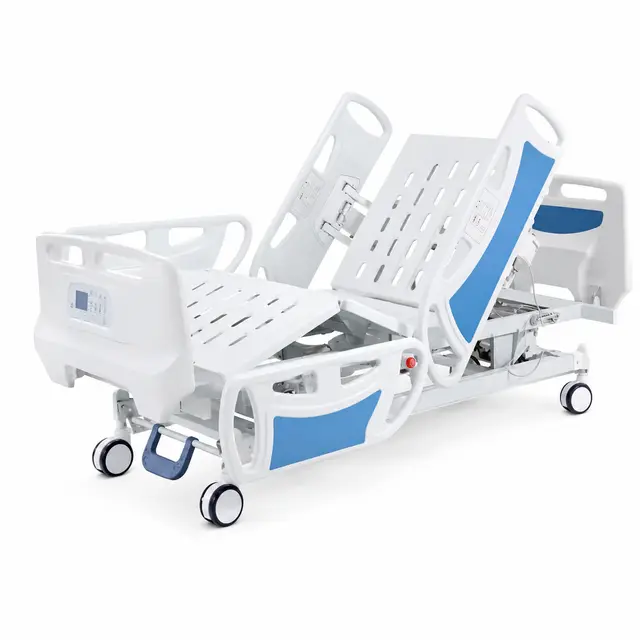
| ICU bed | 5-function electric bed with CPR release, tilt, options for scales and battery | ICU, HDU | KL-BC101 |
| Bariatric bed | Wider, higher-load bed for patients of larger size | Any ward with bariatric patients | Not made by Keling; see our bariatric guide |
| Low / hi-low bed | Deck lowers close to the floor to reduce fall injury | Geriatric, dementia, rehab | Not made by Keling; see our low-bed guide |
| Enclosed / safety bed | Bed with padded or netted walls around the sleep surface | Special needs, home care | Not made by Keling |
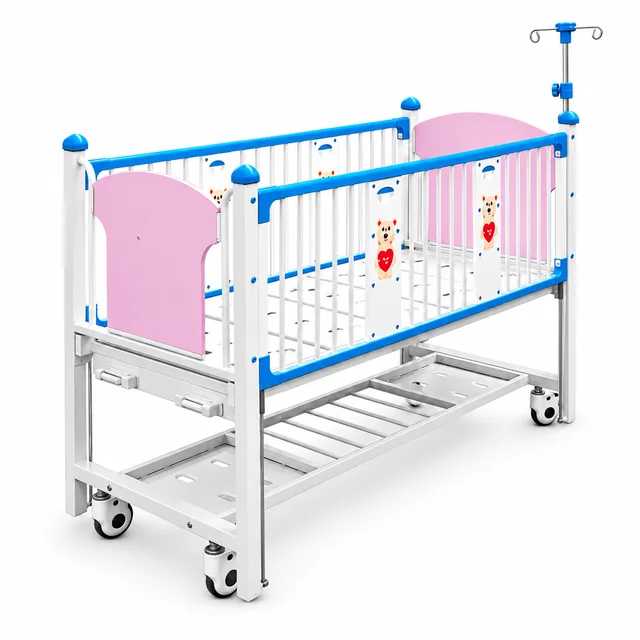
| Paediatric cot and infant crib | Child-size beds with full-length rails or bassinets | Paediatric, maternity | Children & infant beds |
| Delivery bed | High bed with leg supports and steep tilt | Labour and delivery | KL-BC110 |
| Orthopaedic traction bed | Bed with overhead frame, pulleys and trapeze | Orthopaedic wards | KL-BC111 |
| Flat / nursing bed | Fixed-height bed, backrest only or none | Low-acuity, observation | KL-BC129, KL-BC130, KL-BC131 |
| Air-fluidised (sand) bed | Bed of air-driven beads that behaves like fluid | Burns, complex wounds | Not made by Keling |
| Kinetic / rotating bed | Bed that turns the patient side to side | Critical care | Not made by Keling |
| Examination couch | Fixed or adjustable table for examination | Outpatients, exam rooms | Not made by Keling |
| Operating table | Positioning table for surgery | Operating theatre | Not made by Keling |
Ward, med surg and ICU beds: drive system and function count
A ward bed (called a med surg bed in the US) is a general-purpose adjustable bed for inpatients; an ICU bed is the same basic platform with more functions, faster emergency controls and room for monitoring accessories. The two variables that matter most are the drive system and the number of adjustable axes.
Manual, semi-electric and full-electric
A manual medical bed uses foot-end cranks; a semi-electric bed motorises the backrest and knee-rest but cranks the height; a full-electric bed motorises everything. Our comparison of full-electric, semi-electric and manual hospital beds sets out the staff-workload and maintenance trade-offs.
Function count
Beds are sold as 1-, 2-, 3- or 5-function. The count is the number of adjustable axes: backrest, knee-rest, height, then Trendelenburg and reverse Trendelenburg. It says nothing about whether the axes are powered. Our article on what each hospital bed function does explains the clinical use of each.
What makes an ICU bed
An ICU bed adds a CPR release that flattens the backrest in one action, a nurse lock on patient controls, an angle indicator and tilt. The KL-BC101 is an example: 5 functions, height 480 to 760 mm, tilt 13 ± 5°, 0 to 90° angle indicator, 240 kg safe working load, optional weighing system and battery. See what separates ICU beds from ward beds for imaging access, scales and accessories.
Bariatric beds and hospital bed sizes
A bariatric bed is a hospital bed built with a wider platform and a higher safe working load for patients whose size or weight exceeds a standard bed. Standard adult hospital beds have a mattress platform of about 900 mm (roughly 36 in) by 1,900 to 2,000 mm; bariatric hospital beds are commonly specified around 1,000 to 1,200 mm wide, with some models wider still.
Two cautions. First, safe working load is the total load the bed carries (patient, mattress, accessories), not a patient weight limit; our explainer on what 200 kg and 240 kg actually mean covers this. Second, a 48-inch-wide hospital bed may not pass a standard ward doorway or lift, so measure circulation before you buy. Our guide to bariatric hospital bed width and safe working load goes through patient fit and transport.
Keling's highest-rated adult beds carry 240 kg. Keling does not make a dedicated bariatric patient bed, and we do not recommend using a standard bed as one.
Twin, full and queen size hospital beds
Home-care buyers often ask about a twin, full, queen or "double" hospital bed. A standard hospital mattress (about 36 × 80 in) is narrower than a domestic twin (about 38 × 75 in) and the same length as a twin XL. Full-size and queen-size hospital beds exist mainly in home care, sometimes as two independently adjustable halves. For a clinical setting a single-patient bed is the norm, because staff need access from both sides. For home use, the bed-height, rail and mattress questions are different from a ward, and a local DME supplier is the usual route.
Low beds and hi-low hospital beds
A low bed (also called a low low bed or hi-low bed) is a hospital bed whose deck can lower close to the floor, so that a fall from bed is a short drop, and then rise to a normal working height for care. A standard ward bed typically bottoms out around 450 mm; a low bed goes considerably lower.
A low bed does not prevent falls by itself. It changes the consequence of a fall and needs to be paired with floor mats, alarms and a mattress-and-rail combination that keeps entrapment gaps closed. Our article on low hospital beds and fall-risk planning covers heights, alarms and transfers. Keling's adjustable beds have a minimum height of 450 to 480 mm, so they are not low beds.
Safety beds, enclosed beds and special needs beds
A safety bed, or enclosed bed, is a bed surrounded by padded panels, mesh or a fabric canopy that keeps the occupant within the sleep surface. They are marketed as special needs beds, autism beds or safety beds for autistic children and adults who climb, wander or injure themselves at night.
Points a buyer should understand:
- Restraint status. Because an enclosed bed limits freedom of movement, care regulators and facility policies may treat it as a physical restraint. The FDA's hospital bed resources include a CMS/CDRH letter on the restraint definition, and its entrapment data show most victims are frail, elderly or confused.
- Entrapment gaps. Gaps between mattress, panels and frame must be assessed like rail gaps. See our guide to bed rails and entrapment safety.
- Child and small-adult standards. In the UK, MHRA National Patient Safety Alert NatPSA/2023/010 asks providers to use beds that comply with BS EN 50637:2017 for children and adults with atypical anatomy (under 146 cm, under 40 kg or BMI under 17). IEC 80601-2-89:2025 now covers the same population internationally.
The decision to use an enclosed bed follows the facility's protocols and the treating clinician's assessment of the individual. Keling does not make enclosed or autism beds. For hospital paediatric wards, see our paediatric hospital beds and cots guide.
Paediatric, maternity and orthopaedic beds
Several hospital departments use beds built for one patient group or procedure. Each has a dedicated article on this site.
- Paediatric cots. Child-size beds with full-length rails, such as the KL-BC114 child's cot (1,880 × 900 × 1,260 mm, backrest 70 ± 10°, IV pole). Read paediatric cots and infant cribs.
- Infant cribs and bassinets. Transparent bassinets on wheeled frames for maternity rooming-in, such as KL-BC116, KL-BC117 (height 650 to 900 mm, tilt 0 to 12°) and KL-BC118. See neonatal cribs, isolettes and bassinets.
- Delivery beds. High beds with leg supports and steeper tilt; the KL-BC110 birth bed rises 680 to 900 mm with 17 ± 5° tilt. See obstetric delivery beds and gynaecological examination beds.
- Orthopaedic traction beds. Beds with an overhead frame, pulleys and trapeze, such as the KL-BC111. See orthopaedic and traction beds.
- Flat and nursing beds. Fixed-height beds at 500 mm, such as KL-BC129 and KL-BC130, for low-acuity or observation areas.
Specialty therapy beds: air-fluidised, rotating and prone
Specialty therapy beds are powered beds whose surface or frame actively treats the patient, rather than simply supporting them. They are usually rented or bought in small numbers by critical-care, burns and wound-care units. Keling does not make any of them.
Air-fluidised bed (sand bed)
An air-fluidised bed is a bed filled with fine beads through which warm air is blown, so the bead mass behaves like a fluid and the patient floats with very low interface pressure. The informal names "sand bed" and "medical sand bed" come from the beads. The FDA classifies it as a powered flotation therapy bed (21 CFR 890.5170, Class II): a mattress containing "a large volume of constantly moving water, air, mud, or sand" for pressure ulcers, severe burns and circulation. Units are heavy and need floor-loading checks.
Kinetic and rotating hospital beds
A rotating (kinetic therapy) bed turns a patient from side to side continuously. The FDA's powered patient rotation bed (21 CFR 890.5225, Class II) "turns a patient who is restricted to a reclining position", for pressure-injury prevention, burns, urinary drainage and circulation. In ICU language these are sometimes called a roto bed or patient rotation bed system, and are used in some units for pulmonary care.
Prone positioning
Proning is the medical term for placing a patient face-down, most often for severe acute respiratory distress syndrome. In the PROSEVA trial (Guérin et al., NEJM 2013) sessions of at least 16 consecutive hours were associated with lower 28-day mortality. Most units prone patients on a standard ICU bed with positioning aids; dedicated prone-capable frames exist but are uncommon. Whether and how to prone a patient is decided by the treating clinician under the unit's protocol.
Examination couches and operating tables
Examination couches and operating tables are patient-support devices, but they are not hospital beds. IEC 80601-2-52 explicitly excludes examination tables, and an operating table is regulated as a separate device (in the US, an AC-powered operating table falls under 21 CFR 878.4960).
- Examination couch (exam table). A narrower, fixed- or adjustable-height table with a short backrest, used in the medical exam room for consultations and procedures lasting minutes, not nights. Also called a doctor examination bed, clinic examination bed or medical examining table.
- Operating table (surgical table, surgery table). A rigid positioning table, often with radiolucent sections, with sections and attachments for head, arms and legs, built for surgical access and precise tilt. General surgery tables and orthopaedic surgical tables differ in attachments, such as traction extensions for fracture work.
Keling does not make examination couches or operating tables. The nearest product is the KL-BC110, which is a birth bed rather than an exam couch.
How to choose the right type of hospital bed
Choose the bed type by patient group and care task first, then by drive system, then by the numbers. A short decision list:
- Who is the patient? Adult, child, infant, bariatric, high fall risk.
- What happens at the bed? Overnight care, resuscitation, traction, delivery, examination.
- Power and staffing: is mains power reliable, and how many staff are available per shift?
- Numbers: safe working load, height range, platform size (usually 1,900 to 1,930 × 900 mm), tilt angle.
- Compatibility: mattress size and thickness, rail type, castor brakes, bed head services.
- Standards: IEC 80601-2-52 for adult beds, IEC 80601-2-89 for children, plus local registration.
Specification line: 5-function electric ward/ICU bed, backrest 0–70°, knee-rest 0–40°, height 480–760 mm, Trendelenburg and reverse Trendelenburg ±13°, CPR release, nurse lock, angle indicator, safe working load 240 kg, platform 1,930 × 900 mm, compliant with IEC 80601-2-52.
If you are equipping a whole room, our hospital furniture checklist covers everything around the bed, and our hospital beds for sale buying guide compares new, used and factory-direct options. Browse the full hospital bed range or contact our export team with your ward mix for a model-by-model recommendation.
Sources and further reading
- IEC 80601-2-52:2026 — Medical beds for adults (ISO catalogue) — scope, exclusions and what it replaced.
- IEC 80601-2-89:2025 — Medical beds for children — scope for children and adults with atypical anatomy.
- FDA product classification: AC-powered adjustable hospital bed — 21 CFR 880.5100, Class II.
- 21 CFR 890.5170 Powered flotation therapy bed — legal definition of air-fluidised beds.
- 21 CFR 890.5225 Powered patient rotation bed — legal definition of kinetic beds.
- FDA: Hospital Beds — entrapment data and bed safety guidance.
- MHRA National Patient Safety Alert NatPSA/2023/010 — beds for children and adults with atypical anatomy.
- Guérin et al., Prone positioning in severe ARDS, NEJM 2013 — the PROSEVA trial.
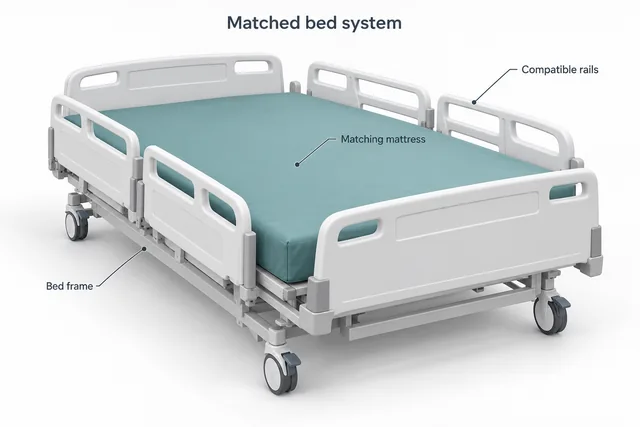
Illustration: AI-generated image for explanation only; it does not show a specific Keling model. See the linked product pages for actual product photos and specifications.
Frequently asked questions
What are the 4 types of hospital beds?
There is no official list of four, but most sources group hospital beds into manual beds, semi-electric beds, full-electric beds and specialty beds. Specialty beds include bariatric, low, ICU, paediatric, delivery, orthopaedic traction and therapy beds such as air-fluidised and rotating beds. Grouping by drive system is useful for budgeting; grouping by patient type is better for specifying.
What is a sand bed in a hospital?
A hospital sand bed is the informal name for an air-fluidised bed. It holds a mass of fine beads through which warm air is pumped, so the beads behave like a fluid and the patient floats with very low surface pressure. It is used for severe burns and complex pressure injuries. The FDA classifies it as a powered flotation therapy bed, Class II.
How wide is a bariatric hospital bed?
A standard hospital bed platform is about 900 mm (36 in) wide. Bariatric hospital beds are commonly specified around 1,000 to 1,200 mm wide, and some models are wider, up to about 48 in. Check the external width against doorways and lifts, and check the safe working load, which includes the mattress and accessories as well as the patient.
What is an enclosed bed for special needs?
An enclosed bed is a bed with padded panels, mesh or a canopy around the mattress that keeps the occupant inside, often marketed as an autism bed or safety bed. Because it limits movement it may be treated as a restraint under care regulations, and its gaps must be assessed for entrapment. Use follows the facility's protocols and the treating clinician's assessment.
What is the difference between a hi-low bed and a standard hospital bed?
A standard ward bed typically lowers to around 450 mm. A hi-low or low low bed lowers much closer to the floor to shorten a potential fall, then rises to a normal working height for care. It reduces the consequence of a fall rather than preventing one, so it is used with floor mats, alarms and individual fall-risk plans.
Is an examination table a hospital bed?
No. An examination couch is designed for short examinations and procedures, not overnight care, and IEC 80601-2-52 excludes examination tables from its scope. Operating tables are also regulated separately; in the US an AC-powered operating table falls under 21 CFR 878.4960. Keling makes hospital beds but not examination couches or operating tables.
What is a rotating hospital bed used for?
A rotating or kinetic therapy bed turns a patient continuously from side to side. The FDA defines a powered patient rotation bed as a device that turns a patient restricted to a reclining position, for preventing or treating pressure sores, burns, urinary blockage and poor circulation. Some ICUs use them for pulmonary care under clinician direction.
About the author
This article was written by the Keling Medical export team, drawing on the engineering data for the 33 bed, cot, mattress and accessory models Keling manufactures at its Yangzhou plant, and checked against the published standards and guidance listed in the sources. Keling Medical has been making medical appliances since 1996 and holds CE, ISO 9001 and ISO 13485 certification. More about Keling.