Obstetric Delivery & Birthing Beds: Positions, Supports and Features
Compare delivery bed positions, leg supports, drive systems and cleaning requirements. Build a practical specification for maternity and delivery rooms.
A birthing bed should support the maternity team's planned care pathway, provide suitable patient access and remain practical to clean between admissions. Buying one by its number of electric functions misses the decisions that usually matter most: whether patients can transfer onto it, how quickly staff can change the working arrangement, and whether the supports supplied match the intended procedures.
For a hospital or distributor, the useful comparison is therefore a complete delivery-room configuration. The bed, mattress sections, leg supports, controls, removable components and service package should appear together in the quotation. This guide explains how to turn clinical preferences into requirements that a supplier can demonstrate before a bulk order.
Start with the labour-to-recovery workflow
Some facilities use separate beds for labour, delivery and recovery. Others want one platform to cover several stages. Neither arrangement can be selected from the phrase “delivery bed” alone. Define where the woman first transfers onto the bed, where examinations occur, how the room changes for birth, and where immediate recovery takes place.
Invite midwives, obstetric staff, cleaning staff and maintenance personnel to review that sequence. Each sees a different obstruction. A foot section may give useful support during labour but take up floor space when removed. A control pedal may be convenient for the operator yet difficult to reach beside a stool. A high minimum position may help standing work while complicating access for someone with limited mobility.
Record these tasks in the specification. Asking a supplier to demonstrate a change from the admission arrangement to the delivery arrangement is more informative than asking whether the product is “multifunctional”. Include the equipment normally positioned beside the bed in that demonstration.
Birthing positions: specify flexibility without prescribing care
Bed adjustment enables positioning; it does not determine the best position for an individual woman. NICE recommends supporting comfortable movement and position choices during labour, with specific advice against lying flat on the back. Decisions during birth depend on the clinical situation, analgesia and the woman's preferences. NICE intrapartum care recommendations.
Procurement teams can translate those requirements into physical questions. Can the backrest provide the working range the service wants? Is there room for side-lying with appropriate support? Are manufacturer-approved handholds available where the team needs them? If kneeling or another posture is proposed, does the instructions-for-use document permit it, and is the mattress secured for that use?
Do not treat a photograph of one posture as evidence that every alternative is supported. Whole-bed tilt is also different from raising the backrest. List them separately, and ask for the permitted combination of movements under the intended load. Clinical staff should approve positioning protocols independently of the purchase decision.
Features to evaluate as a complete system
Section adjustment and foot-section handling
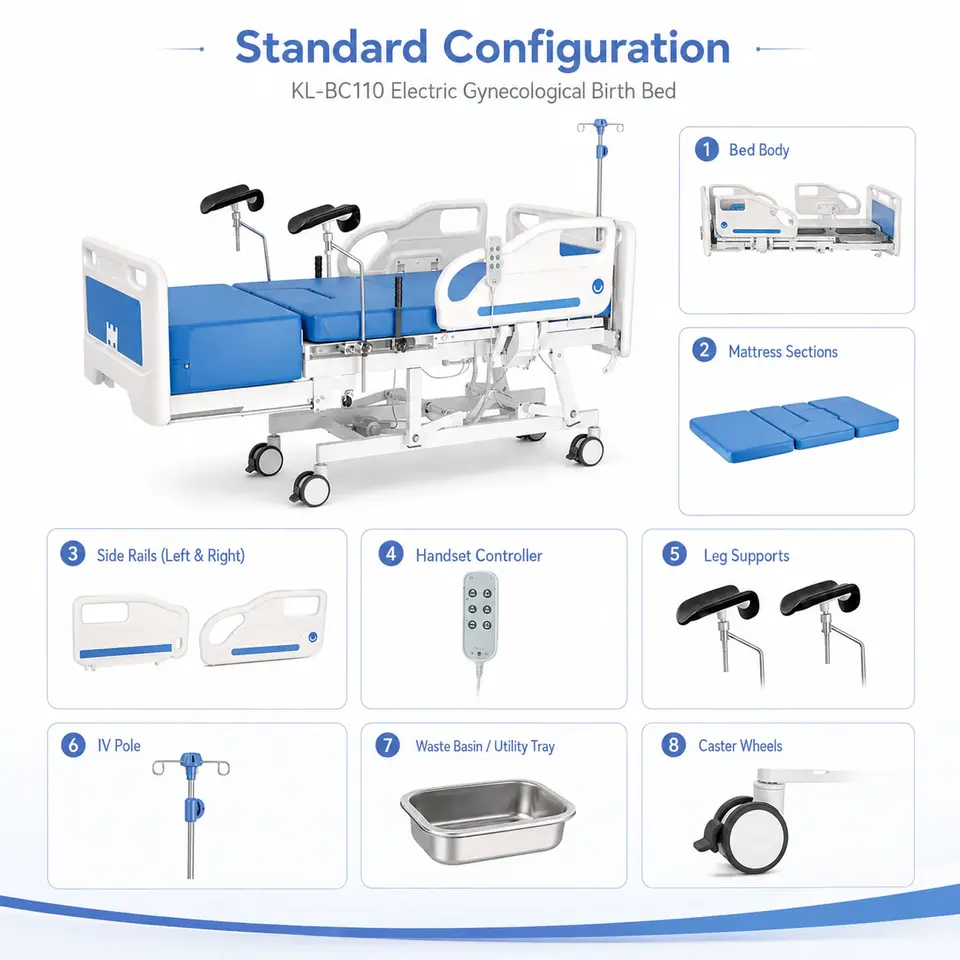
The adjustment range is only part of the requirement. Staff need predictable movement, controls they can identify quickly, and clear instructions for returning the platform to its normal configuration. Ask whether movements can operate together, which can be locked, and what happens when electrical power is unavailable.
A retractable foot section stays with the bed but needs adequate mechanism clearance. A removable section creates a separate handling and storage task. Confirm its weight, locking arrangement and cleaning procedure. Never assume that a foot section is removable because another model in the same catalogue has that feature.
Leg supports and stirrups
Leg supports should be reviewed for adjustment range, attachment security, padding, cleanability and the positions permitted by the manufacturer. Ask for the rating of each accessory and its approved mounting point; the bed's overall load rating does not automatically apply to a support arm.
Demonstrate adjustments with the intended clinical users present. They should be able to identify both sides, secure the attachments and inspect the locks without relying on hidden fasteners or an ambiguous photograph. Include replacement pads and attachment components in the parts discussion.
Drainage and access
Where a drainage tray is required, specify its dimensions, removal path, material and compatibility with local cleaning processes. Check whether it conflicts with the operator's knees or stool. A tray described as optional should be priced separately, and its fit should be demonstrated on the exact model.
| Requirement | Evidence to request | Practical acceptance question |
|---|---|---|
| Patient access | Minimum working-surface height and access drawing | Can the planned transfer method be performed? |
| Backrest and tilt | Signed movement ranges and operating instructions | Are the required movements available under permitted loading? |
| Foot section | Demonstration of removal or retraction, if supplied | Where does the section go during delivery? |
| Leg supports | Accessory list, ratings and attachment details | Can staff position and lock them consistently? |
| Fluid collection | Tray specification and cleaning instructions | Can the tray be removed without contaminating adjacent components? |
| Emergency access | Model-specific response procedure | Can the team create the required access promptly? |
Electric, hydraulic and manual delivery beds
An electric delivery bed can reduce the effort involved in repeated positioning, provided the controls, electrical supply and servicing arrangements fit the facility. Compare voltage, plug configuration, control placement and any battery option. Battery availability is not a promise of unlimited operation: request the supplier's stated operating capability, charging instructions and replacement procedure.
A hydraulic arrangement can provide height movement without a powered height actuator, but other sections may still be manual or electric. Inspect pump effort, descent control and access to seals or replacement parts. “Hydraulic” does not describe every movement on the bed.
A manual arrangement may suit a service with fewer positioning changes and available staff assistance. However, evaluate handle access and operating effort across the clinical workflow. Lower purchase complexity does not remove the need for mechanical inspection or staff training. Compare the actual tasks each drive system supports, alongside the service resources available locally.
What an LDR bed specification should include
LDR stands for labour, delivery and recovery. It describes a planned use across stages of care, not an extra adjustment function. A bed suitable for a short examination may not provide the surface, accessories or workflow that the hospital expects for an extended stay.
An LDR brief should identify the expected period of occupancy, the patient support surface, bedside access and storage of delivery accessories during recovery. Consider whether family seating, newborn equipment and monitoring equipment remain in the room. The bed's widest operational configuration, rather than its transport footprint alone, belongs in the room plan.
Use the obstetric delivery-room planning page as a starting point for discussing the room package. For outpatient equipment, compare the different priorities in Gynaecological Examination Beds & Chairs: Specs for Clinics.
Hygiene, mattresses and replacement supplies
Look at the junction between mattress sections, the underside of removable parts and the surfaces around support clamps. These locations are easy to overlook when reviewing a catalogue image. Ask the cleaning team to work through a sample turnover procedure using the intended products and the manufacturer's compatibility instructions.
Specify the mattress as a model-matched component. Its attachment system, section geometry and cover construction need to remain suitable as the platform moves. A generic replacement may interfere with access or bunch where sections meet. Request separate replacement codes for the complete mattress, individual sections where available, and detachable support pads.
An absorbent sheet or disposable cover does not remove the need to inspect and clean the underlying equipment. Agree which items are reusable, what must be removed for cleaning, and how a damaged cover or pad is taken out of service. Include a small, agreed starter stock of replacement items in the commercial comparison if continuity of operation depends on them.
Reviewing Keling's KL-BC110
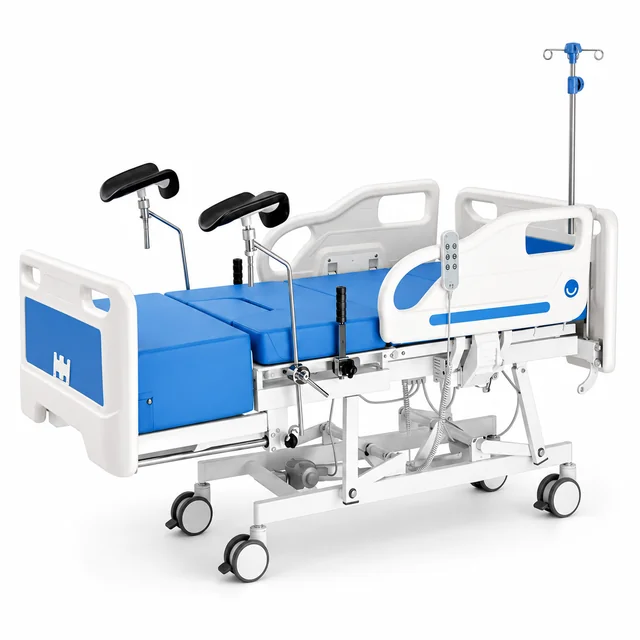
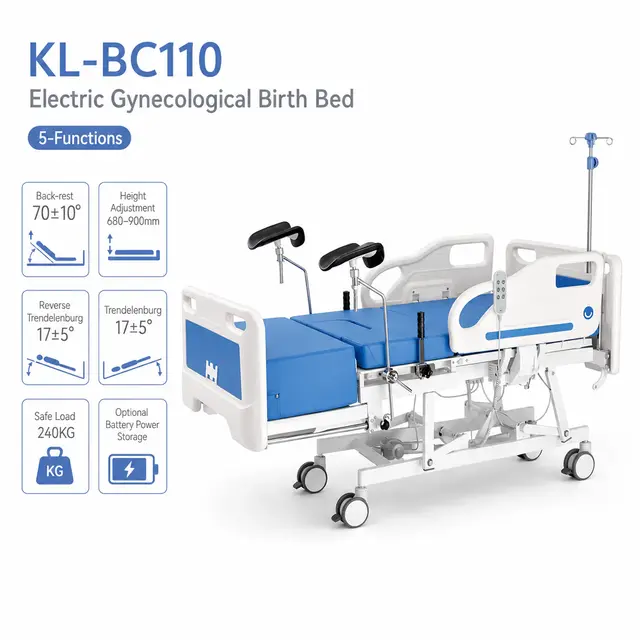
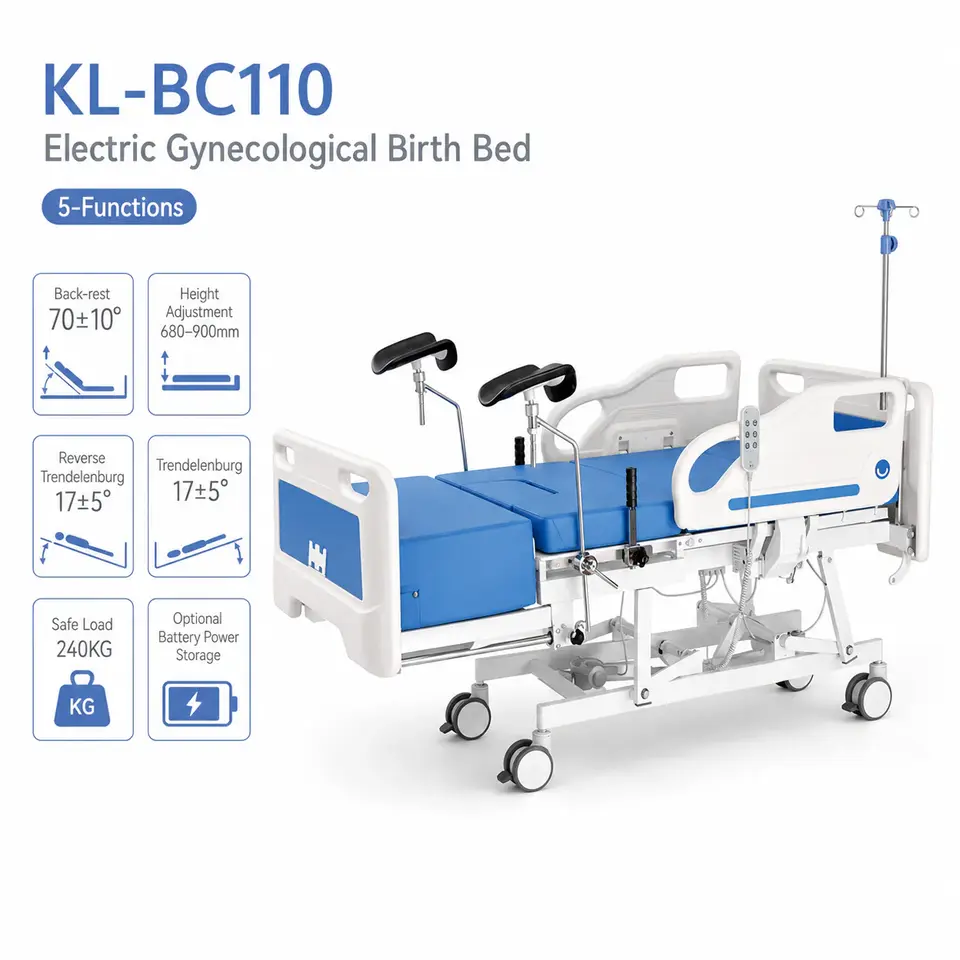
Keling lists the KL-BC110 electric gynecological birth bed with electric positioning, leg support stirrups and optional battery storage. The published specification gives a height range of 680–900 mm, a bed surface of 1930 × 900 mm and a safe working load of 240 kg. Treat these as catalogue starting points and obtain the signed specification for the offered configuration.
The minimum height deserves particular attention where assisted transfers or outpatient access form part of the brief. Also request explicit confirmation of the foot-section arrangement, drainage accessories, mattress package and emergency procedures. Do not infer a complete LDR package from the product name or the number of functions.
For a mixed department order, separate delivery beds from examination-only equipment and list the accessories for each. This makes the quote easier to check and reduces ambiguity during installation and staff handover.
Frequently asked questions
Can a standard ward bed replace a delivery bed?
Only if the clinical team determines that its intended use and complete configuration cover the required tasks. A ward bed may provide backrest and height adjustment while lacking the appropriate delivery access and approved accessories. Compare the workflow and documented use, rather than the adjustment count.
Does every delivery bed include stirrups and a drainage tray?
No. Included accessories vary by model and quotation. Require the supplier to identify each component, quantity and mounting arrangement. Photographs may show optional equipment, so a labelled packing list should accompany the order.
Is a battery essential?
That depends on the power environment and the hospital's continuity plan. If a battery is specified, verify which functions it supports and how the staff should respond when charge is low. Assess the option with the facility's engineering team.
What should be sent with a quotation request?
Provide the department type, quantity, destination country, transfer requirements, desired movements, accessory list and required delivery schedule. Where available, attach a room drawing and the facility's cleaning-product list.
Next step
For a delivery-room purchase, send Keling your requirements and request an itemised bed, mattress and accessory proposal for review by your clinical and procurement teams.
About the author
This article was written by the Keling Medical export team, drawing on the engineering data for the 33 bed, cot, mattress and accessory models Keling manufactures at its Yangzhou plant. Keling Medical has been making medical appliances since 1996 and holds CE, ISO 9001 and ISO 13485 certification. More about Keling.