Hospital bed safe working load: what 200 kg and 240 kg actually mean
Safe working load is the most misread number on a hospital bed datasheet. It is not a patient weight limit — and specifying it as one is how wards end up with beds that are marginal in exactly the situations where failure matters most.

Short answer
Safe working load (SWL) is the total mass a hospital bed is rated to support in normal use: the patient, the mattress, bedding, and anything else resting on or applied to the bed — including a member of staff kneeling on it during CPR. It is not a patient weight limit. Subtract the mattress and bedding from the SWL to get the real patient allowance, and specify a bed rated well above your heaviest expected patient rather than at their weight.
Safe working load is a single number on a datasheet, and it is misread more often than any other figure in hospital bed procurement. The misreading is consistent: buyers treat it as a maximum patient weight. It is not, and the difference is large enough to matter.
The definition
Safe working load (SWL) is the total mass the bed is designed to support in normal use. Everything on the bed counts:
- the patient;
- the mattress;
- bedding, pillows and any positioning aids;
- equipment resting on the bed — infusion pumps clamped to the frame, monitors placed on the surface, traction weights;
- a clinician's body weight when they kneel or lean on the bed to perform chest compressions.
That last item is the one nobody includes and the one that matters most, because it applies at precisely the moment when a bed failure would be catastrophic.
Doing the arithmetic
Take a bed with a 200 kg safe working load and work out the real patient allowance:
| Item | Typical mass |
|---|---|
| Safe working load | 200 kg |
| Less: mattress | 10–18 kg |
| Less: bedding, pillows, positioning aids | 4–8 kg |
| Less: equipment on the bed | 0–10 kg |
| Remaining patient allowance | approximately 164–186 kg |
Now add a 75 kg nurse kneeling on the mattress to deliver compressions, and the same bed is at its rated limit with a 90 kg patient on it.
This is not an argument that 200 kg beds are unsafe — they are entirely appropriate for general wards with a typical admissions profile. It is an argument that the number on the datasheet is not the number you should compare against your heaviest patient.
200 kg or 240 kg?
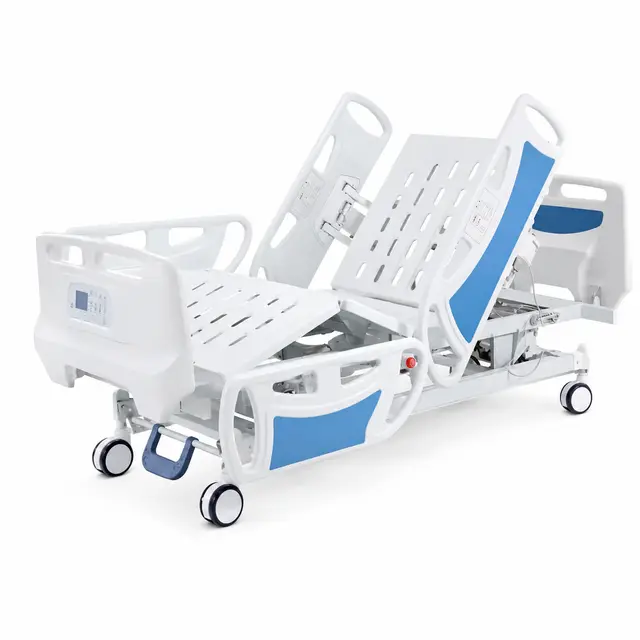
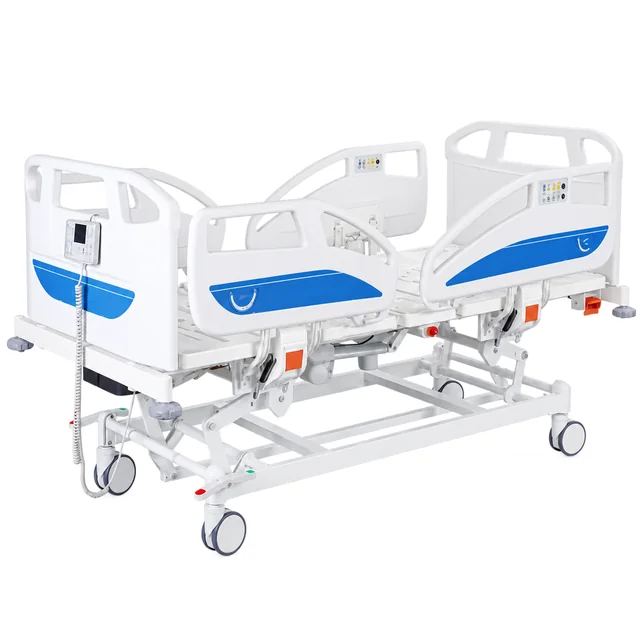
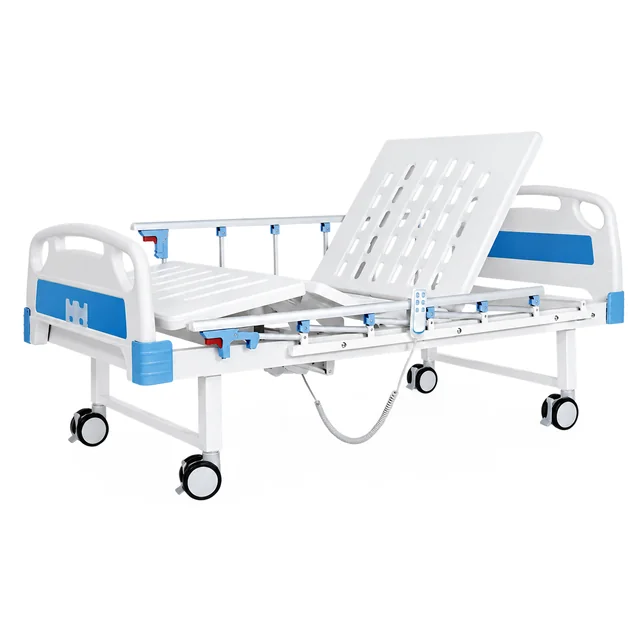
The two ratings that dominate the general hospital bed market are 200 kg and 240 kg. In our own range, the three-function KL-BC104 and the manual beds are rated at 200 kg, while the five-function KL-BC101 and KL-BC102 are rated at 240 kg.
A reasonable allocation rule:
- 200 kg for general medical, surgical, rehabilitation and long-term care wards with a typical admissions profile.
- 240 kg for ICU, high-dependency and coronary care — because CPR happens there, and because the sickest patients often carry the most equipment.
- 240 kg for any ward that admits bariatric patients at all, even occasionally.
- A dedicated bariatric platform where bariatric admission is routine, not just a higher SWL (see below).
The cost difference between a 200 kg and a 240 kg bed is modest. The cost of a bed that is marginal in a resuscitation is not.
Why load rating is not the whole bariatric question
A common and expensive mistake is to treat bariatric provision as purely a load-rating problem. It is not. A heavier patient is usually also a wider patient, and the constraints that bite first are dimensional:
- Bed surface width. A standard hospital bed surface is around 900 mm. A patient whose body width approaches or exceeds that is unsafe on a standard bed regardless of what the frame is rated to carry, because there is nowhere to position the arms and the rails cannot contain them.
- Rail geometry. Standard rails on a wider patient sit against the body rather than beside it.
- Mattress. A standard mattress under a much heavier patient bottoms out, eliminating the pressure redistribution it was chosen for.
- Castors and steering. A loaded bariatric bed is a serious mass to move down a corridor; standard castors and a single directional lock are not sufficient.
If your ward regularly admits patients above roughly 180–200 kg, specify a bariatric platform rather than upgrading the SWL on a standard-width bed.
What happens when a bed is overloaded
Overloading rarely produces the dramatic failure people imagine. What it produces is degradation:
- Actuators stall, draw excess current, overheat and wear out early. A bed that "takes a long time to lift" is usually a bed that has been overloaded for months.
- Lifting columns develop play. The bed still works, but it rocks slightly, and the rocking accelerates the wear.
- Frames take a small permanent set. The bed stops sitting level, the mattress no longer lies flat, and the articulation binds.
- Castors deform and start to drag, which is the symptom most often reported first, and the one least often connected to the cause.
The bed then fails at an unpredictable moment — often during a transfer, which is the worst time. This is why overload is a safety issue and not just a warranty issue.
Questions to ask a supplier
Four questions that separate a real engineering answer from a marketing number:
- "Does the SWL apply across the full range of adjustment?" On some beds the rating drops at full height or in extreme tilt, because the load path through the lifting columns changes. If the datasheet gives one figure, ask for written confirmation that it holds throughout.
- "Is the SWL a static or a dynamic rating?" A patient being repositioned, or compressions being delivered, applies dynamic load well above the static weight. Ask what test the figure derives from.
- "What is the tested actuator capacity, and what is the duty cycle?" Actuators are rated for both force and for how much of each period they can run. A bed used in a busy ICU actuates far more often than the duty cycle assumptions behind a general ward bed.
- "What is the rating of the castors and the brakes?" The frame is only as strong as what it stands on, and castor rating is routinely the lowest number in the chain.
Documenting it
Two pieces of practical advice for hospitals rather than for buyers.
Label the bed. The SWL should be legible on the bed itself, not only in a manual in an office. Staff make load judgements at the bedside.
Record it in your equipment register alongside the mattress mass, so the effective patient allowance is available to a ward manager without arithmetic under pressure.
The specification line
Safe working load not less than 240 kg, applicable across the full range of height, backrest, knee-rest and tilt adjustment, inclusive of mattress, bedding and applied equipment. Supplier to state the mass of the supplied mattress and the resulting maximum patient mass.
That second sentence is the one that gets you a useful answer. Asking a supplier to state the maximum patient mass — rather than the SWL — forces the arithmetic to be done by the party that knows the product.
Full load ratings for every model we build are listed on each product page, and every category page carries a specification table covering all of its models.
Frequently asked questions
Is safe working load the same as maximum patient weight?
No. Safe working load is the total mass the bed is rated to carry, which includes the mattress, bedding, any equipment resting on the bed, and the weight of a clinician leaning or kneeling on the bed during a procedure. Maximum patient weight is the SWL minus all of those, and is always the lower number.
What safe working load should a general ward bed have?
200 kg is the common general ward rating and is adequate where bariatric admissions are not expected. 240 kg gives meaningful headroom and is what we would specify for any ward that might admit heavier patients, for high-dependency areas, and anywhere CPR is realistically performed on the bed.
What happens if a bed is overloaded?
Overloading rarely causes a dramatic failure. What it usually causes is progressive damage: actuators that stall or wear prematurely, lifting columns that develop play, frames that deform slightly and stop sitting level, and castors that fail. The bed degrades and eventually fails at an unpredictable moment, often during a transfer.
Do I need a dedicated bariatric bed?
Bariatric beds differ from standard beds by more than load rating: they are wider, with wider rails and a wider mattress, stronger castors and often a higher-capacity lifting mechanism. If your ward regularly admits patients whose body width exceeds a standard 900 mm bed surface, a higher SWL on a standard-width bed does not solve the problem. Specify a bariatric platform.
Does safe working load change with bed position?
It can. Some beds carry a lower rating in certain positions, particularly at full height or in extreme tilt, because the load path through the lifting columns changes. If the datasheet states a single figure, ask the manufacturer to confirm it applies across the full range of adjustment.
About the author
This article was written by the Keling Medical export team, drawing on the engineering data for the 33 bed, cot, mattress and accessory models Keling manufactures at its Yangzhou plant. Keling Medical has been making medical appliances since 1996 and holds CE, ISO 9001 and ISO 13485 certification. More about Keling.