Bed rails for seniors and elderly patients: entrapment zones, types and safe use
How to choose and check bed rails for elderly users: full, half and assist rails, the FDA's seven entrapment zones, IEC 60601-2-52 gap limits and the alternatives.

Short answer
Bed rails for seniors are safe only as part of a matched system: the rail, bed frame and mattress must keep every gap within the FDA's entrapment limits (under 120 mm in zones 1 to 3, under 60 mm in zone 4) and IEC 60601-2-52, with the rail top at least 220 mm above the mattress. Assess each person first, since rails are unsuitable for confused residents likely to climb over.
Bed rails for seniors are among the most common pieces of equipment in hospitals, nursing homes and home care, and among the most misunderstood. A rail that suits one older person can be a fall-prevention aid; the same rail on the wrong bed, with the wrong mattress or for a confused resident, can create a gap in which a head, neck or chest becomes trapped.
This guide is written for buyers, nurses and DME suppliers who need to choose and check bed rails for elderly users. It covers the rail types on the market, the FDA's seven entrapment zones, the gap dimensions in IEC 60601-2-52, the US rule for adult portable bed rails, when a rail becomes a restraint, and the alternatives. Our existing guide to hospital bed side rail materials covers ABS, aluminium and stainless steel construction; this article concentrates on entrapment and safe use.
What are bed rails for seniors, and what are they for?
A bed rail (also called a side rail, bed guard or bed guard rail) is a barrier fitted along the side of a bed to reduce the risk of an occupant rolling or sliding out, or to give a hand-hold for repositioning. Bed rails for seniors are not designed to stop a person who intends to get out of bed, and regulators in the UK and US are explicit that using them for that purpose increases risk.
In practice, rails do three different jobs, and the job should decide the type:
- Preventing accidental roll-out in a person who is drowsy, sedated or has limited trunk control but is not trying to leave the bed.
- Providing a hand-hold for turning, sitting up and moving to the edge of the bed.
- Protecting during transport when a hospital bed is moved with the patient on it.
Types of bed rails: full, half, split and assist rails
There are five broad types of bed side rails, and they differ mainly in how much of the bed side they cover and how many gaps they create. More coverage means more fall protection but, usually, more places where the rail meets a headboard, footboard or another rail.
| Type | Coverage | Typical use | Main entrapment concern |
|---|---|---|---|
| Full-length side rails | Most of the bed side, one piece per side | Hospital and nursing beds; transport | Zone 3 (rail to mattress) and zone 6/7 at the ends; climbing over adds fall height |
| Split rails (head and foot sections) | Two or more sections per side | Electric hospital beds that articulate | Zone 5, the gap between the split rails, changes as the bed profiles |
| Half rails (head-end) | Upper third to half of the bed side | Hand-hold and turning; lower restraint effect | Zone 4 at the open end of the rail |
| Assist rails, bed handles, bed grab bars | Short handle near the shoulder | Sit-to-stand and transfer support | Openings within and under the handle; not a fall-prevention device |
| Adult portable bed rails | Added to a domestic bed, held by straps or a frame under the mattress | Home use on ordinary or adjustable beds | Rail separating from the mattress, creating a zone 3 gap |
The UK's MHRA guidance makes a point that buyers often miss: a bed grab handle or bed assist bar is a mobility aid and is not a substitute for a bed rail where fall prevention is the aim. Conversely, a full-length rail is not the right answer when all a person needs is a handle to help them sit up.
The seven hospital bed entrapment zones
The FDA's 2006 guidance, Hospital Bed System Dimensional and Assessment Guidance to Reduce Entrapment, divides a bed system into seven zones where a person can become trapped. It recommends dimensional limits for zones 1 to 4 and none for zones 5 to 7.
| Zone | Location | FDA recommended limit |
|---|---|---|
| 1 | Within the rail (any open space inside the rail perimeter) | Less than 120 mm (4 3/4 in) |
| 2 | Under the rail, between rail supports or next to a single support | Less than 120 mm (4 3/4 in) |
| 3 | Between the inside of the rail and the compressed mattress | Less than 120 mm (4 3/4 in) |
| 4 | Under the rail, at the ends of the rail | Less than 60 mm (2 3/8 in), with any V-shaped opening wider than 60° |
| 5 | Between split bed rails | No dimension; neck and chest risk, V-shaped wedging |
| 6 | Between the end of the rail and the head or foot board | No dimension; neck and chest risk |
| 7 | Between the head or foot board and the end of the mattress | No dimension; head risk, depends on mattress compression and shift |
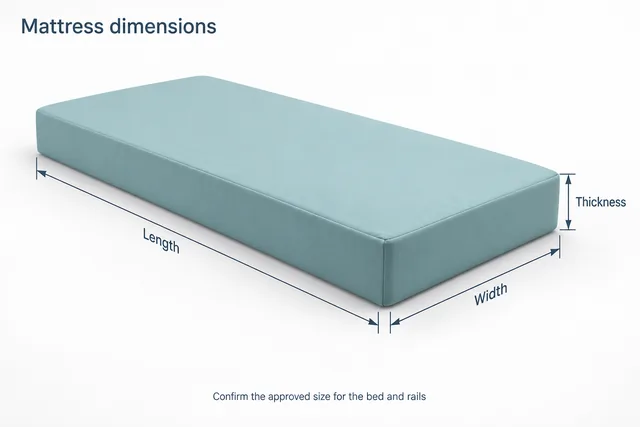
The important word in the FDA title is system. The zones are measured on the bed frame, rails and mattress together. A bed that passes with its original foam mattress can fail when a thinner mattress, a softer overlay or an air mattress of a different size is fitted, because zone 3 depends on how far the mattress compresses and moves away from the rail.
Bed rail dimensions in IEC 60601-2-52
IEC 60601-2-52 (adopted in Europe as EN 60601-2-52) is the international safety standard for medical beds for adults, and it sets measurable limits for side rails. The MHRA's 2023 guidance Safe use of bed rails summarises the limits from BS EN 60601-2-52:2010+A1:2015 as follows.
| Measurement | Limit |
|---|---|
| Height of rail top above the uncompressed mattress | 220 mm or more |
| Openings within the rail perimeter; gap between rail and mattress platform | Less than 120 mm |
| Gap between headboard and the end of the rail | Less than 60 mm |
| Gap between footboard and the end of the rail | Less than 60 mm or more than 318 mm |
| Gap between split rails | Less than 60 mm or more than 318 mm |
| Open rail end to mattress platform | Less than 60 mm |
| Rail to mattress (plan view) | Tested with a 120 mm cone rather than a fixed figure |
The logic of "less than 60 mm or more than 318 mm" is that a gap must be either too small for a neck to enter or large enough that a body is not wedged. The 220 mm height rule exists because a thick pressure-relief mattress or overlay raises the patient: if the rail top ends up less than 220 mm above the mattress, the MHRA says a risk assessment should show equivalent safety. For children and adults with atypical anatomy, the MHRA recommends a maximum of 60 mm between rail bars, and medical beds for children have their own standard, IEC 80601-2-89 (which replaces EN 50637).
Specification line: Side rails to comply with IEC 60601-2-52 (EN 60601-2-52) dimensional requirements when fitted to the specified bed with the specified mattress; rail top at least 220 mm above the uncompressed mattress; supplier to state compatible mattress thickness range.
The standard uses specific test tools, so ask the manufacturer for its test evidence rather than relying on a tape measure alone.
Portable bed rails for adults and home beds
Portable bed rails for adults are consumer products that clamp, strap or slide under the mattress of a domestic bed. In the US they are regulated by the Consumer Product Safety Commission under 16 CFR part 1270, which adopted ASTM F3186-17 with modifications and took effect on 21 August 2023.
CPSC's figures explain why: the agency cited 284 deaths involving adult portable bed rails between January 2003 and December 2021, most of them entrapment. The rule requires:
- Entrapment testing of zones 1 to 4 using the FDA entrapment probe, against the range of mattress thicknesses the manufacturer declares.
- A retention system that keeps the rail in place without readjustment, is permanently attached and can be removed only with a tool.
- Clear disclosure of the mattress thickness range the rail is designed for.
The rule does not cover rails that are accessories to FDA-regulated hospital beds; those are medical devices. Two practical points follow. First, a portable rail designed for a domestic bed should not be fitted to a hospital bed as a substitute for the bed's own rails. Second, a bed rail for an adjustable bed (a consumer adjustable base) must be one the manufacturer states is compatible with that base, because a rail anchored under a mattress can shift away from it as the base articulates. If a home user needs a profiling bed with integral rails, see our guide to choosing a hospital bed for home use.
Child bed rails are a separate product again. Portable bed rails for children (16 CFR part 1224, ASTM F2085) are intended for children of about 2 to 5 years who can get out of an adult bed unaided, and CPSC says they should never be used for children under two. An infant needs a crib or cot with integral sides, not a bed rail.
When is a bed rail a restraint?
A bed rail becomes a restraint when it stops a person from getting out of bed when they want to. For a resident who can and wishes to leave the bed, raised full-length rails restrict free movement; for a resident who is confused and determined, they add the height of the rail to any fall.
In US nursing homes, federal regulation 42 CFR 483.25(n) requires facilities to:
- attempt appropriate alternatives before installing a side or bed rail;
- assess the resident for risk of entrapment;
- review risks and benefits with the resident or representative and obtain informed consent;
- ensure the bed's dimensions are appropriate for the resident's size and weight;
- follow the manufacturer's recommendations for installation and maintenance.
The MHRA lists situations in which bed rails may not be appropriate: an occupant who is confused and likely to climb over, one with erratic or violent movement, one whose clinical condition would be worsened by rails, and any case where the assessed risks outweigh the benefits. In the UK, decisions for people who lack capacity also fall under the Mental Capacity Act 2005. Decisions about rail use for an individual patient always follow the facility's protocols and the assessment of the treating clinician and care team.
Alternatives to bed rails for the elderly
The least restrictive option that manages the risk should be tried first. Each alternative solves one problem and can create another, so it belongs in the same risk assessment as the rail.
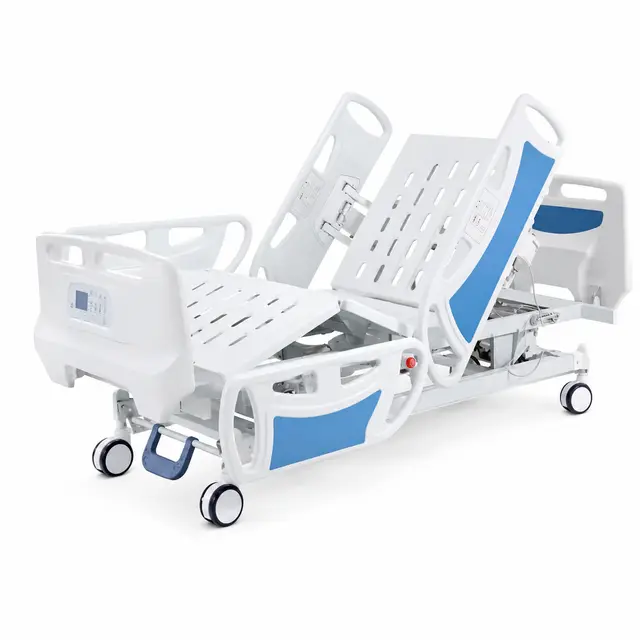
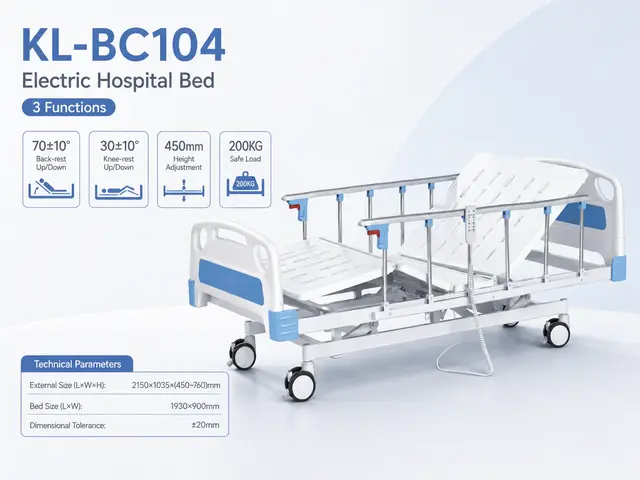
- Low and ultra-low beds. Lowering the sleep surface reduces fall height. Keling's height-adjustable beds such as the KL-BC101 electric hospital bed lower to 480 mm and the KL-BC103 and KL-BC104 to 450 mm; floor-level beds that go much lower are a separate category. Our guide to low hospital beds and fall-risk planning covers the trade-offs.
- Fall mats beside the bed, which cushion a fall but can be a trip hazard for staff and for the patient when standing.
- Bed-exit or pressure-sensor alarms, which alert staff rather than block movement.
- Half rails at the head end only, which give a hand-hold while leaving the foot end open for exit.
- Positioning wedges and supports, and padded or inflatable bed sides, which the MHRA lists with the caveat that each can introduce hazards of its own.
- Toileting rounds and call bells within reach, which remove common reasons for an unaided exit.
How to install and check hospital bed rails
Most entrapment risk is created after delivery, when rails, mattresses and beds are mixed.
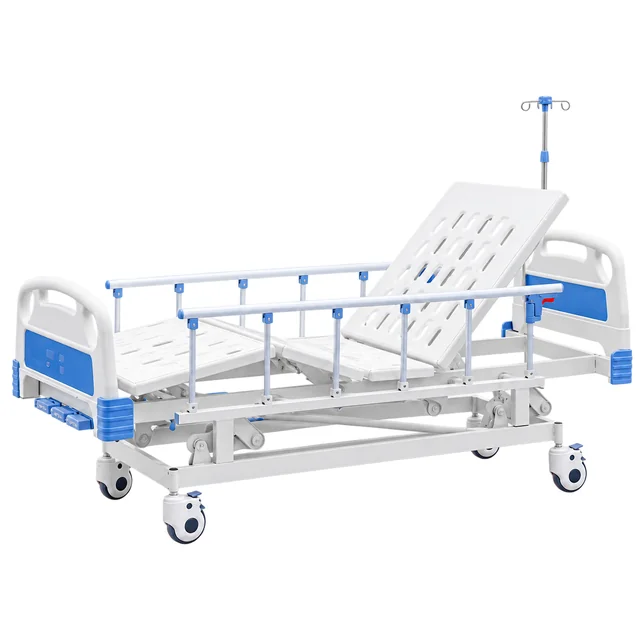
- Match the rail to the bed model. Use rails specified by the bed manufacturer for that frame; a rail that fits the brackets is not necessarily the right length or height for the bed.
- Match the mattress to the bed and rail. Record the mattress dimensions and thickness the rail was assessed with, and re-check zones 2, 3 and 7 whenever a mattress or overlay is changed.
- Check the latch in the raised position. A rail that can be pushed down from inside without operating the release is a fall hazard.
- Measure the gaps with proper test tools at commissioning and after any repair, including with the backrest and knee-rest raised, because split-rail and end gaps change as the bed profiles.
- Inspect on a schedule. Loose fixings, worn guides and bent bars widen gaps over time. Add rails to the planned-maintenance list.
- Treat bed rail covers and pads as part of the system. Padded bed rail covers and gap protectors can reduce impact injuries, but they also change rail height and gaps, so they should be designed for that rail and checked once fitted.
Specifying hospital bed side rails for an order
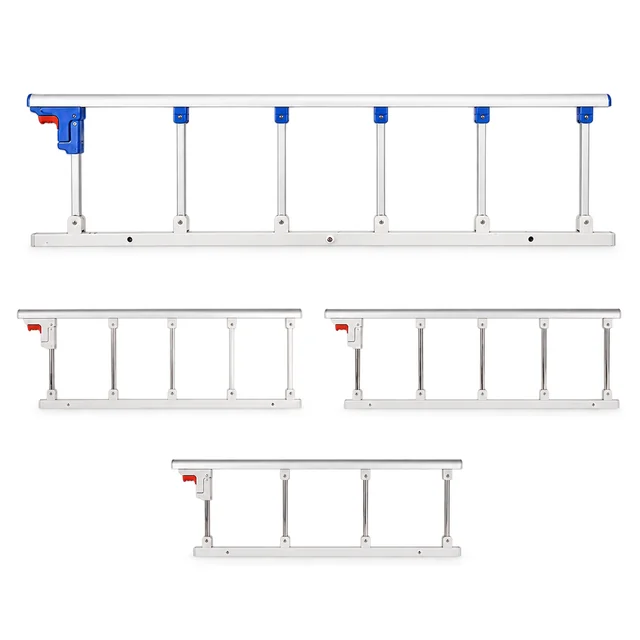
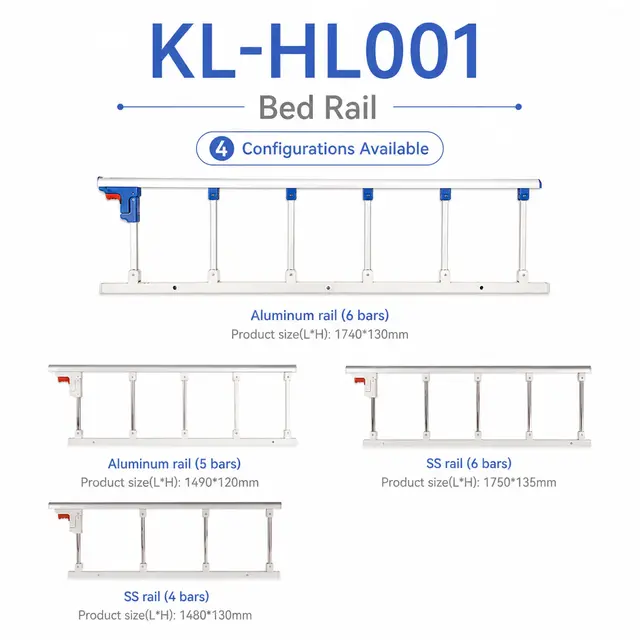
For tenders and replacement orders, the useful specification is not "side rails included" but the rail type, length, height, material and the mattress it will be used with. Keling supplies rails both fitted to its beds and as spare or OEM components.
| Keling rail | Construction | Size (L × H) |
|---|---|---|
| KL-HL001 aluminium, 6 bars | Ladder-bar rail | 1740 × 130 mm |
| KL-HL001 aluminium, 5 bars | Ladder-bar rail | 1490 × 120 mm |
| KL-HL001 stainless steel, 6 bars | Ladder-bar rail | 1750 × 135 mm |
| KL-HL001 stainless steel, 4 bars | Ladder-bar rail | 1480 × 130 mm |
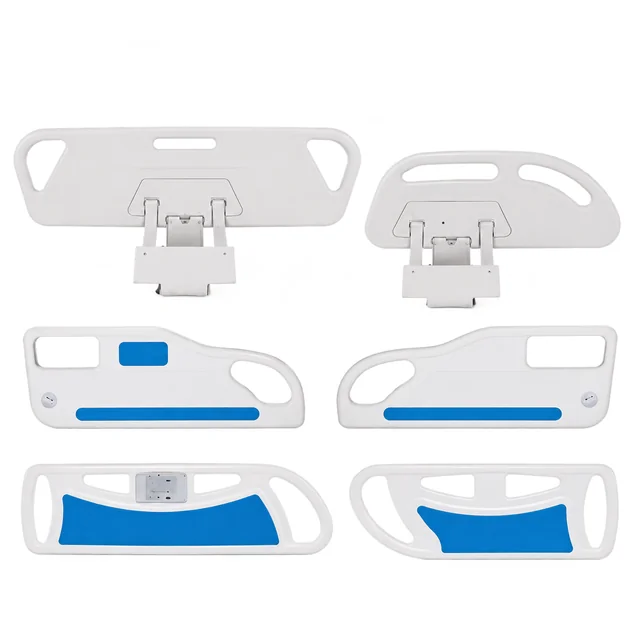
| KL-HL002 | ABS panel rail | Big and small sizes; ask for drawings |
Before ordering, confirm with us which rail suits your bed model, the mattress thickness you plan to use, and the gap measurements on the assembled system. For long-stay settings, our article on hospice and nursing home beds covers how rail choice fits into a wider long-term-care bed specification.
Specification line: Full-length (or split) side rails, aluminium or stainless steel, fitted to bed model [code], assessed against FDA entrapment zones 1–4 and IEC 60601-2-52 with mattress [code, thickness mm]; spare rails and fixings listed by part number.
To check rail compatibility or request a quotation for beds, rails and matched mattresses, contact our export team.
Sources and further reading
- FDA: Hospital Bed System Dimensional and Assessment Guidance to Reduce Entrapment (2006) — defines the seven entrapment zones and limits for zones 1–4.
- MHRA: Safe use of bed rails — UK guidance with the EN 60601-2-52 dimensional table and alternatives.
- Federal Register: Safety Standard for Adult Portable Bed Rails, 16 CFR part 1270 — final rule, scope and test requirements.
- CPSC: New mandatory standard for adult portable bed rails — incident data behind the rule.
- eCFR: 42 CFR 483.25(n), bed rails in long-term care facilities — US nursing home requirements.
- CPSC: Federal standard for children's portable bed rails — age range and hazards for child bed rails.
Illustration: AI-generated image for explanation only; it does not show a specific Keling model. See the linked product pages for actual product photos and specifications.
Frequently asked questions
Are bed rails safe for elderly people?
Bed rails can be safe for elderly people when the rail suits the bed and mattress, all gaps meet FDA and IEC 60601-2-52 limits, and an assessment shows the benefit outweighs the risk. They are unsafe for people who are confused and likely to climb over, and when an unmatched mattress leaves a gap between rail and mattress.
What are the seven entrapment zones on a hospital bed?
The FDA's seven zones are: 1 within the rail; 2 under the rail between supports; 3 between the rail and the mattress; 4 under the rail at its ends; 5 between split rails; 6 between the rail end and the head or foot board; and 7 between the head or foot board and the mattress end.
How high should a bed rail be above the mattress?
Under IEC 60601-2-52, as summarised by the UK MHRA, the top of a hospital bed side rail should be at least 220 mm above the uncompressed mattress. Thick pressure-relief mattresses and overlays reduce this effective height, so check it whenever the mattress is changed and use extra-height rails where needed.
What is the difference between a bed rail and a bed assist rail?
A bed rail is a barrier along the side of the bed intended to reduce the risk of rolling out. A bed assist rail, bed handle or bed grab bar is a short handle that helps a person sit up, turn and stand. Assist rails are mobility aids and should not be relied on for fall prevention.
Can you put bed rails on an adjustable bed?
Only rails the manufacturer states are compatible with that adjustable bed or base. As the bed articulates, a rail held under the mattress can move away from it and open a gap. Hospital beds should use the manufacturer's own side rails rather than add-on portable bed rails designed for domestic beds.
Are bed rails considered a restraint?
A bed rail is considered a restraint when it prevents a person from leaving the bed when they want to. US nursing homes must try alternatives first, assess entrapment risk and obtain informed consent under 42 CFR 483.25(n). UK guidance asks for an individual risk assessment and, where relevant, the Mental Capacity Act.
What are alternatives to bed rails for seniors?
Common alternatives are low or ultra-low beds, fall mats, bed-exit alarms, half rails at the head end only, positioning wedges and padded bed sides, together with toileting rounds and keeping the call bell within reach. Each alternative carries its own risks and should be part of the same individual assessment.
About the author
This article was written by the Keling Medical export team, drawing on the engineering data for the 33 bed, cot, mattress and accessory models Keling manufactures at its Yangzhou plant, and checked against the published standards and guidance listed in the sources. Keling Medical has been making medical appliances since 1996 and holds CE, ISO 9001 and ISO 13485 certification. More about Keling.