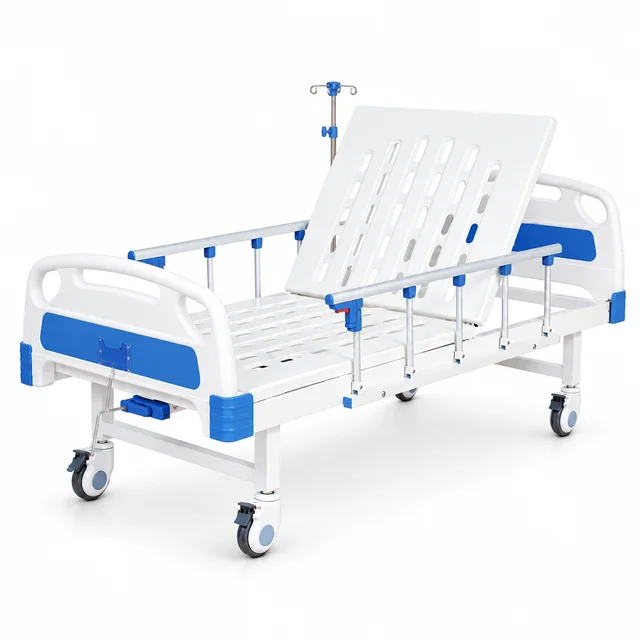
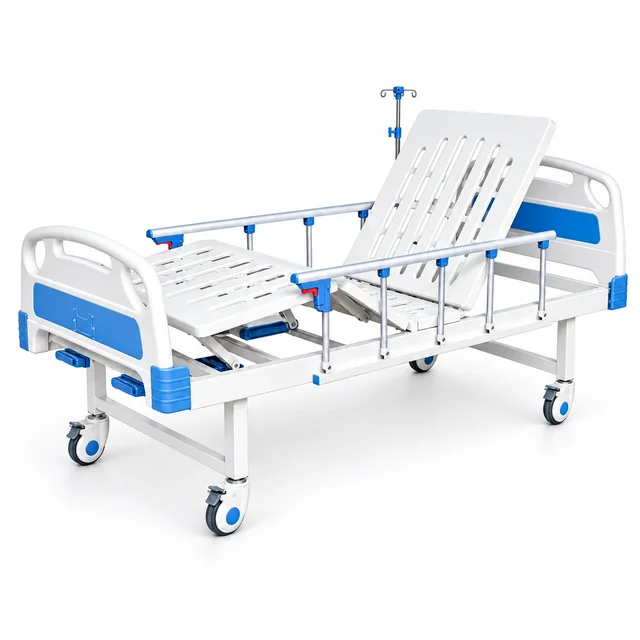
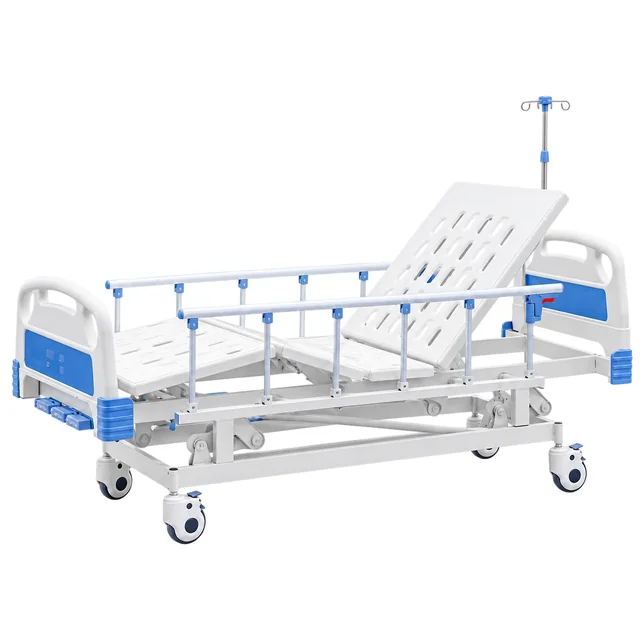
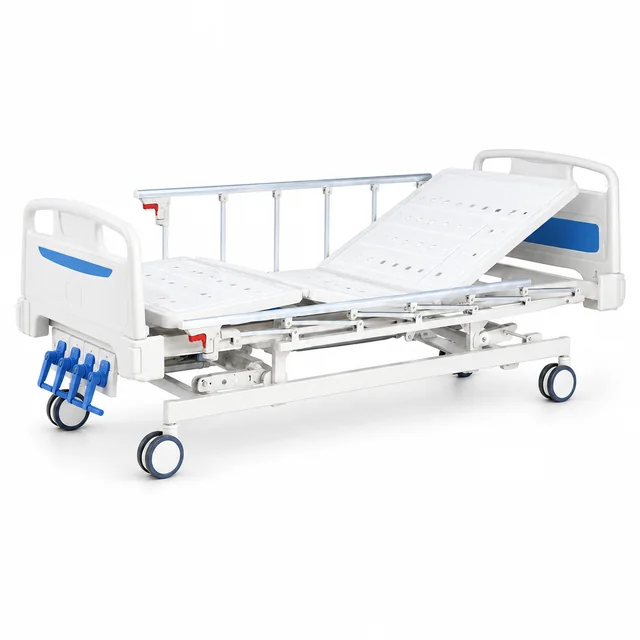
1, 2, 3 and 5-function hospital beds: what each function actually does
Hospital beds are sold by function count, but the term is rarely defined. Here is exactly which axis each function adds, what it is clinically for, and why the jump from three to five functions is a bigger decision than it looks.
Short answer
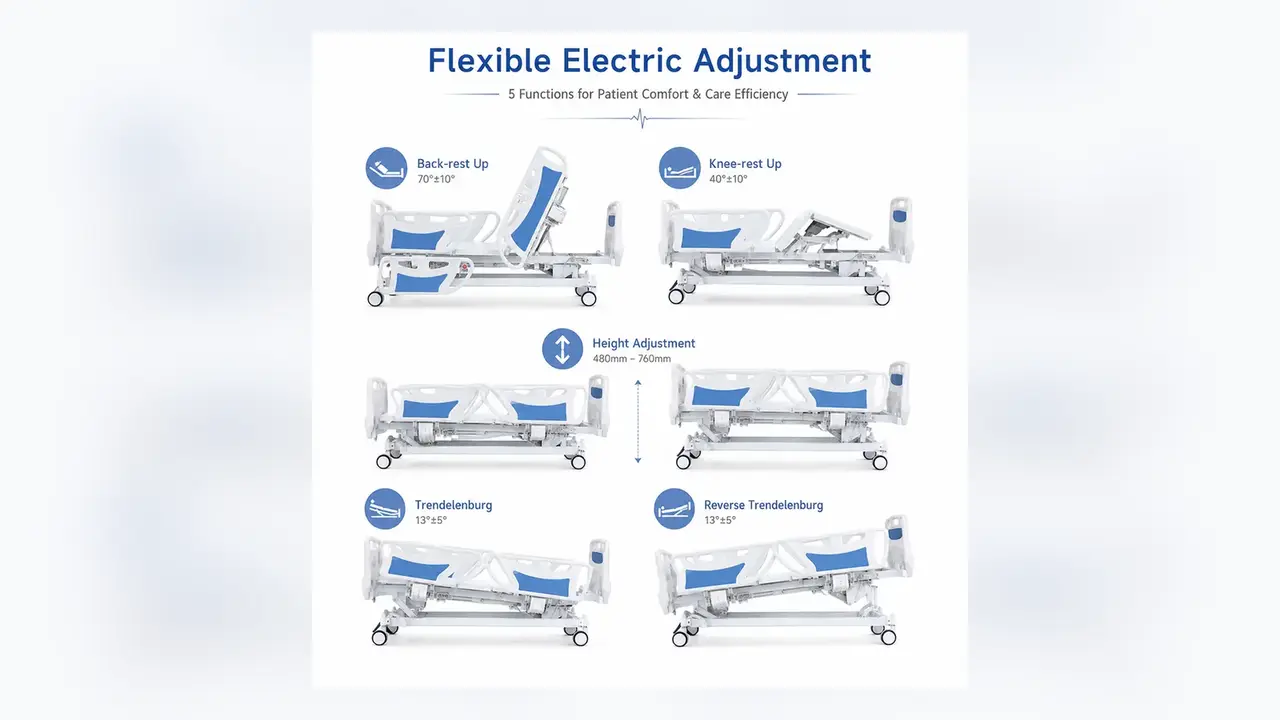
A hospital bed's function count is the number of powered or cranked adjustment axes. One function is backrest only; two adds the knee-rest; three adds bed height; five adds Trendelenburg and reverse Trendelenburg tilt. Backrest supports breathing, feeding and ventilator care; knee-rest stops the patient sliding down and reduces shear; height adjustment protects both patient and nursing staff during transfers; tilt enables postural drainage and anti-shock positioning. Function count is independent of whether the bed is electric or manual.
"Five-function electric hospital bed" appears in thousands of tender documents and product listings, and is almost never defined. The result is specifications that ask for a function count without knowing what the functions do — and beds bought with capability nobody uses, or missing capability a ward needed.
This article defines each function precisely and explains what it is clinically for.
The convention
A hospital bed's function count is the number of adjustable axes, powered or manual. The order in which functions are added as the count rises is consistent across the industry:
| Count | Axes | Common name |
|---|---|---|
| 1 | Backrest | Backrest bed, flat bed |
| 2 | Backrest, knee-rest | Two-function bed |
| 3 | Backrest, knee-rest, height | Three-function bed |
| 5 | Backrest, knee-rest, height, Trendelenburg, reverse Trendelenburg | Five-function bed |
Crucially, the count says nothing about the drive system. Our KL-BC109 is a five-function manual bed; the KL-BC101 is a five-function electric bed. Same five movements, different actuation. A tender that specifies "five-function" without specifying electric or manual has left the most expensive variable unstated.
Function 1: backrest elevation
The backrest raises the patient's upper body, pivoting near the hip. Typical range on a ward bed is 0–70°, and a good bed carries a mechanical angle indicator reading 0–90° so the angle can be set rather than estimated.
What it is for:
- Breathing. Sitting a patient up increases functional residual capacity and reduces the work of breathing. For a patient in respiratory distress this is the first intervention available to a nurse.
- Eating and drinking safely. Swallowing while flat carries a real aspiration risk.
- Ventilator-associated pneumonia prevention. Standard ventilator care bundles specify a backrest angle, commonly 30–45°. This is the reason the angle indicator is not a gimmick — the protocol is a number, and the bed has to be able to report it.
- Social and psychological. A patient who can sit up can see the room, talk to visitors at eye level and read. On long stays this is not trivial.
If you buy only one function, buy this one. It is why the one-function KL-BC106 exists as a category at all.
Function 2: knee-rest elevation
The knee-rest raises the thigh section, typically to 40°, creating a break between hip and knee.
Its purpose is widely misunderstood: it is not primarily about comfort. Raising the backrest without the knee-rest makes the patient slide down the bed. As they slide, the skin over the sacrum and heels stays in place while the tissue underneath moves — the shear that is one of the main mechanisms of pressure injury. Raising the knee-rest first creates a seat that holds the patient in position.
Secondary uses: post-operative lower-limb positioning, reducing oedema by elevating the legs, and relieving lower back strain for patients who cannot lie flat comfortably.
The correct sequence, which is worth putting in nursing induction: knee-rest first, then backrest. A two-function bed such as the KL-BC107 makes this possible; a one-function bed does not.
Function 3: bed height
Height adjustment raises and lowers the whole bed surface, typically across a range like 480–760 mm.
This is the function with the clearest financial case, because it protects two different people:
- The patient. At the low setting an average adult can sit on the edge of the bed with feet flat on the floor. That is what makes an unassisted transfer safe, and it substantially reduces the injury severity of a fall from bed. Falls from a high bed break hips.
- The nursing staff. At the high setting, washing, wound care, catheter care and bed-making happen at waist height instead of at a stoop. Musculoskeletal injury is among the largest causes of lost nursing days in most health systems, and repeated bending over a low bed is a primary contributor.
In pure cost terms, the move from a two-function to a three-function bed is usually the best value decision in the whole specification. A single avoided back injury pays for a lot of beds.
One practical note: the working height is the bed surface plus the mattress. A 100 mm mattress raises both ends of the range by 100 mm, so check the figures against the mattress you are actually buying.
Functions 4 and 5: Trendelenburg and reverse Trendelenburg
These are whole-bed tilts, keeping the sleeping surface flat while tipping the entire plane. On hospital beds the angle is typically around 13° in each direction — meaningful, but far short of an operating table.
Trendelenburg (head down) is used for postural drainage of the lungs, for certain surgical preparations, and historically for hypotension and shock management. Its role in shock is now more limited than it once was, and protocols vary; what matters for procurement is that clinicians in certain units want it available.
Reverse Trendelenburg (head up, whole bed) is used to reduce gastro-oesophageal reflux, to assist breathing in patients who cannot tolerate backrest flexion, and to help reduce intracranial pressure in neurological care.
The important distinction: reverse Trendelenburg is not the same as raising the backrest. The backrest bends the patient at the hip; reverse Trendelenburg keeps them straight and tilts the whole plane. For a patient with a spinal injury, or one whose abdomen must not be compressed, that difference is clinically decisive.
Where to specify tilt: ICU, high-dependency, coronary care, surgical recovery and emergency. Where not to: general medical, rehabilitation and long-term care wards, where in practice the tilt is almost never actuated.
Specialised function sets
Some beds carry five functions configured for a specific clinical purpose rather than for general ward use:
- The KL-BC110 electric gynaecological birth bed uses its five functions around delivery positioning, with leg supports and a removable foot section.
- The KL-BC111 manual orthopaedic traction bed carries an overhead traction frame in addition to its adjustment axes.
If your tender bundles these into a generic "five-function bed" line, they will be mis-priced. List them separately.
Choosing electric or manual
Because function count and drive system are independent, you have a genuine choice for every function count:
Electric is right where staff repeat adjustments many times a shift, where a patient needs to reposition themselves without calling a nurse, and where mains power and maintenance are dependable. It is also the only practical option for a genuinely heavy patient.
Manual is right where the electrical supply is unreliable, where biomedical maintenance is thin, and where the ward's adjustment frequency is low. A crank has no actuator to burn out, no handset cable to be run over by a trolley and no control board to fail. The five-function manual KL-BC109 delivers the full positioning range with none of those failure modes.
The pragmatic answer for many hospitals is a mix: electric in the units where positioning is frequent and clinically urgent, manual in the wards where it is not.
Writing the specification line
A line that leaves nothing ambiguous looks like this:
Hospital bed, five-function electric: backrest 0–70°, knee-rest 0–40°, height 480–760 mm, Trendelenburg and reverse Trendelenburg each not less than 12°; CPR instant release on backrest; nurse lock on patient controls; mechanical backrest angle indicator 0–90°; safe working load not less than 240 kg; bed surface 1930 × 900 mm; four castors of not less than 125 mm with central braking and one directional lock.
Every figure in that line is checkable on a datasheet. That is the point. If you would like us to review a specification you are drafting, send it over — we will tell you where it is ambiguous, including where it inadvertently excludes beds you would want to receive bids from.
Frequently asked questions
What is a 5-function hospital bed?
A five-function hospital bed has five adjustable axes: backrest elevation, knee-rest elevation, overall bed height, Trendelenburg tilt (head down) and reverse Trendelenburg tilt (head up). The five functions may be driven by electric actuators or by manual cranks — the count describes the movements, not the power source.
Does function count mean the bed is electric?
No. Function count and drive system are independent specifications. A five-function manual bed offers exactly the same five movements as a five-function electric bed, actuated by cranks instead of motors. This is why tenders should state both: for example 'five-function, electric' or 'three-function, manual'.
What is the Trendelenburg position used for?
Trendelenburg is a whole-bed tilt with the head lower than the feet, typically around 13 degrees on a hospital bed. It is used for postural drainage, for certain surgical preparations and historically for shock management. Reverse Trendelenburg raises the head end and is used to reduce reflux, assist breathing and reduce intracranial pressure.
Why does a bed need a knee-rest?
Raising the backrest alone makes a patient slide down the bed, which produces shear forces against the sacrum and heels — a primary mechanism of pressure injury. Raising the knee-rest first creates a hollow that holds the patient in position. It also supports post-operative lower-limb positioning and reduces oedema.
Is a 4-function hospital bed a real category?
It is not a standard industry category. A bed marketed as four-function is usually a three-function electric bed with one manually cranked axis, or a five-function bed missing one tilt direction. Ask the supplier to list the five axes explicitly and state which are powered.
About the author
This article was written by the Keling Medical export team, drawing on the engineering data for the 33 bed, cot, mattress and accessory models Keling manufactures at its Yangzhou plant. Keling Medical has been making medical appliances since 1996 and holds CE, ISO 9001 and ISO 13485 certification. More about Keling.