Neonatal Cribs, Isolettes & Hospital Bassinets: Specifying for Maternity & NICU
Compare hospital bassinets, neonatal cribs and incubators. Review newborn sleep surfaces, mobility, cleaning and specifications for maternity and NICU orders.
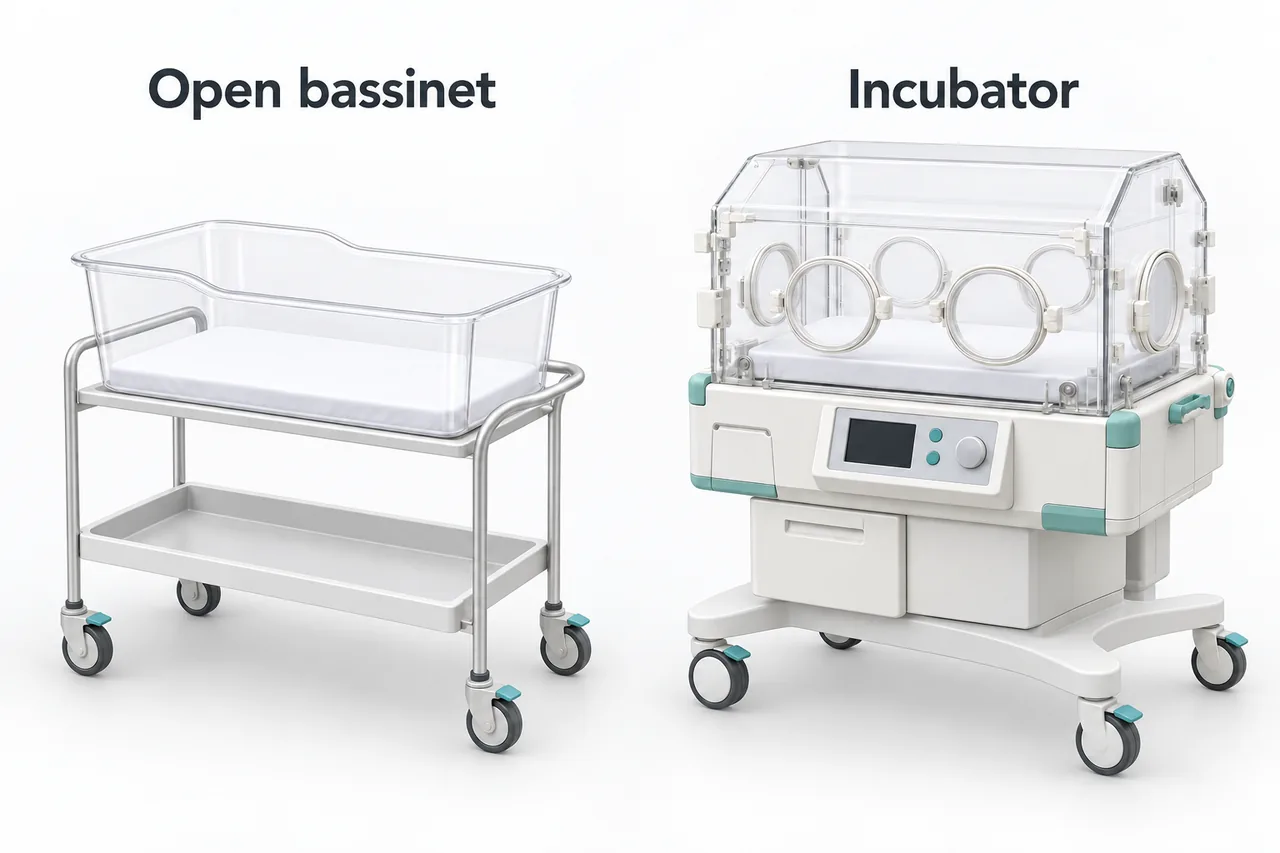
A hospital bassinet, a neonatal crib and an incubator are different pieces of equipment. The fact that each can hold a newborn does not make them interchangeable. For a maternity or NICU procurement project, specify the intended care environment first, then identify the equipment category and its documented capabilities.
This distinction matters when quotations use words such as “baby crib”, “newborn bed” or “isolette” loosely. A transparent tray on a mobile frame may be appropriate for a defined maternity role, but it does not provide the controlled thermal environment of an incubator. Clear product naming helps buyers compare suitable equipment and prevents a budget line from concealing an important clinical difference.
Open bassinet, medical crib and incubator
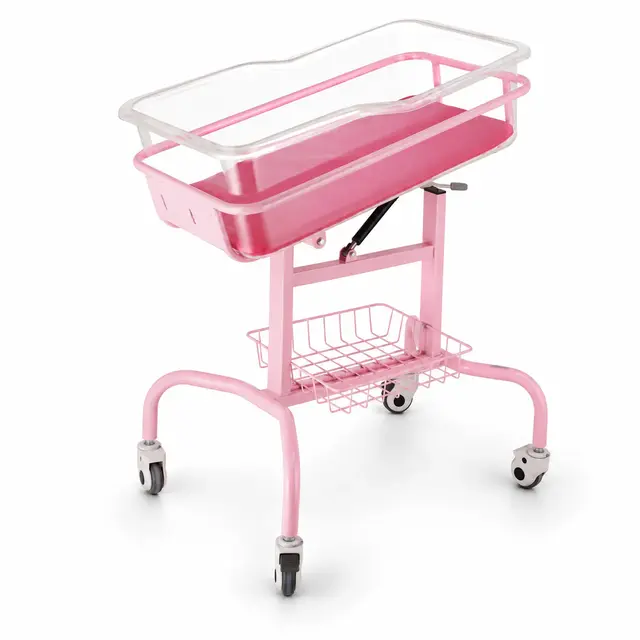
An open hospital bassinet typically combines an infant support surface, surrounding tray or walls and a mobile base. A medical crib provides a different enclosure and access arrangement, often including sides that staff can open or lower in accordance with its instructions. Neither description establishes heating capability.
“Isolette” is a term buyers may encounter when searching for an infant incubator. An incubator is a separate regulated device category. FDA classification identifies neonatal incubators under 21 CFR 880.5400; medical bassinets have their own classification. FDA neonatal incubator classification, FDA medical crib and bassinet information.
| Equipment category | What the procurement description should establish | What must not be assumed |
|---|---|---|
| Open hospital bassinet | Intended newborn use, approved mattress, tray, base and movement limits | Active warming, oxygen control or intensive-care capability |
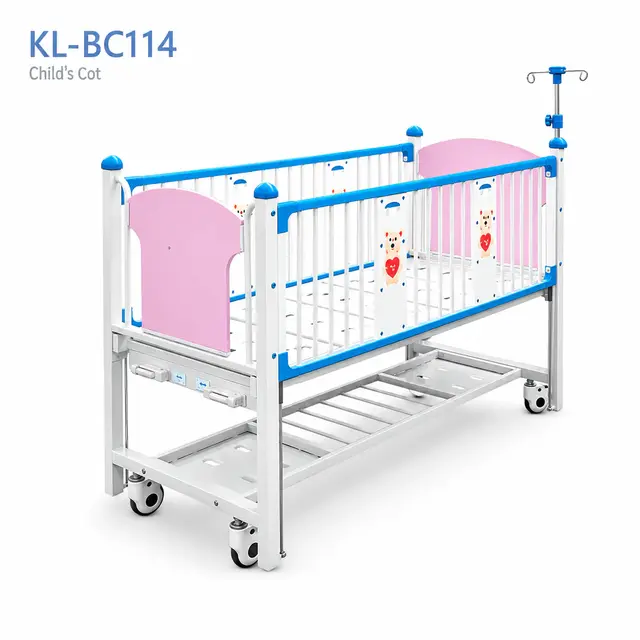
| Paediatric medical crib | Intended patient range, enclosure, side access and compatible mattress | Suitability for every newborn or every child |
| Neonatal incubator | Documented thermal-control functions, alarms, service and clinical use | That every incubator includes every humidity or monitoring option |
| Transport incubator | Intended transport environment and complete transport configuration | That a ward incubator or wheeled bassinet provides equivalent capability |
Ask suppliers to quote these categories on separate lines. Where a project needs incubators as well as bassinets, retain separate technical evaluations and acceptance criteria.
A hospital bassinet begins with the sleep surface
For routine infant sleep, the surface should be firm, flat and noninclined, with the infant placed on the back and the sleep space kept free of loose or soft objects. These principles apply even when the equipment includes additional positioning features. American Academy of Pediatrics safe-sleep guidance.
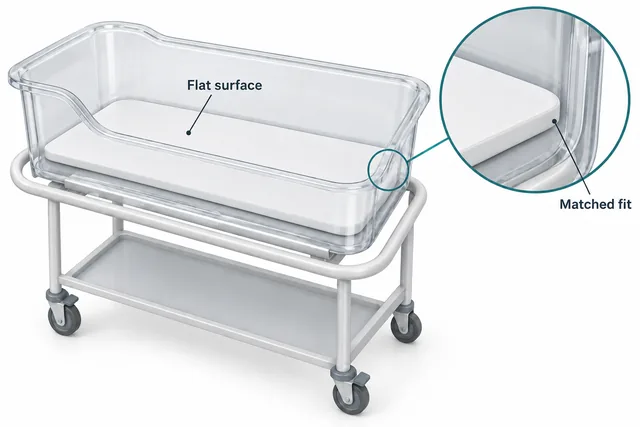
For the buyer, this means reviewing the supplied mattress and tray as a matched system. Request internal sleeping-surface dimensions, mattress construction, allowable thickness and replacement identification. External trolley dimensions are useful for room planning but cannot establish mattress fit. A thicker replacement insert should not be treated as an automatic comfort upgrade.
If a bassinet offers tilt, ask how staff confirm and secure the flat position. Do not specify inclination as a routine sleep aid or a treatment for reflux. Any medically necessary departure from routine safe-sleep practice belongs to the responsible neonatal team, the equipment's intended use and a documented clinical protocol.
Transparent trays: visibility and service life
A transparent tray can improve the view of the infant, but visibility is not continuous monitoring and does not replace observation or monitoring prescribed by the clinical team. Evaluate the tray under the ward's normal lighting, including reflections from task lights and the effect of labels placed on its sides.
Ask for the exact tray material rather than assuming that all clear plastics are acrylic. Request cleaning compatibility, replacement availability and the method of attachment to the base. Check whether removal is permitted, whether tools are required and how the tray is secured after reinstallation.
Surface damage is an operational issue as well as an appearance issue. Scratches, clouding or cracks may make inspection and cleaning harder. During sample review, identify who checks the tray, what conditions require withdrawal from use and how a replacement is ordered. Avoid generic claims that a transparent material is unbreakable or compatible with every disinfectant.
Height adjustment and the mobile base
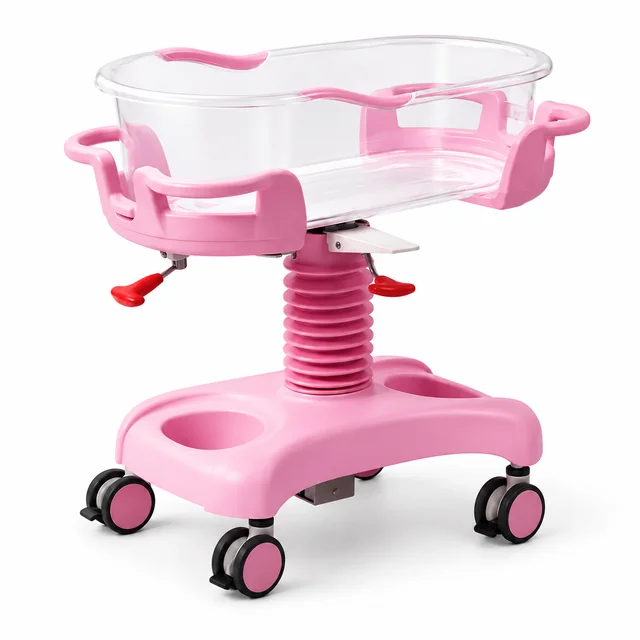
Height adjustment can help staff position equipment for bedside work. Compare the actual access height, the range of movement and the base footprint throughout adjustment. Overall product height may refer to the top of the tray, not the mattress surface, so the measurement reference must be clear.
Assess the base beside the adult maternity bed, chair and overbed table normally used in the room. Confirm that pedals, castors and storage baskets do not obstruct the mother's transfer route or staff access. Matching a bassinet's height to an adult bed does not turn it into an approved bedside sleeper or allow bridging the gap between the two surfaces.
For mobility, request the number and type of brakes, the intended use of the handles and the permitted movement conditions. Staff should be able to identify the brake state without guessing. Demonstrate movement using the manufacturer's procedure and an appropriate test load; an empty trolley in a showroom provides limited information about the occupied configuration.
Selecting equipment for maternity and NICU areas
The clinical team decides when an infant needs an incubator, radiant warmer or open cot. Procurement should not substitute a single weight, age or gestational threshold for that decision. Write the clinical category requested by the neonatal service into the tender, together with the necessary environmental control and service requirements.
An open crib may be required within a neonatal department for an approved care pathway, but its location does not turn it into an incubator. Similarly, an incubator requires a more detailed technical and maintenance evaluation than a mobile bassinet. Avoid accepting a general “NICU suitable” statement without the intended use and model documentation behind it.
For a combined maternity project, plan the quantities with the service team and allow for cleaning, inspection and equipment temporarily out of use. Keep the equipment allocation transparent instead of assuming one bassinet per adult bed covers every operational need. The newborn bassinet-area page can support an initial discussion of the room package.
Cleaning and rooming-in workflows
Ask the cleaning team to demonstrate tray removal, surface cleaning, drying and reassembly on a sample. Include the mattress cover, tray underside, height-adjustment column, brake pedals and basket. Require model-specific instructions for the cleaning agents the facility uses.
Storage should support a tidy care area without creating an extra load that exceeds the base's limits. Specify the permitted basket load and keep the infant's sleep space separate from stored linen and equipment. Identification labels need a defined location that remains readable without obstructing the view of the infant or the controls.
For maternity rooming-in, review the bassinet alongside the mother's mobility and assistance needs. Access to a separate infant sleep surface, the call system and staff support should be addressed in the room plan. A compact footprint alone does not prove that the arrangement works during night care or recovery after a procedure.
Keling's neonatal options: compare documented differences
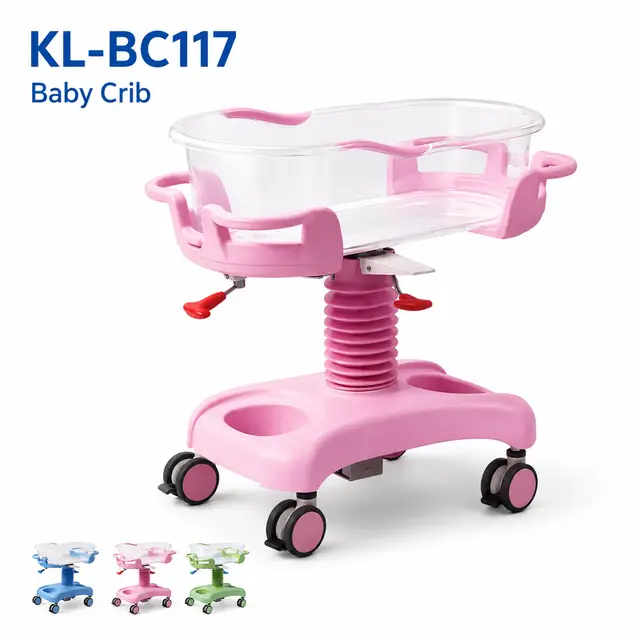
Keling's children and infant bed range includes three relevant bassinet listings. These are useful starting points for a maternity enquiry; request the signed configuration and appropriate safety documentation before purchase.
| Model | Published catalogue information | Procurement follow-up |
|---|---|---|
| KL-BC116 | Transparent bassinet; external size 810 × 520 × 990 mm; tilt feature | Confirm flat-position security, mattress fit and brake configuration |
| KL-BC117 | Height range 650–900 mm; external length and width 875 × 525 mm | Confirm height reference, intended patient limits and replacement mattress |
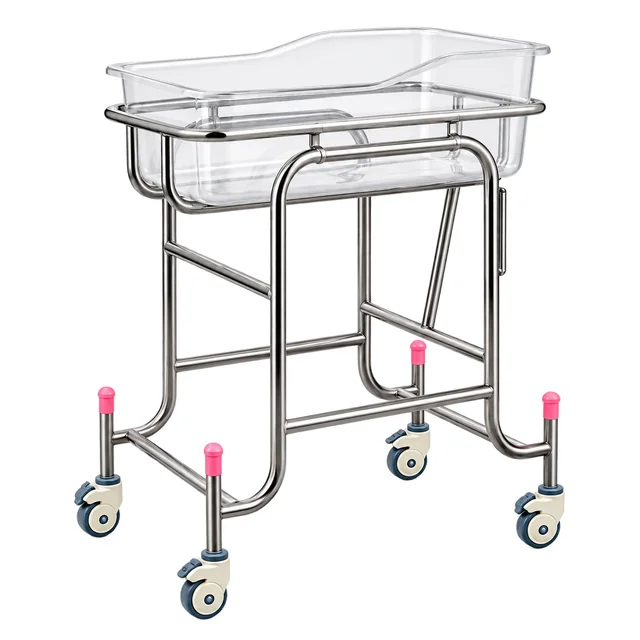
| KL-BC118 | Stainless steel frame; external size 810 × 520 × 900 mm; two braked castors | Confirm tray specification, approved cleaning and mattress package |
The listed bassinets should not be described as Keling incubators. If the tender includes thermal-care equipment, request a separate documented proposal and verify availability. No incubator capability follows from the transparent body, wheels or tilt mechanism of an open bassinet.
Frequently asked questions
Is a hospital bassinet the same as an isolette?
No. In procurement, an isolette search generally concerns an incubator, while an open bassinet is a separate product category. Specify the intended environmental-control functions instead of relying on a broad newborn-bed label.
Is a tilting bassinet better for routine infant sleep?
Tilt should not be used as a routine sleep benefit. Confirm that the approved sleeping configuration is flat and that staff can secure it. Clinical positioning decisions require the responsible team's assessment and the equipment's documented intended use.
Can an adult mattress be cut down for a bassinet?
Do not treat cutting foam to size as evidence of compatibility. The mattress must match the specific tray and meet the appropriate requirements for firmness, construction and fit. See Hospital Crib Mattresses & Infant Bed Safety: Firmness, Covers and Standards for the replacement procurement process.
Where should buyers start when comparing cots and bassinets?
Use Keling's paediatric cots and infant cribs overview for the category distinctions, then Paediatric Hospital Beds & Cots: Safety Heights, Enclosures and Sizing for children's ward enclosure and sizing decisions. Keep each intended patient group separate in the purchasing schedule.
Next step
For a maternity or neonatal-area order, send Keling your equipment schedule with quantities, room drawings and the clinical category required. Ask for model-matched mattresses, documentation and an itemised configuration for review.
About the author
This article was written by the Keling Medical export team, drawing on the engineering data for the 33 bed, cot, mattress and accessory models Keling manufactures at its Yangzhou plant. Keling Medical has been making medical appliances since 1996 and holds CE, ISO 9001 and ISO 13485 certification. More about Keling.