Paediatric cots and infant cribs: specifying beds for children's and maternity wards
Children are not small adults, and a paediatric ward needs at least three distinct bed types. This guide covers the difference between a cot, a crib and a bassinet, the entrapment geometry that matters, and how to specify for maternity, neonatal and paediatric wards.

Short answer
A paediatric ward needs three distinct products: infant cribs or bassinets for newborns up to roughly six months, child cots with full-length safety rails for infants and toddlers, and standard adult beds with appropriate rails for older children. The specification decisions that matter most are rail height and gap geometry to prevent entrapment, rail drop or slide mechanisms that a nurse can operate one-handed while holding a child, surface height for bedside care, and the tilt capability needed for reflux and respiratory positioning.
Paediatric wards are frequently equipped as an afterthought — a line in a tender that says "children's beds" without further definition, filled with whatever the supplier had. The result is a ward with the wrong product in it: cribs used for toddlers who can climb out, or full-size cots occupying space in a maternity bay where a bassinet was needed.
Children's wards need at least three distinct products, and the distinctions are worth getting right at specification stage.
Three products, three age bands
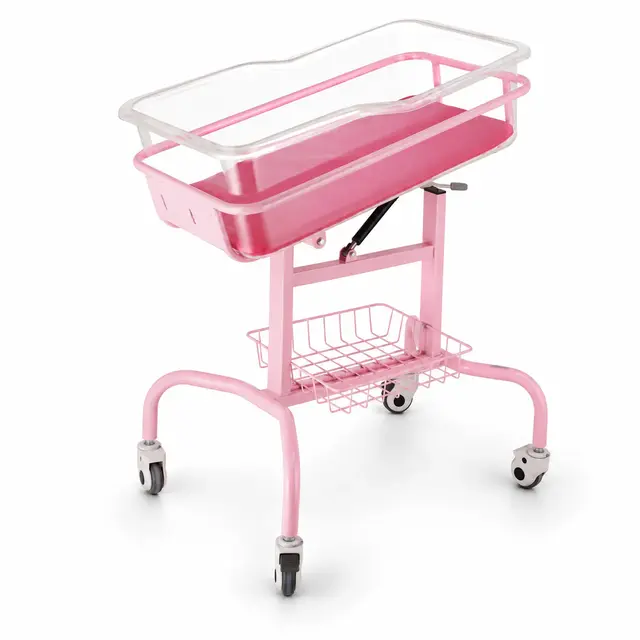
Infant crib or bassinet — a compact unit, often with transparent sides, on a trolley base. Used for newborns from birth to roughly six months, at the mother's bedside in maternity or in a neonatal area. It moves constantly: to the mother, to the nursery, to the examination area.
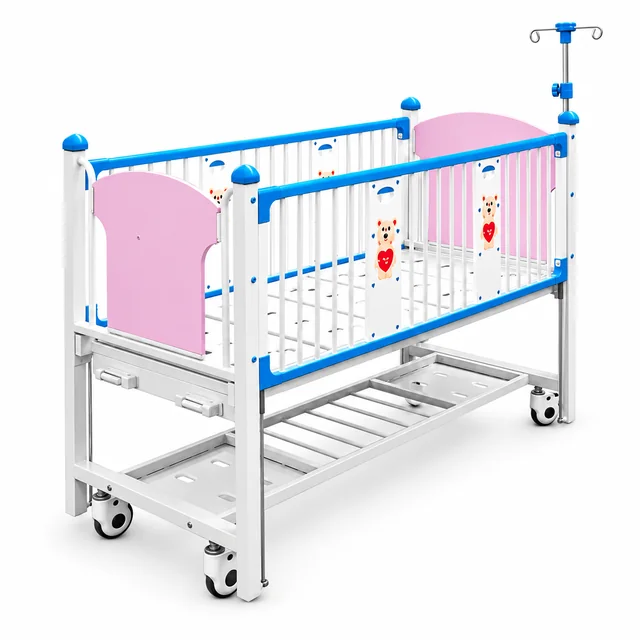
Child cot — a larger enclosed bed with full-height rails, for infants and toddlers who can sit, stand and climb. Rail height is the defining specification, because a rail that a determined two-year-old can get a leg over is not a safety feature.
Standard bed with rails — from roughly four or five years upward, children are nursed in an adult-format bed. An enclosed cot for a school-age child is both clinically unnecessary and, for the child, an unpleasant experience. What matters here is appropriate rails and a low minimum bed height.
Getting the mix right for your ward is a question about your admissions profile, not about the catalogue.
Entrapment geometry: the specification that matters most
The single most important safety property of any enclosed cot is the geometry of its gaps. The mechanism of injury is consistent and well documented: a child's limb, head or neck enters a gap and cannot be withdrawn.
Three gaps to interrogate on any product you are considering:
- Between the rail bars. Wide enough for a limb but too narrow for the head is the dangerous condition.
- Between the rail and the mattress, and between the mattress and the cot sides. This is why the mattress must be the size the cot was designed for. A mattress 40 mm short creates exactly the gap the design intended to eliminate.
- Between the rail sections, and between a dropped rail and the frame. Check the geometry with the rail in every position it can be left in, not just fully up.
Also check the rail height above the mattress surface — not above the cot base, which is the figure more flattering to the product. The measurement that matters is from the top of the compressed mattress to the top of the rail.
Rail mechanisms and one-handed operation
A paediatric nurse is frequently holding a child with one arm while operating the cot with the other. A rail that requires two hands, or a simultaneous press-and-lift, is a rail that gets left down.
When evaluating, actually try it: hold a weight equivalent to an infant in one arm and operate the rail with the other. Then ask:
- Can the rail be released and lowered one-handed?
- Does it latch positively, with an audible or tactile confirmation?
- Can it be released accidentally by a child leaning on it or pulling at it?
- Does a dropped rail sit clear of the working space, or does it block access?
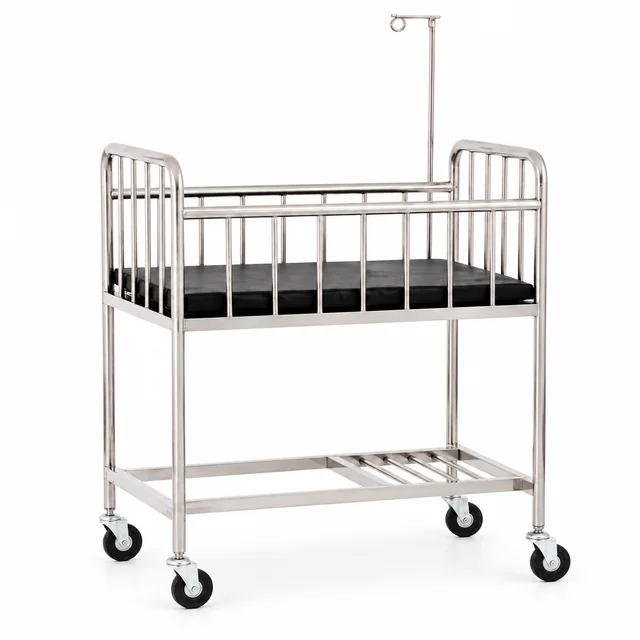
Our KL-BC114 child's cot uses full-length safety rails with an adjustable mechanism; the KL-BC115 stainless steel cot is the more heavily built option where durability dominates.
Cribs: transparency, tilt and mobility
For newborn cribs, three properties do most of the work.
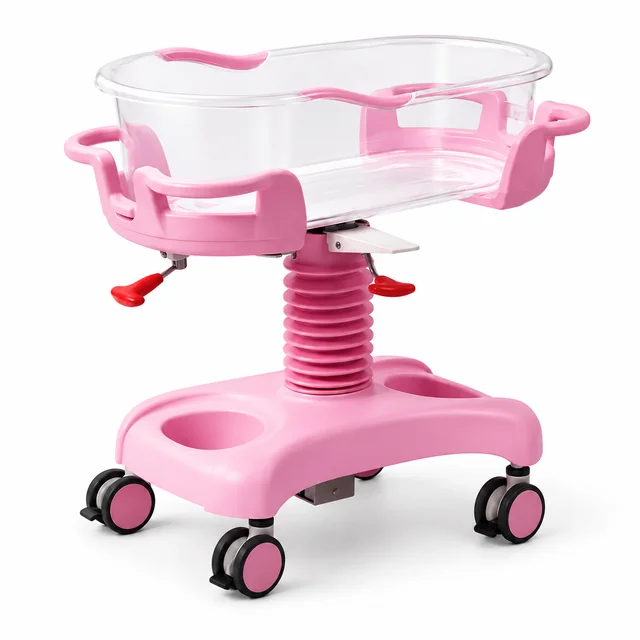
Transparency. A transparent crib body — as on the KL-BC116 — lets staff and the mother observe the infant from any angle without opening the crib. This matters clinically, and it matters to a mother who has just had a caesarean and cannot easily sit up.
Tilt. A tilt capability of around 15–18° is used for infants with reflux or respiratory difficulty, and for postural drainage. Check that the tilt holds its position when the crib is wheeled, and that it can be set without lifting the infant.
Mobility and height. Cribs are moved many times a day. Castor quality and a height that brings the infant to the mother's bedside level are what make that practical. The KL-BC117 offers height adjustment specifically so the crib can be matched to the height of the mother's bed and to the working height of the staff attending it.
Where durability and disinfection dominate over transparency — a busy neonatal area with a heavy cleaning regime — a stainless steel framed bassinet such as the KL-BC118 is the more robust choice.
Materials and cleaning
Paediatric equipment is cleaned harder and more often than adult equipment, and the cleaning is the thing that destroys it.
Stainless steel resists corrosion where disinfectant pools in joints and around fixings, and survives being cleaned several times a day for a decade. It is heavier and colder to the touch.
ABS and acrylic are lighter, warmer, quieter and transparent, and are far cheaper to replace when a panel cracks. They are more vulnerable to certain solvents — which is the specification question to ask, and the answer must be checked against the disinfectants your infection-control policy actually mandates, not against a generic compatibility claim.
Two details that matter more than the headline material:
- Welds and joints. Continuous, smooth welds clean; crevices harbour. Look underneath the product, not at the display surfaces.
- Removable mattress platforms and pads. If the surface the infant lies on cannot be removed for cleaning, it will not be cleaned properly.
Sizing a ward
Some practical planning notes, in no particular order:
- At least one crib per maternity bed, plus spares. Cribs are constantly out of the bay for cleaning or repair, and a fleet sized exactly to bed count is a fleet that runs short every day.
- Cots take floor space. They are wider than they look once the rails are considered, and a paediatric bay planned on adult bed dimensions does not fit them with the access clearance staff actually need.
- Parent accommodation. Most paediatric admissions come with a resident parent. If your bay has no provision for one, the parent will sleep in a chair or on the child's bed — which has both dignity and safety consequences. Plan it in.
- Mattresses are not interchangeable. Each cot and crib model has a mattress size it was designed around. Cross-fitting creates exactly the gaps discussed above. Order the matched mattress with the cot.
- Spares from day one. Rails, latches, castors and transparent panels are the parts that fail. Buy them with the fleet.
A specification line that works
Infant crib, hospital bassinet type: transparent crib body permitting 360° observation; tilt adjustable to not less than 15° and lockable; trolley base with four castors, of which at least two braked; height suitable for bedside use at a maternity bed; crib body removable for cleaning; supplied with matched mattress pad; frame material stainless steel or equivalent corrosion-resistant material compatible with [named disinfectant].
Naming the disinfectant is the detail most specifications omit and the one most likely to cause a product to degrade in its first year.
If you are equipping a maternity or paediatric unit, send us the bay layout and the admissions profile and we will suggest a mix — including telling you where a standard bed with rails is the better answer than a cot. The full range is in the children and infant beds catalogue.
Frequently asked questions
What is the difference between a hospital cot, a crib and a bassinet?
In hospital use, a crib or bassinet is a small, often transparent-sided unit on a trolley base for newborns, used at the mother's bedside or in a neonatal area. A cot is a larger, enclosed bed with full-height rails for infants and toddlers who can stand and climb. Beyond roughly four or five years of age, children are usually nursed in a standard bed with appropriate side rails rather than an enclosed cot.
Why do hospital baby cribs have transparent sides?
Transparency allows continuous visual observation of a newborn from any angle without opening the crib or disturbing the infant, which matters both for clinical monitoring and for a mother recovering in the next bed. It also makes soiling immediately visible, which supports cleaning discipline.
What tilt does an infant crib need?
A crib tilt of around 15 to 18 degrees is used to position newborns with reflux or respiratory difficulty, and for postural drainage. It should be adjustable and lockable, and the tilting mechanism should hold position reliably when the trolley is moved.
What material should paediatric cots be made from?
Stainless steel frames are standard where durability and repeated aggressive disinfection are required, and they do not corrode when cleaning agents pool in joints. ABS and acrylic are used for panels and crib bodies because they are lighter, warmer to the touch and transparent. The critical property in both cases is compatibility with the disinfectants your infection-control policy actually mandates.
How many cribs does a maternity ward need?
Plan for at least one crib per maternity bed, plus spare capacity for the neonatal area and for cleaning turnover. Cribs are moved constantly between rooms, so a fleet sized exactly to bed count leaves no margin when several are out of service for cleaning or repair.
About the author
This article was written by the Keling Medical export team, drawing on the engineering data for the 33 bed, cot, mattress and accessory models Keling manufactures at its Yangzhou plant. Keling Medical has been making medical appliances since 1996 and holds CE, ISO 9001 and ISO 13485 certification. More about Keling.