What is the Trendelenburg position? Definition, angles, uses and limits
Head-down tilt is still taught everywhere, but its role has narrowed. Here is the clinical definition, the angles used, where it helps, and why it is no longer a fix for low blood pressure.
Short answer
The Trendelenburg position is a supine position in which the whole bed or table is tilted so the head is lower than the feet, usually by about 15° or more; steep Trendelenburg is roughly 30–45°. It is used for central line insertion and pelvic surgery. Reverse Trendelenburg tilts the head up. Head-down tilt is no longer routinely recommended for treating low blood pressure or shock.
The Trendelenburg position is one of the most widely taught positions in nursing and surgery, and one of the most misunderstood. Many staff still reach for it when a patient's blood pressure falls, yet the evidence for that use is weak. This explainer gives the clinical definition, the angles used in practice, the legitimate indications, the risks and the current thinking on hypotension and shock.
If you are specifying beds rather than positioning patients, our companion guide on Trendelenburg tilt requirements for hospital beds covers tilt ranges, controls and tender wording in detail. This article stays with the clinical side.
What is the Trendelenburg position?
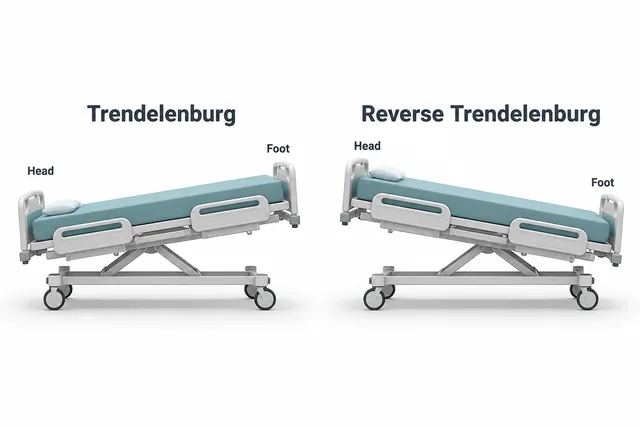
The Trendelenburg position is a supine position in which the whole bed or operating table is tilted so that the head is lower than the feet. The body stays straight; the tilt comes from the support surface, not from bending the patient.
StatPearls describes it as tilting the head of the bed down so that the pubic symphysis becomes the highest point of the trunk. The position is named after the German surgeon Friedrich Trendelenburg, who used head-down tilt in the nineteenth century to move abdominal organs away from the pelvis and improve surgical access. It is sometimes misspelled "tren de lenburg"; in Spanish-language clinical texts it is the posición de Trendelenburg.
Two points are worth fixing early:
- It is a whole-body tilt. Raising only the legs while the trunk stays flat is a different manoeuvre (see modified Trendelenburg below).
- It is defined by direction, not a single angle. Head-down is Trendelenburg; head-up is reverse Trendelenburg. The angle is chosen for the purpose.
Trendelenburg position angles: standard, steep and reverse
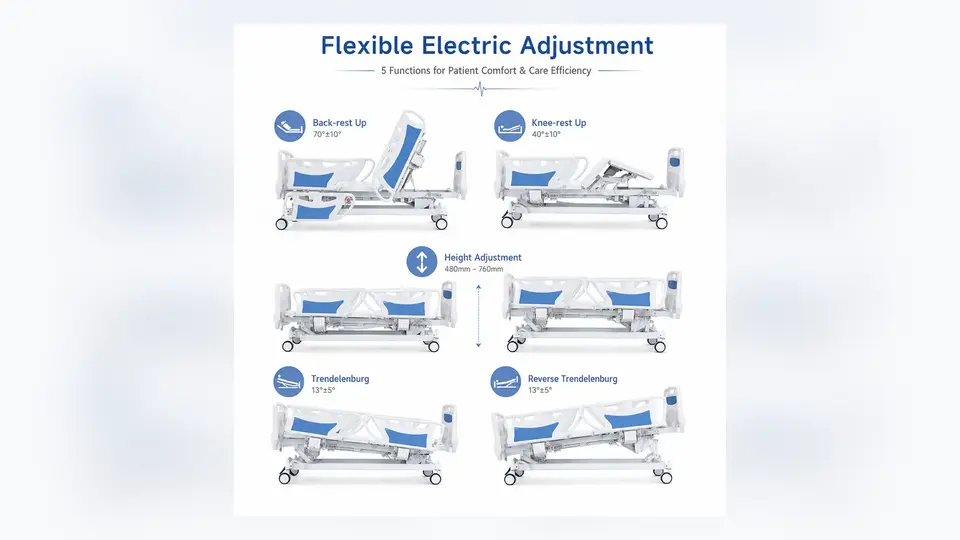
Standard Trendelenburg is usually described as a head-down tilt of about 15° or more, and steep Trendelenburg as roughly 30–45°. Reverse Trendelenburg is the same tilt in the opposite direction, commonly described as about 15° head-up, although ward beds typically reach only about 12–13°.
| Position | Direction | Typical angle | Typical setting |
|---|---|---|---|
| Trendelenburg | Head down, feet up | About 15° or more | Central venous access, pelvic and lower abdominal surgery, some spinal anaesthesia techniques |
| Steep Trendelenburg | Head down | About 30–45° | Robotic and laparoscopic pelvic surgery (operating table) |
| Reverse Trendelenburg (anti-Trendelenburg) | Head up, feet down | About 10–15° on ward beds; steeper on operating tables | Upper abdominal and bariatric surgery, reflux, ward repositioning, sitting-out preparation |
| Modified Trendelenburg / passive leg raise | Legs raised, trunk flat or lowered | Legs about 30–45° | Bedside assessment of fluid responsiveness in critical care |
| Left lateral Trendelenburg | Left side down, head down | Head-down tilt plus left lateral roll | Classic response to suspected venous air embolism |
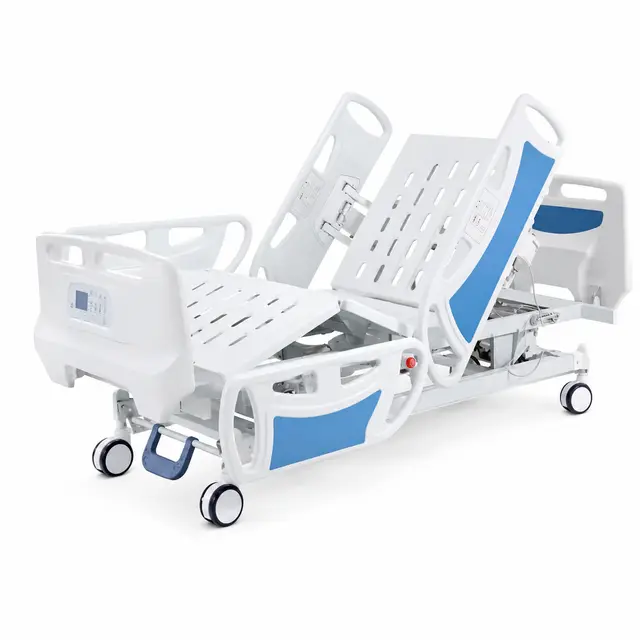
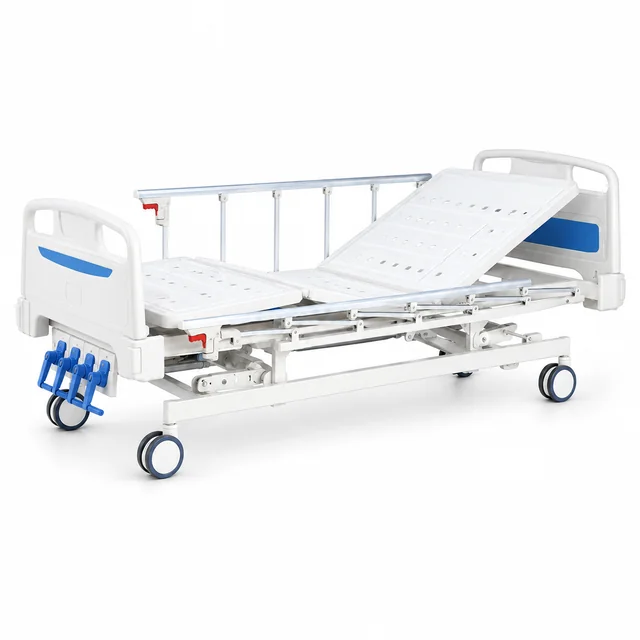
Ward beds tilt far less than operating tables. A typical five-function ward bed reaches about 12–13° in either direction: the KL-BC101 electric hospital bed is specified at 13±5°, and the manual KL-BC109 at 12±5°. Steep Trendelenburg of 30° or more is an operating-room position delivered by a surgical table, not something a ward bed is designed to do.
What is Trendelenburg used for today?
Today the Trendelenburg position is used mainly to distend neck and chest veins for central line insertion, to improve surgical exposure of pelvic organs, and in some anaesthetic and imaging techniques. Its routine use for low blood pressure is no longer recommended.
- Central venous catheter insertion and removal. Head-down tilt fills the internal jugular and subclavian veins, making them easier to cannulate and reducing the risk of air entering the vein.
- Trendelenburg position in surgery. In gynaecological, urological and colorectal procedures, gravity moves bowel out of the pelvis. Steep Trendelenburg is standard for many robotic pelvic operations.
- Spinal anaesthesia. Tilt is used to influence how far a hyperbaric spinal anaesthetic spreads.
- Imaging. Some myelography techniques use head-down tilt to move contrast.
- Postural drainage. Head-down positions have historically been used in airway clearance for selected patients, under physiotherapy direction.
Does Trendelenburg help low blood pressure?
Usually not in any lasting way. Reviews of the available studies have found no consistent, sustained improvement in blood pressure or cardiac output when hypotensive patients are tilted head-down, and the position carries real risks.
The habit has a history. American physiologist Walter Cannon popularised the Trendelenburg position for shock during the First World War, and later revised his view, but the practice persisted for decades. Studies since then have been small and mixed:
- A summary of the evidence on Life in the Fast Lane notes that where a rise in blood pressure is seen, it is generally short-lived, lasting less than about 10 minutes.
- A Best Evidence Topic review of five small studies of hypovolaemic or hypotensive patients concluded there was no evidence of benefit; most showed no significant change in cardiac index.
- StatPearls notes that most haemodynamic variables return to baseline within about ten minutes of head-down tilt.
Meanwhile, head-down tilt pushes abdominal contents against the diaphragm, can worsen gas exchange, and raises intracranial and intraocular pressure. Cleveland Clinic summarises the position for shock as something that "is no longer routinely recommended". So the honest answer to searches like "Trendelenburg position for low BP" or "Trendelenburg for hypotension" is that it is not a treatment; definitive management of hypotension follows the facility's resuscitation protocols and the treating clinician.
Modified Trendelenburg and the passive leg raise
Modified Trendelenburg means raising the legs while keeping the trunk flat, rather than tilting the whole body. Its rigorous modern descendant is the passive leg raise (PLR) test, used in critical care to predict whether a patient will respond to fluid.
In the PLR test as described by Monnet and Teboul, the patient starts semi-recumbent; the bed is then adjusted so that the trunk goes flat and the legs are raised. This shifts roughly 300 mL of venous blood from the legs and abdomen towards the heart, acting as a reversible "fluid challenge" with no fluid given. Key practical points from their guidance:
- Start from semi-recumbent, not supine, so that splanchnic blood is also mobilised.
- Make the change with the bed, not by lifting the patient's legs by hand, which causes pain and adrenergic responses that distort the result.
- Measure cardiac output directly and in real time; blood pressure alone is not a reliable readout.
- Read the effect within about a minute, because it fades quickly, and confirm values return to baseline afterwards.
This is the main reason the bed matters: a PLR is easiest on a bed whose backrest, knee-rest and tilt can be driven smoothly from a single control, such as a five-function electric bed. Our explainer on what each hospital bed function does shows how backrest, knee-rest and tilt combine.
Trendelenburg vs reverse Trendelenburg
Reverse Trendelenburg is a supine position with the whole bed tilted so the head is higher than the feet. It is used to move abdominal organs away from the diaphragm and upper abdomen, to reduce reflux and to help breathing, and to prepare a patient to sit or stand.
| Feature | Trendelenburg | Reverse Trendelenburg |
|---|---|---|
| Highest point of trunk | Pelvis (pubic symphysis) | Head |
| Main clinical aims | Venous distension for central access; pelvic surgical exposure | Upper abdominal exposure; reduced aspiration and reflux; easier breathing in obese patients |
| Main risks | Raised intracranial and intraocular pressure, reduced lung compliance, facial and airway oedema, sliding towards the head | Reduced venous return and hypotension, reduced cerebral perfusion, increased heel pressure, sliding towards the foot |
| Useful patient-safety measures | Non-slip pads, limited duration, monitored ventilation | Knee-rest or foot support to stop sliding, heel offloading |
Steep reverse Trendelenburg, typically above 20–30°, is mostly seen on operating tables for laparoscopic upper abdominal and bariatric surgery. On a ward bed, reverse Trendelenburg is often combined with the knee-rest so that a patient can be brought upright without sliding down the mattress, which also limits shear on the sacrum.
Trendelenburg position in pregnancy and obstetrics
In later pregnancy, lying flat on the back can compress the inferior vena cava and aorta, so obstetric teams generally favour left lateral tilt over plain supine or head-down positions. Head-down tilt does have one well-known obstetric use: umbilical cord prolapse.
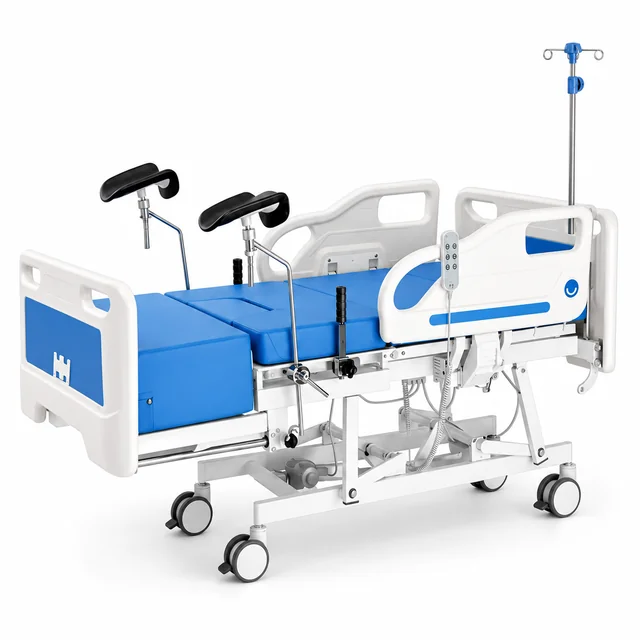
NHS maternity guidance on cord prolapse, referencing RCOG Green-top Guideline No. 50, lists the knee–chest position or the exaggerated Sims position (left lateral with a pillow under the left hip), with or without Trendelenburg, to reduce pressure on the cord while delivery is arranged. That combination is what many people mean by searching "left lateral Trendelenburg position" in an obstetric context. Birth beds therefore tend to offer more tilt than ward beds; Keling's KL-BC110 electric birth bed is specified at 17±5° Trendelenburg and reverse Trendelenburg.
The other classic "left lateral Trendelenburg" scenario is suspected venous air embolism, where placing the patient left side down and head down (sometimes called Durant's manoeuvre) is intended to keep air in the right side of the heart. In both cases, positioning follows the facility's protocols and the treating clinician.
Related surgical positions: lithotomy and jackknife
Trendelenburg is often combined with other surgical positions, which is why it appears alongside lithotomy and jackknife in nursing courses.
- Lithotomy position in nursing. The patient is supine with hips and knees flexed and legs supported in stirrups, abducted about 30–45° from the midline per StatPearls. Legs are raised and lowered together to protect the spine and hips. It is frequently paired with some head-down tilt for pelvic access.
- Jackknife position in nursing (Kraske). The patient is prone with the table flexed at the hips so the buttocks are highest. The "prone jackknife position with slight Trendelenburg" is used in anorectal surgery.
- Risks shared by all three. Pressure on bony prominences, nerve stretch (brachial plexus, common peroneal, sciatic) and, in head-down positions, raised eye and head pressure. StatPearls emphasises padding and keeping arm abduction below 90°.
Trendelenburg bed position: what the bed has to do
On a hospital bed, the Trendelenburg bed position is produced by lowering the head end of the frame relative to the foot end, usually by a height-actuator pair or a manual crank. For clinical teams, four practical capabilities matter:
- Angle visibility. A readable indicator so staff know the tilt they have set.
- Fast return to flat. A CPR release that levels the backrest quickly in an emergency.
- Lockout. A nurse lock so patients cannot select tilt themselves.
- Mattress grip and support. A mattress that stays in place when tilted; see our mattress size and compatibility guide.
Specification line: Five-function hospital bed with Trendelenburg and reverse Trendelenburg of at least 12° each (stated tolerance), independent of backrest and knee-rest, with angle indicator, CPR quick release and nurse control lockout.
For the full procurement treatment of tilt ranges, control layout and test questions, read Trendelenburg and reverse Trendelenburg: positions and bed requirements, and for the wider set of positions a bed supports, see our guide to patient positioning in a hospital bed. If you are planning a ward or ICU order, contact Keling Medical for model-specific datasheets.
Sources and further reading
- StatPearls: Anatomy, Patient Positioning — definitions of Trendelenburg, reverse Trendelenburg and lithotomy, and positioning risks.
- Cleveland Clinic: Trendelenburg Position — angles, uses, risks and current view on shock.
- Life in the Fast Lane: Trendelenburg Position for the Hypotensive Patient — history and evidence summary.
- BestBETs: Trendelenburg position in hypovolaemic shock — appraisal of five small studies.
- Monnet and Teboul, Passive leg raising: five rules, not a drop of fluid! Critical Care 2015 — how to perform the PLR test.
- NHS Right Decisions: Umbilical cord prolapse guideline — positioning for cord prolapse, referencing RCOG Green-top Guideline No. 50.
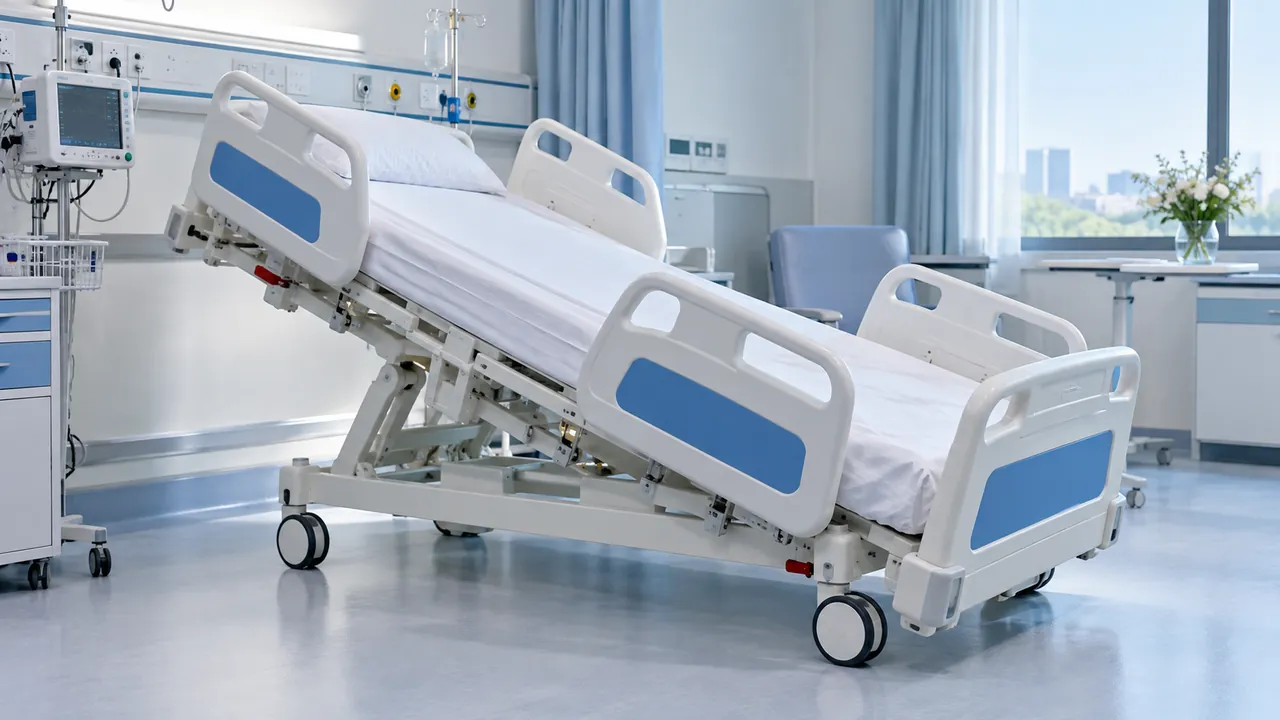
Illustration: AI-generated image for explanation only; it does not show a specific Keling model. See the linked product pages for actual product photos and specifications.
Frequently asked questions
What is the Trendelenburg position?
The Trendelenburg position is a supine position with the whole bed or operating table tilted so the head is lower than the feet. The body stays straight and the pelvis becomes the highest point of the trunk. It is named after the German surgeon Friedrich Trendelenburg and is used mainly for central venous access and pelvic surgery.
What is the reverse Trendelenburg position?
Reverse Trendelenburg, also called anti-Trendelenburg, is a supine position with the whole bed tilted so the head is higher than the feet. It is used in upper abdominal and bariatric surgery, to reduce reflux and aspiration risk, to ease breathing and to help a patient move towards sitting. Ward beds typically offer around 12–13° of reverse tilt.
Does Trendelenburg help low blood pressure?
Not reliably. Reviews of small studies found no consistent or sustained rise in blood pressure or cardiac output, and any effect usually fades within about ten minutes. Head-down tilt can also impair breathing and raise intracranial pressure. It is no longer routinely recommended for hypotension or shock; treatment follows the facility's protocols and the treating clinician.
What is steep Trendelenburg?
Steep Trendelenburg is a head-down tilt of roughly 30–45°, used mainly on operating tables for robotic and laparoscopic pelvic surgery such as prostate and gynaecological procedures. It needs anti-slip padding, careful arm and shoulder protection and monitoring of ventilation and eye pressure. Standard ward beds do not tilt this far; they typically reach 12–13°.
What is modified Trendelenburg?
Modified Trendelenburg means raising the legs while keeping the trunk level, instead of tilting the whole body. In critical care, the structured version is the passive leg raise test, where the bed moves the patient from semi-recumbent to trunk-flat with legs raised, shifting about 300 mL of blood towards the heart to test fluid responsiveness.
Is the Trendelenburg position used in pregnancy?
Plain supine and head-down positions are generally avoided in later pregnancy because the uterus can compress major vessels; left lateral tilt is preferred. One recognised exception is umbilical cord prolapse, where guidance lists knee-chest or exaggerated Sims positioning, with or without Trendelenburg, to relieve pressure on the cord while delivery is arranged.
About the author
This article was written by the Keling Medical export team, drawing on the engineering data for the 33 bed, cot, mattress and accessory models Keling manufactures at its Yangzhou plant, and checked against the published standards and guidance listed in the sources. Keling Medical has been making medical appliances since 1996 and holds CE, ISO 9001 and ISO 13485 certification. More about Keling.