Patient positioning in a hospital bed: Fowler, supine, lateral, prone and Sims explained
Every bed position has a name, an angle and a reason. Here are the standard hospital bed positions in nursing, what each is for, and which bed functions make them safe and repeatable.
Short answer
Patient positioning is the deliberate placement of a patient and the bed to meet a clinical goal while preventing injury. The main hospital bed positions are supine (flat), Fowler's (head raised about 45–60°, semi-Fowler's 30–45°, high Fowler's 60–90°), lateral (30° tilt preferred), Sims (left semi-prone), prone (face down) and Trendelenburg or reverse Trendelenburg (whole bed tilted).
Patient positioning is one of the most frequent things a nurse does and one of the most consequential. The way a patient lies or sits in bed affects breathing, swallowing, circulation, skin integrity and comfort, and every position has a name, a typical angle and a reason. This guide explains the standard hospital bed positions used in nursing, what each is for, and which bed functions make them possible.
It is written for nurses, educators and the procurement teams who buy beds for them. Positioning decisions for an individual patient always follow the facility's protocols and the treating clinician; this article explains the positions, not a treatment plan.
What is patient positioning?
Patient positioning is the deliberate placement of a patient's body, and of the bed or table supporting it, to achieve a clinical goal while protecting the patient from injury. The goal may be easier breathing, safe eating, access for an examination or procedure, pressure redistribution or simply comfort.
In practice, positioning in healthcare has three parts: choosing the position, achieving it with the bed and positioning aids (pillows, wedges, heel offloading devices), and maintaining it safely with regular checks. StatPearls stresses that every position carries risks to skin and nerves, so padding bony prominences and avoiding overstretching joints are part of the job, not extras.
Hospital bed positions at a glance
Most medical bed positions fall into a handful of families: lying flat on the back, sitting up, lying on the side, lying face down and tilted. The table below gives the common names, typical angles and the bed function each relies on.
| Position | Description | Typical angle | Common uses | Bed function used |
|---|---|---|---|---|
| Supine | Flat on the back, spine neutral | 0° | Examination, many procedures, rest | Flat deck |
| Dorsal recumbent | Supine with knees flexed, feet flat | 0°, knees bent | Perineal care, catheterisation, abdominal exam | Flat deck, pillows |
| Low Fowler | Head of bed slightly raised | About 15–30° | Rest, reduced shear while still elevated | Backrest |
| Semi-Fowler | Head of bed moderately raised | About 30–45° | Breathing, ventilated patients, tube feeding | Backrest, knee-rest |
| Fowler | Semi-upright | About 45–60° | Eating, breathing, talking, reading | Backrest, knee-rest |
| High Fowler | Upright | About 60–90° | Respiratory distress, nasogastric tube placement | Backrest to 70° plus pillows |
| Lateral (side-lying) | On one side, supported | 30° tilt preferred to 90° | Pressure relief, comfort, recovery | Flat deck, wedges |
| Sims (semi-prone) | Left side, upper leg flexed, body rolled forward | Between lateral and prone | Rectal exam, enema, unconscious patient airway | Flat deck |
| Prone | Face down | 0° | Severe ARDS in ICU, spinal and posterior procedures | Flat deck, specialist padding |
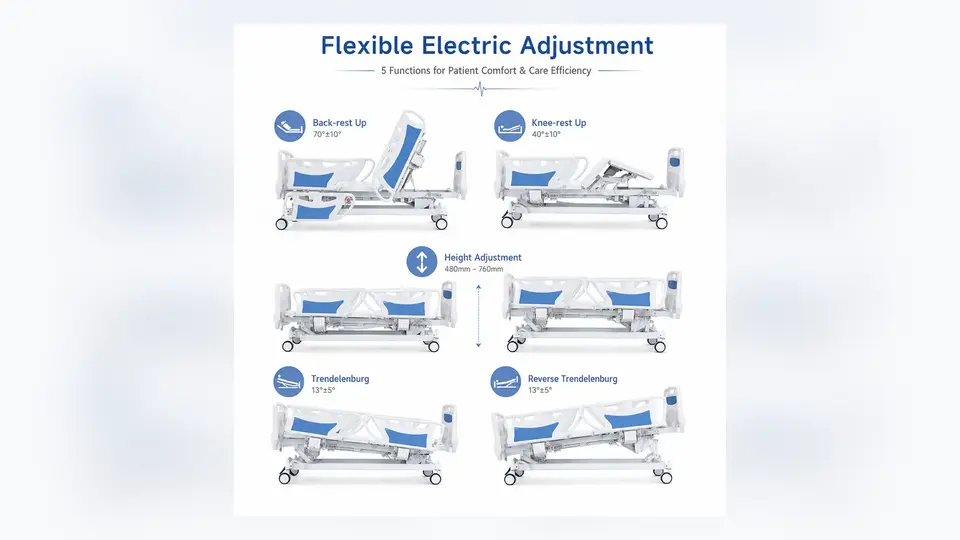
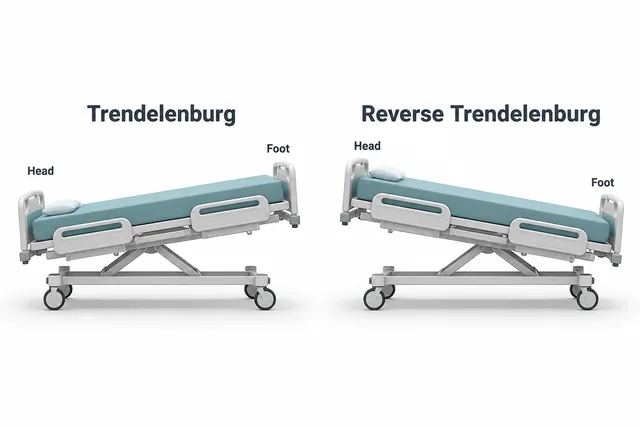
| Trendelenburg / reverse | Whole bed tilted head down / head up | About 12–13° on ward beds | Central line insertion; reflux and sitting preparation | Tilt (five-function beds) |
Angles for the Fowler family follow StatPearls (Fowler 45–60°, high Fowler 60–90°, semi-Fowler about 30–45°); low Fowler at about 15–30° is the common nursing convention. Different textbooks draw the boundaries slightly differently, which is why many units specify the angle in degrees rather than by name.
Supine and recumbent positions
Supine means lying flat on the back. "Recumbent" simply means lying down, so a recumbent position in medical usage can be supine, lateral or prone; dorsal recumbent is supine with the knees bent.
Supine is the default for examination and many procedures, but it is rarely the best long-term resting position. StatPearls advises keeping arms abducted less than 90° and hands neutral or supinated to protect the brachial plexus and ulnar nerve. For pressure care, a supine patient needs the heels offloaded, because heels carry high pressure over a small area.
Supine vs semi-Fowler's is a common exam question: supine is flat, while semi-Fowler raises the head of the bed about 30–45°, which improves breathing and lowers aspiration risk, but increases load on the sacrum.
Fowler's position in nursing: semi-Fowler's vs Fowler's
Fowler's position is a seated position in bed with the head of the bed raised about 45–60°; semi-Fowler's is lower at about 30–45°, and high Fowler's is 60–90°. These are the positions used most often on any ward.
Why elevate the head of the bed? StatPearls notes that sitting up improves oxygenation in mild to moderate respiratory distress by easing chest expansion and reducing abdominal pressure on the diaphragm, and that high Fowler's lowers aspiration risk during nasogastric tube placement. Ventilator care bundles commonly specify a head-of-bed angle of 30–45°.
The trade-off is shear. When the backrest rises without support under the thighs, the patient slides down the bed and the skin over the sacrum is dragged against deeper tissue. NSW Clinical Excellence Commission guidance on pressure injury prevention advises raising the knee break to 30° or less before raising the head to 30° or less, keeping the head of bed as flat as the patient's condition allows, and repositioning off the sacrum after meals. On a two- or three-function bed this is simple: knee-rest first, then backrest. Our explainer on hospital bed functions covers why.
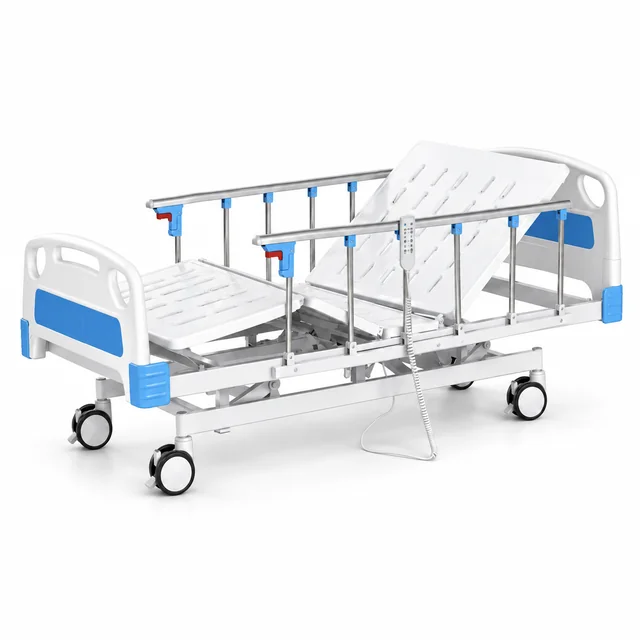
The seated position in medical terms covers sitting in bed (Fowler) and sitting out in a chair; "erect" position in nursing usually means standing or sitting fully upright. A bed with a 70° backrest, such as the KL-BC104 three-function electric bed, reaches the high Fowler range with pillow support.
Lateral side positioning and the 30-degree tilt
In the lateral recumbent position, the patient is lying on their side, with the head, spine and pelvis aligned and the upper leg supported. It is the workhorse of repositioning schedules.
The detail that matters is the angle. International pressure injury guidance (EPUAP/NPIAP/PPPIA 2019), as summarised by NSW CEC, favours a 30° lateral tilt over a full 90° side-lying position, because 90° side-lying concentrates load on the greater trochanter and shoulder. The 30° tilt is held with a wedge or pillow behind the back, alternating sides. Repositioning frequency should be individualised to the patient's risk, mobility, skin tolerance and goals of care, not set by habit alone.
StatPearls adds two protections for full lateral decubitus positioning during procedures: neither arm abducted beyond 90°, and an axillary roll placed below the axilla to protect the brachial plexus and vessels.
Sims position: medical term and how to place a patient
The Sims position is a semi-prone, left-sided position, sometimes described as lateral semi-prone recumbent. The patient lies on the left side, rolled partly forward, with the left arm behind or alongside the body and the right hip and knee flexed towards the chest.
How would you place a patient in Sims position? In outline:
- Explain the procedure, ensure privacy and set the bed flat at a safe working height with the brakes on.
- Turn the patient onto their left side, keeping head, spine and pelvis aligned.
- Bring the left arm back so the chest rolls slightly forward.
- Flex the right hip and knee and rest the right leg on a pillow so it does not press on the left.
- Support the head with a small pillow and check that the lower shoulder and ear are not compressed.
Sims is used for rectal examination, enemas and suppositories, and for comfort in later pregnancy. An exaggerated Sims position (left lateral with a pillow under the left hip) appears in obstetric guidance for umbilical cord prolapse, sometimes combined with head-down tilt; our article on the Trendelenburg position explains that combination.
Prone positioning: body position prone and lying prone for lungs
A prone patient lies face down. On a general ward it is used for comfort or wound access in selected patients; in intensive care, prone positioning is an established therapy for severe acute respiratory distress syndrome (ARDS).
The landmark PROSEVA trial (Guérin et al., New England Journal of Medicine, 2013) randomised 466 patients with severe ARDS and found that prone sessions of at least 16 hours a day reduced 28-day mortality from 32.8% to 16.0%. Lying prone redistributes ventilation and perfusion so that more lung units take part in gas exchange.
Prone bed positioning is resource-heavy. Turning a ventilated patient needs a trained team, careful control of tubes and lines, and padding of the face, chest, pelvis and knees. StatPearls identifies perioperative vision loss as an avoidable complication of the prone position, which is why eye and face pressure checks are mandatory.
Some ICUs use specialist automated beds that rotate the patient, either side to side (continuous lateral rotation therapy) or fully into the prone position. These are niche intensive-care devices; most units prone patients on a standard ICU bed with a trained team. Keling does not make rotating or automated proning beds; our five-function ICU and ward beds, such as the KL-BC101, provide the flat deck, height adjustment and CPR release that manual proning protocols rely on.
Surgical patient positioning and exam positions
Surgical patient positioning happens on an operating table rather than a ward bed, but the same names appear in nursing curricula and EMT courses. The main surgical positions in the operating room are:
- Supine for most abdominal and limb surgery.
- Lithotomy: supine with hips and knees flexed and legs abducted about 30–45° from the midline in stirrups; legs raised and lowered together.
- Prone and jackknife for spinal and anorectal surgery.
- Lateral for kidney, hip and thoracic surgery.
- Trendelenburg and reverse Trendelenburg for pelvic and upper abdominal access.
- Beach chair (sitting) for shoulder surgery.
Patient exam positions on wards and in clinics are simpler: supine and dorsal recumbent for abdominal exams, Sims for rectal exams, lithotomy for gynaecological exams (see our guide to gynaecological examination beds and chairs), and sitting for chest auscultation.
Proper bed positioning for patients: a safety checklist
Proper bed positioning for patients combines the right position with a safe routine. These positioning guidelines summarise common nursing practice and the sources cited below:
- Set the bed to working height and apply brakes before moving anyone; return it to the lowest height afterwards.
- Use slide sheets and enough staff; do not drag the patient across the sheet.
- Raise the knee-rest before the backrest to limit sliding and shear.
- Prefer a 30° lateral tilt to 90° side-lying for pressure relief.
- Offload heels and pad bony prominences; check skin at each repositioning.
- Keep arm abduction under 90° and avoid pressure on the elbow and fibular head.
- Document the position, time and skin findings so the next shift continues the schedule.
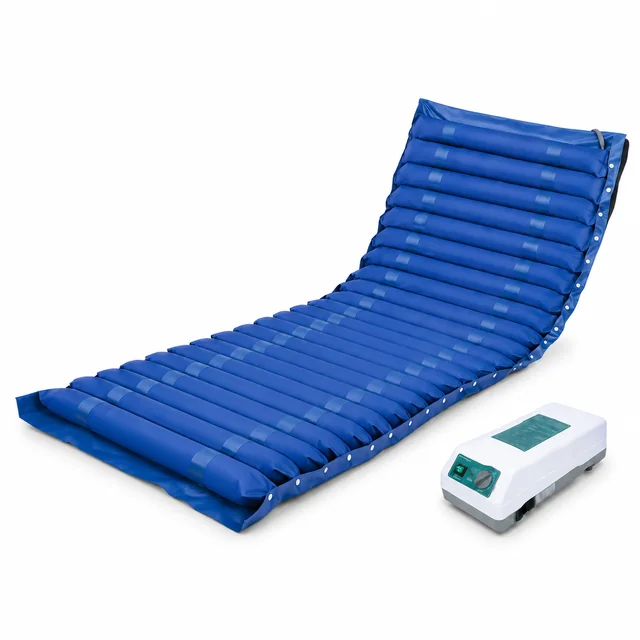
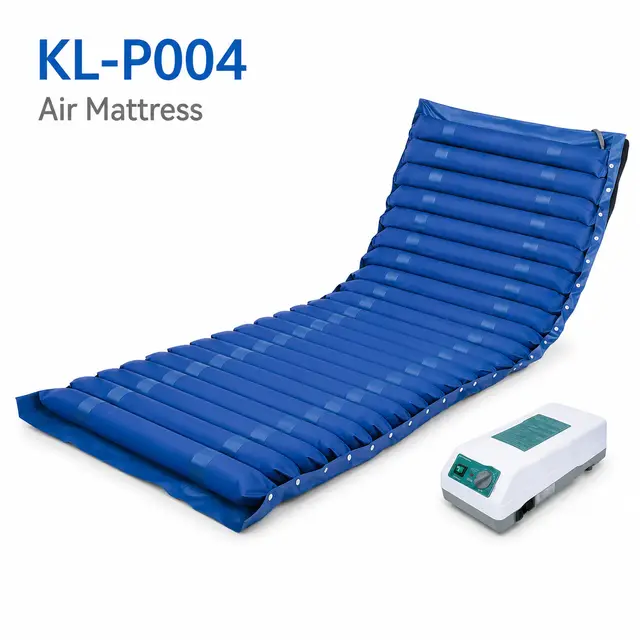
- Match the support surface to risk; see how to prevent bed sores with support surfaces and our KL-P004 alternating-pressure air mattress.
Smooth, wrinkle-free linen also matters for skin; our step-by-step guide on how to make a hospital bed covers occupied bed making.
Choosing a positioning bed for the ward
A positioning bed is any hospital bed whose sections and frame move to support these positions. The function count decides which positions staff can achieve without extra lifting:
| Bed type | Positions supported directly | Keling example |
|---|---|---|
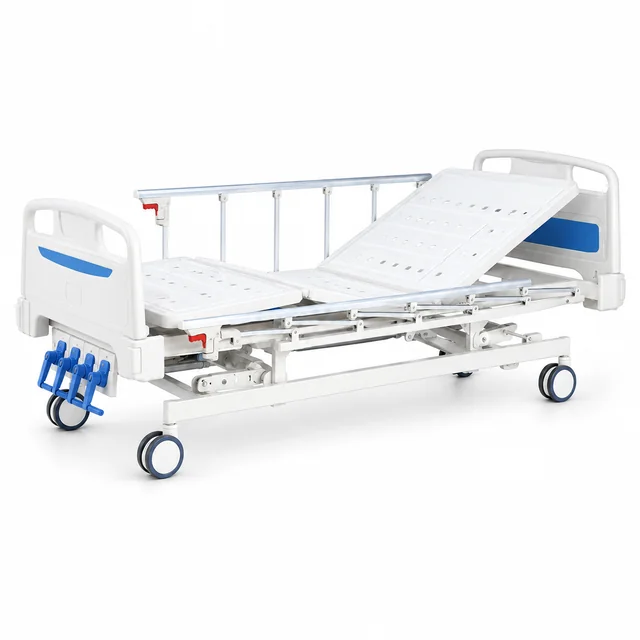
| 2-function | Supine, Fowler family, knee break | KL-BC107 (manual) |
| 3-function | As above plus working height and low height for transfers | KL-BC104 (electric), KL-BC108 (manual) |
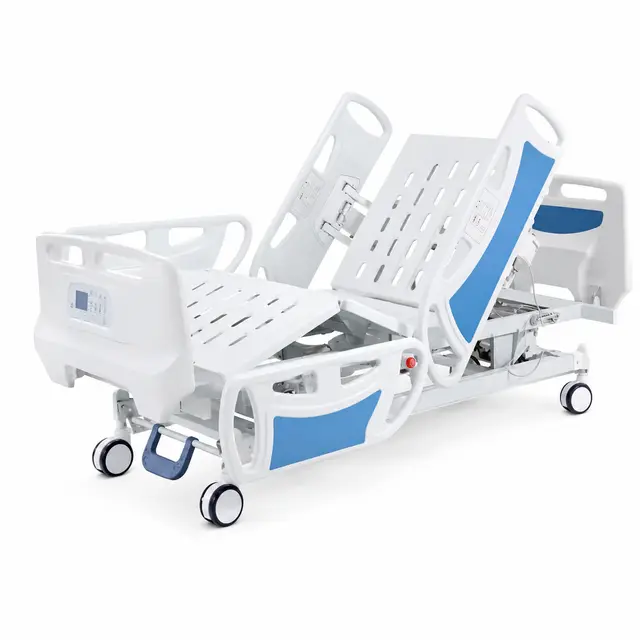
| 5-function | As above plus Trendelenburg and reverse Trendelenburg, cardiac-chair style sitting | KL-BC101, KL-BC103 (electric), KL-BC109 (manual) |
Specification line: Electric hospital bed with backrest 0–70°, knee-rest 0–30° or more, height adjustment approximately 450–760 mm, Trendelenburg and reverse Trendelenburg of at least 12°, backrest angle indicator, CPR release and lockable nurse controls.
Browse the full hospital bed range, or request a quotation with your ward mix and we will match functions to your positioning protocols.
Sources and further reading
- StatPearls: Anatomy, Patient Positioning — Fowler angles, supine, prone, lateral, lithotomy and positioning risks.
- NSW Clinical Excellence Commission: Pressure injury prevention, repositioning and support surfaces — 30° tilt, head-of-bed and heel guidance.
- EPUAP/NPIAP/PPPIA International Pressure Injury Guideline — the international clinical practice guideline on repositioning.
- Guérin C et al. Prone positioning in severe ARDS (PROSEVA), NEJM 2013 — mortality benefit of prolonged prone sessions.
- WisTech Open: Nursing Assistant (CC BY 4.0) — open nursing skills text covering positioning and bed care.
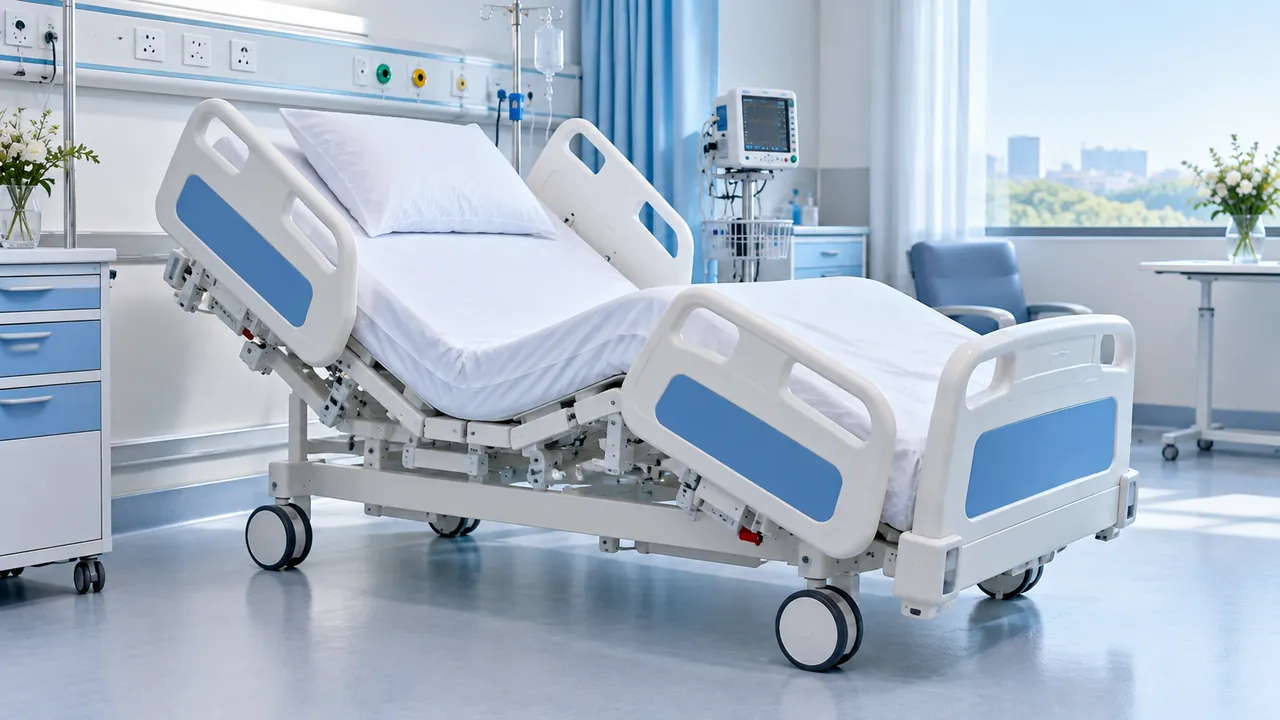
Illustration: AI-generated image for explanation only; it does not show a specific Keling model. See the linked product pages for actual product photos and specifications.
Frequently asked questions
What are the main hospital bed positions in nursing?
The main hospital bed positions are supine, dorsal recumbent, low Fowler's, semi-Fowler's, Fowler's, high Fowler's, lateral side-lying, Sims (semi-prone), prone, and Trendelenburg or reverse Trendelenburg. Each serves a different goal, such as breathing, eating, examination, pressure relief or procedural access, and each needs specific padding and checks to protect skin and nerves.
What is the difference between semi-Fowler's and Fowler's position?
Semi-Fowler's raises the head of the bed about 30–45°, while Fowler's raises it about 45–60°; high Fowler's is 60–90°. Semi-Fowler's is common for ventilated and tube-fed patients and for rest with some elevation. Fowler's suits eating, talking and breathing. Raising the knee-rest first in both helps stop the patient sliding down the bed.
In the lateral recumbent position, how is the patient lying?
In the lateral recumbent position the patient is lying on their side, with head, spine and pelvis aligned, the upper leg flexed and supported by a pillow, and the lower arm positioned to avoid pressure on the shoulder. For pressure relief, guidance favours a 30° lateral tilt supported by a wedge rather than a full 90° side-lying position.
What is the Sims position used for?
The Sims position is a left-sided, semi-prone position with the right hip and knee flexed. It is used for rectal examinations, enemas and suppository administration, for comfort in later pregnancy, and to help drain secretions from the mouth of a drowsy patient. An exaggerated Sims position also appears in obstetric guidance for umbilical cord prolapse.
Why is lying prone good for the lungs?
Lying prone redistributes ventilation and blood flow so more lung tissue takes part in gas exchange, especially in severe acute respiratory distress syndrome. The PROSEVA trial found that prone sessions of at least 16 hours a day reduced 28-day mortality in severe ARDS. Proning ventilated patients requires a trained team and follows the unit's protocol.
How high should you elevate the head of the bed?
It depends on the goal. Ventilator care bundles commonly use 30–45° to reduce aspiration risk, while eating and breathing difficulties may need Fowler's or high Fowler's. For pressure injury prevention, guidance suggests keeping the head as flat as the condition allows, ideally 30° or less, with the knee-rest raised first to limit shear.
About the author
This article was written by the Keling Medical export team, drawing on the engineering data for the 33 bed, cot, mattress and accessory models Keling manufactures at its Yangzhou plant, and checked against the published standards and guidance listed in the sources. Keling Medical has been making medical appliances since 1996 and holds CE, ISO 9001 and ISO 13485 certification. More about Keling.