Hospital bed for home use: choosing a homecare bed for elderly and disabled patients
How to choose a hospital bed for home care: which type suits the user and carer, how to check size and doorways, and which mattress and rails to pair with it.
Short answer
The best hospital bed for home use is usually a three-function electric homecare bed: electric backrest, knee-rest and height, a platform about 900 × 1930 mm, lockable castors, rails tested with the chosen mattress and a lockable handset. Check the bed is documented for home care under IEC 60601-2-52, that it fits through every doorway, and that the mattress matches the user's pressure-injury risk.
A hospital bed for home use has to do two jobs that a ward bed rarely does at the same time: fit into an ordinary house, and be operated safely by family members or visiting carers rather than trained nursing staff. Getting it right makes care at home safer and less physically demanding; getting it wrong can mean a bed that will not go through the bedroom door, or a mattress that undermines the side rails.
This guide is written for home-care and DME suppliers, distributors and care providers choosing beds for elderly and disabled people living at home. It covers the types of homecare bed, sizing, height, mattresses, rails and how people actually obtain a hospital bed at home.
What is a hospital bed for home use?
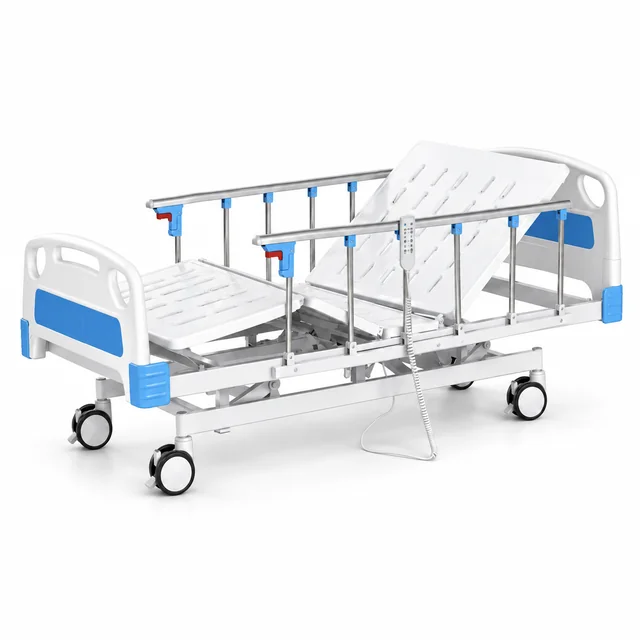
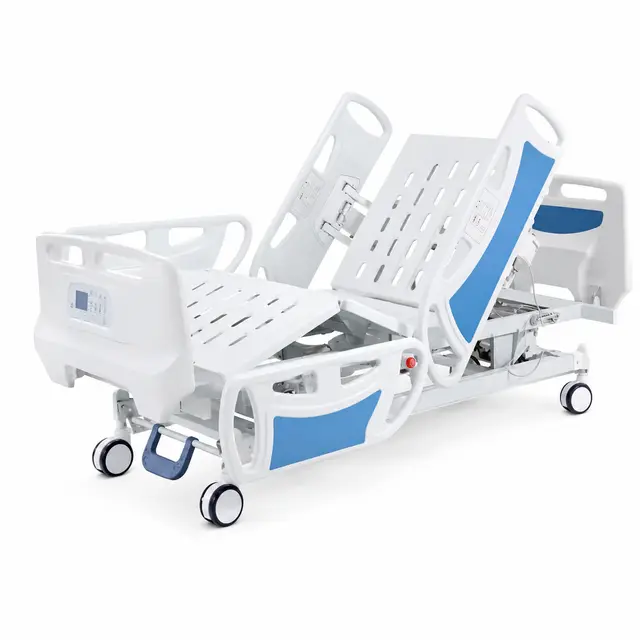
A hospital bed for home use — often called a homecare bed — is a medical bed that adjusts backrest, knee-rest and usually height, intended for care in a private home. It is the same class of device as a ward bed, but it should be designed and documented for a domestic setting.
The medical bed standard IEC 60601-2-52 makes this explicit. It defines application environments: intensive care (1), acute care (2), long-term care in a medical area such as a nursing home (3), care in a domestic area — home care (4) — and outpatient care (5). The new edition, IEC 80601-2-52:2026, extends coverage to settings such as mental-health care. A bed's instructions for use should state which environments it is designed for.
Home care differs from a ward in ways that affect the specification: the operators are lay people; children and pets may reach the handset; the floor may be carpet; the room was not built for a bed; and servicing is less frequent. For an overview of the medical-versus-furniture question, see adjustable bed vs hospital bed.
Types of hospital beds for home use
Home hospital beds fall into five practical types, distinguished by how they are adjusted and who they are for.
| Type | How it adjusts | Best suited to | Keling example |
|---|---|---|---|
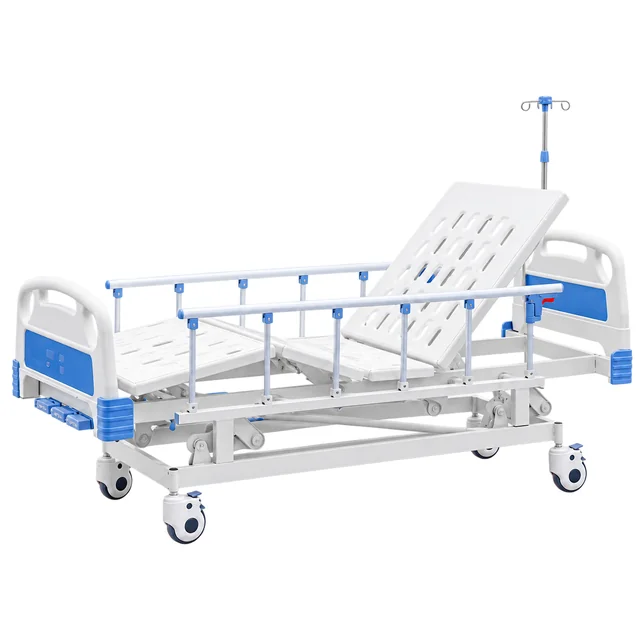
| Manual | Hand cranks for backrest, knee-rest and (on 3-function beds) height | Low budgets, unreliable power, carers able to crank | KL-BC108 (3-function, 450–760 mm) |
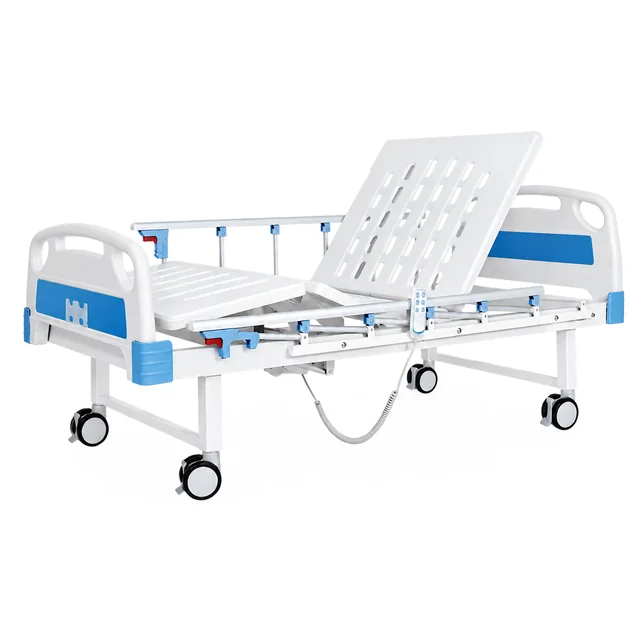
| Semi-electric | Electric backrest and knee-rest; fixed or cranked height | Users who reposition themselves often but need little height change | KL-BC105 (2-function, fixed 450 mm) |
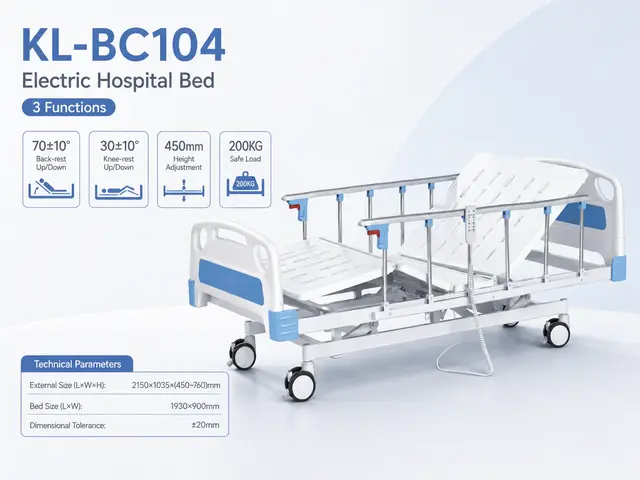
| Full electric | Electric backrest, knee-rest and height | Most home care where a carer gives hands-on help | KL-BC104 / KL-BC104-A (3-function, 450–760 mm) |
| Low or ultra-low | Platform lowers close to the floor | High fall risk, e.g. some people with dementia | Not in Keling's range; see note below |
| Bariatric | Wider frame, higher safe working load | Heavier users | Check SWL; Keling beds are rated 200–240 kg |
For most elderly people at home who need help from a carer, a three-function full electric bed is the best balance: height adjustment protects the carer's back and the user's transfers, and electric controls let the user change position without calling for help. Our comparison of full-electric, semi-electric and manual beds goes into the trade-offs.
Electric or manual: what is better for caregivers?
For a family carer, electric height adjustment is usually the single most valuable feature. A carer may adjust the bed many times a day — up for washing and dressing, down for transfers — and cranking a manual bed through its full height range every time is slow and tiring.
Electric controls also let the user sit up or raise their knees independently, which preserves dignity and reduces calls for help. Manual beds still make sense where mains power is unreliable, where the bed is rarely adjusted, or where budget is the deciding factor; the manual KL-BC108 offers the same 450–760 mm height range as the electric KL-BC104.
Funding rules can push buyers in a different direction. In the US, Medicare covers semi-electric beds when coverage criteria are met but treats the height adjustment on total electric beds as a convenience feature and denies them. Suppliers serving funded US patients therefore need semi-electric beds, such as the KL-BC105 type, alongside full electric models, even though carers benefit from powered height.
What size is a home hospital bed?
Most home hospital beds have a single-bed platform about 900 mm wide and 1900–1930 mm long, with an overall footprint of roughly 2.0–2.2 m by 1.0 m including head and foot boards. A 900 mm platform is the width of a UK single and slightly narrower than a US twin mattress (38 in, about 965 mm), so domestic bedding does not always fit well.
| Model | External size (L × W) | Platform | Height range | Safe working load |
|---|---|---|---|---|
| KL-BC104 (3-function electric) | 2150 × 1035 mm | 1930 × 900 mm | 450–760 mm | 200 kg |
| KL-BC103 (5-function electric) | 2150 × 960 mm | 1925 × 900 mm | 450–760 mm | 240 kg |
| KL-BC105 (2-function electric) | 2150 × 1035 mm | 1930 × 900 mm | Fixed 450 mm | 200 kg |
| KL-BC108 (3-function manual) | 2150 × 1035 mm | 1930 × 900 mm | 450–760 mm | 200 kg |
Before ordering, measure the route as well as the room:
- Doorways and corridors. Measure the narrowest door clear width and every turn on the way. Ask the supplier how the bed is delivered — assembled, or as head end, foot end and platform sections — and the size of the largest piece.
- Stairs and lifts. Check lift car dimensions and stair turns if the bed is going upstairs.
- Room layout. Leave working space on both long sides if two carers or a hoist will be used, and access to a power socket without trailing cables across walkways.
- Living room placement. A living room hospital bed at home keeps the person in family life, but plan privacy, lighting and the route to the toilet.
What is the right bed height for elderly people?
At its lowest, the top of the mattress should let the person sit on the edge of the bed with feet flat on the floor and knees roughly level with the hips; at its highest, it should bring the person to a carer's working height. That is why height range matters more than any single height.
Remember that the mattress adds to the platform height: a bed with a 450 mm minimum and a 100 mm mattress gives a 550 mm sitting height. For shorter users, or people at high risk of falling from bed, a dedicated low or ultra-low bed may be more appropriate than a standard hi-lo bed — Keling's beds start at 450 mm and are not ultra-low beds. Our guide to low hospital beds and fall-risk planning explains the options.
Choosing the mattress for a home hospital bed
A home hospital bed needs a mattress that bends with the bed's sections, is easy to clean and matches the person's pressure-injury risk. Domestic mattresses are usually too wide, too thick or too stiff to articulate.
- Segmented foam, such as the three-section KL-P002 (1900 × 900 mm, 60–150 mm thick), suits most users who can move themselves in bed.
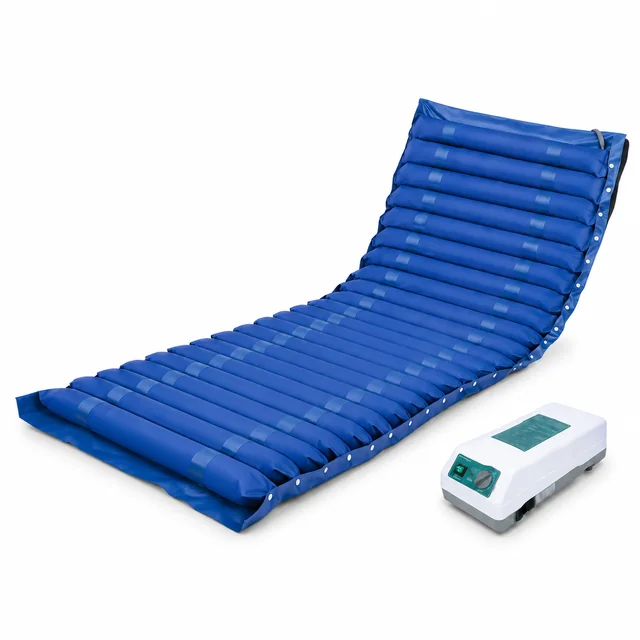
- Alternating-pressure air mattresses, such as the tubular KL-P004 with digital pump, are used for people at higher risk of pressure injuries — a decision for the clinician who assesses the person. See how to prevent bed sores with support surfaces.
Thickness matters for safety: a thicker mattress or overlay reduces effective rail height. The medical bed standard expects rails to stand at least 220 mm above the uncompressed mattress, and MHRA guidance asks for a fresh risk assessment whenever the mattress is changed.
Side rails at home: use them only after assessment
Side rails can help someone turn and stop a sleeping person rolling out, but they also carry entrapment and climbing risks — especially for people who are confused. The US FDA bed safety guide notes that many people can sleep safely without rails, with alternatives including keeping the bed low with wheels locked, transfer aids and meeting needs such as toileting and pain that make people get up.
If rails are used, they should be the ones designed for the bed — such as Keling's KL-HL001 metal or KL-HL002 ABS rails — with gaps checked against the mattress in use. Clinical decisions about rails, mattresses and positioning follow the care provider's protocols and the treating clinician.
How do I get a hospital bed at home?
Most people obtain a hospital bed at home through a clinician's assessment and a funded equipment service, by renting from a home medical equipment company, or by buying one outright.
- US: Medicare covers hospital beds as durable medical equipment for home use when its criteria are met — for example, positioning not possible in an ordinary bed, or the head raised more than 30° most of the time because of congestive heart failure, chronic lung disease or aspiration problems — with an order from the treating practitioner and supply through an enrolled DME supplier.
- Elsewhere: many health systems loan beds through community equipment services after an assessment by a nurse or occupational therapist; private purchase or rental fills the gaps.
- Hospice: patients under hospice care usually receive equipment through the hospice — see hospice and nursing home beds.
The cost of a hospital bed for home depends on functions, mattress, rails, delivery and service. For distributors importing in volume, our article on what drives hospital bed price breaks down a quotation.
Checklist for home-care and DME suppliers
- Application environment stated in the instructions for use includes home care.
- Functions: at least electric backrest and knee-rest; electric height wherever a carer gives hands-on care.
- Height range in mm, and the sitting height with the mattress you will supply.
- Overall size and largest delivery piece versus the client's doors.
- Handset simple enough for lay users, with a lockout for confused users or homes with children.
- Mattress matched to the bed and to the person's assessed risk; rails checked with that mattress.
- Safe working load covering user, mattress and accessories.
- Spare parts, cleaning instructions and a service plan for re-issue between clients.
Specification line: Homecare bed, 3-function electric (backrest 0–70°, knee-rest 0–30°, height 450–760 mm); platform 1930 × 900 mm; lockable castors; integrated side rails tested with the supplied 1900 × 900 mm segmented mattress; handset with function lockout; safe working load 200 kg; IEC 60601-2-52 / IEC 80601-2-52 with home-care application environment; CE marked; manufacturer certified to ISO 13485.
Keling supplies homecare-suitable beds, mattresses and rails to distributors and DME companies. Contact our export team for datasheets and a mixed-container quotation.
Sources and further reading
- Let's get it clear: medical beds (THIIS) — the application environments in the medical bed standard, including home care.
- Hospital beds and accessories — Medicare provider compliance tips (CMS) — coverage criteria for fixed, variable-height, semi-electric and total electric beds.
- A Guide to Bed Safety: Bed Rails in Hospitals, Nursing Homes and Home Health Care (US FDA) — risks of rails and safer alternatives at home.
- Bed rails: management and safe use (MHRA) — risk assessment, gap limits and mattress compatibility.
- IEC 80601-2-52 and medical bed safety (UL Solutions) — the 2026 edition of the medical bed standard.
- International Pressure Injury Guideline (EPUAP/NPIAP/PPPIA) — clinical practice guideline on prevention and treatment of pressure injuries, including support surfaces.
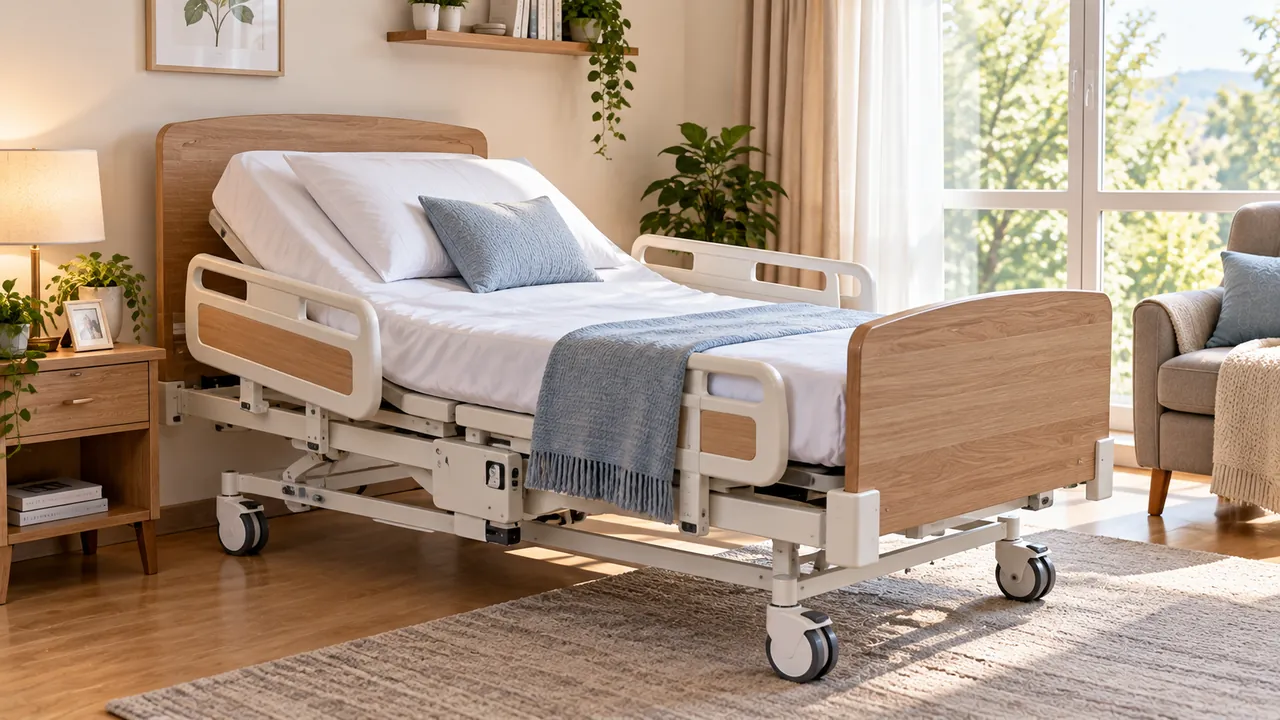
Illustration: AI-generated image for explanation only; it does not show a specific Keling model. See the linked product pages for actual product photos and specifications.
Frequently asked questions
What is the best hospital bed for home use?
For most elderly or disabled people receiving hands-on help at home, a three-function full electric bed is the best fit: electric backrest, knee-rest and height. It lets carers work at a safe height and lets the user change position independently. Add a segmented or pressure-redistributing mattress matched to the person's assessed needs, and rails only after a risk assessment.
How do I get a hospital bed at home?
Usually through a clinician's assessment. In the US, Medicare covers hospital beds as durable medical equipment when coverage criteria are met, with an order from the treating practitioner and supply through an enrolled supplier. In many other countries, community equipment services loan beds after a nurse or occupational therapist assessment. Renting or buying privately are the alternatives.
What are the dimensions of a home hospital bed?
Most home hospital beds have a platform about 900 mm wide and 1900 to 1930 mm long, with an overall footprint of roughly 2.0 to 2.2 m by 1.0 m. Keling's KL-BC104, for example, measures 2150 × 1035 mm overall with a 1930 × 900 mm platform. Always check the largest delivery piece against the narrowest door on the route.
What bed height is best for elderly people?
At its lowest, the top of the mattress should let the person sit on the edge with feet flat on the floor and knees roughly level with the hips. At its highest, it should bring the person to the carer's working height. Remember the mattress adds height: a 450 mm platform with a 100 mm mattress gives a 550 mm sitting height.
Does Medicare pay for an electric hospital bed at home?
Medicare covers semi-electric hospital beds when the patient meets its coverage criteria, for example needing frequent changes in body position. It does not cover total electric beds, because CMS treats powered height adjustment as a convenience feature. Fixed-height, variable-height and heavy-duty beds each have their own criteria set out in the Medicare policy.
Can a hospital bed fit in a normal bedroom?
Usually, yes. A home hospital bed occupies about the same floor area as a single bed plus head and foot boards, roughly 2.2 by 1.0 m. Plan working space on the long sides for carers or a hoist, a nearby power socket, and a clear route through doorways. Ask how the bed is delivered and the size of its largest section.
About the author
This article was written by the Keling Medical export team, drawing on the engineering data for the 33 bed, cot, mattress and accessory models Keling manufactures at its Yangzhou plant, and checked against the published standards and guidance listed in the sources. Keling Medical has been making medical appliances since 1996 and holds CE, ISO 9001 and ISO 13485 certification. More about Keling.