Hospital bed repair and maintenance: common faults, spare parts and service schedules
A practical service guide for hospitals and distributors: what to check and when, how to diagnose the usual faults, and which spare parts to order with the beds.

Short answer
Hospital bed repair is mostly preventable or quick when it is planned. Inspect brakes, rails, handsets and cables between patients, run every function monthly, service fasteners and lubrication every six months, and electrically test electric beds annually. Most faults trace to handsets, actuators, castors or crank gears, so order a model-matched starter kit of these spare parts with the beds.
Most hospital bed repair work is predictable. The same few parts — handsets, castors, actuators, crank gears and side-rail latches — account for the bulk of service calls, and most failures can be caught early by a simple inspection routine. A ward that plans for this keeps beds in service; a ward that does not ends up with a corridor of beds waiting for a part that is six weeks away.
This guide sets out a preventive maintenance schedule, the common faults and how to diagnose them, the hospital bed parts worth ordering with the beds, and how Keling supplies spares. For how the electrical system works in the first place, see how electric hospital beds work.
Hospital bed repair starts with planned maintenance
Hospital bed repair is cheapest when it is planned: inspect on a fixed schedule, follow the manufacturer's instructions, use parts of the same specification and keep a record of every intervention. That is the core of UK MHRA guidance on managing medical devices, and it applies equally to a 20-bed clinic and a 1,000-bed hospital.
The MHRA guidance makes four points every bed owner should build into a service policy:
- Intervals follow the manufacturer. Planned maintenance should be set in line with the manufacturer's instructions; the guidance notes that service intervals for devices generally range between 1 month and 2 years.
- Parts match the original. Replacement parts should come from the manufacturer or be of the same specification, and pre-used parts should not normally be used in a repair.
- Every part is traceable. You should be able to identify every spare part fitted during maintenance or repair of a given bed.
- Only trained people repair. Staff without adequate training should not repair or maintain devices.
In practice that means each bed needs an asset number, a service record and an owner — in-house clinical engineering, the distributor, or a contracted hospital bed repair service.
A preventive maintenance schedule for hospital beds
A workable schedule splits checks into three levels: quick checks by nursing or housekeeping staff, periodic checks by a technician, and an annual inspection with electrical safety testing for electric beds. The table below is a starting framework; the instructions for use for each model take precedence.
| When | Who | What to check |
|---|---|---|
| Between patients / at each clean | Nursing or housekeeping | Castor brakes hold; side rails latch and release; handset and cable undamaged; CPR handle visible; no fluid on control box; mattress cover intact |
| Monthly | Ward staff or technician | Run every function through full travel; listen for grinding or clicking; check nurse lock; inspect castors for wrapped hair and thread; check crank handles fold away |
| Every 6 months | Technician | Tighten frame fasteners and actuator pivot pins; lubricate crank screws and pivots as specified; check side-rail gaps against the rail and mattress in use; test battery charge |
| Annually | Qualified technician | Electrical safety test (protective earth and leakage where applicable); inspect mains cable, strain reliefs and plugs; actuator mounting and wear; full functional test under load; update service record |
Two additions are worth making. First, include bed rails in planned maintenance — MHRA guidance specifically lists worn or loose clamps, cracked welds, stripped threads and damaged plastic parts as faults that create entrapment gaps. Second, re-check the bed, rail and mattress combination whenever any one of the three is replaced.
Common hospital bed faults and how to diagnose them
Most faults reported as "the bed is broken" have a simple cause. Work from the outside in — power, lockout, handset, cables — before replacing an actuator or control box.
| Symptom | Likely causes | First checks | Part usually needed |
|---|---|---|---|
| No function moves | No mains power; nurse lock engaged; handset failed; control box fault | Plug and socket; lockout switch; try a known-good handset | Handset or control box |
| One function will not move | Actuator failed; cable unplugged or damaged; thermal cut-out after heavy use | Let the bed cool for 20 minutes; reseat the actuator plug; swap plugs between actuators to isolate | Actuator |
| Motor runs but section does not move | Stripped gear or loose pivot pin; CPR release partly engaged | Check CPR handle reset; inspect pin and clevis at the actuator rod | Pivot pin, clip or actuator |
| Bed moves on its own or handset button sticks | Fluid ingress into handset; damaged membrane | Disconnect handset and test with a spare | Handset |
| Bed rolls with brakes on | Worn brake pad; contamination on tread; brake lever not fully engaged | Clean tread; check each castor individually | Castor with brake |
| Crank turns but nothing moves (manual bed) | Worn nut or screw; sheared pin; slipped coupling | Remove crank cover; inspect screw and nut | Crank screw assembly or pin |
| Side rail will not latch | Bent rail; worn latch spring; loose mounting | Compare with a rail on another bed of the same model | Rail latch or complete rail |
Electric bed repairs: actuators, control box and handset
Electric hospital bed repair is mostly a matter of swapping modules. Actuators, the control box and the handset connect with plugs, so a technician with a known-good spare of each can isolate a fault in minutes. Do not open sealed actuators or control boxes in the field; return them to the supplier or replace them. After any electrical repair, carry out a functional check of every movement and an electrical safety test before the bed goes back into use.
Manual beds: crank handles and gears
On a manual crank bed, each crank turns a threaded screw that drives a nut or gearbox. The usual failures are wear on the nut, a sheared retaining pin, or a crank handle bent when the bed was pushed into a wall with the handle extended. Keep crank handles folded or stowed when not in use, lubricate screws as the manual specifies, and keep a spare hospital bed crank handle for each model — a bent handle is the most common single repair on manual beds such as the three-function KL-BC108.
When should a bed be taken out of service?
Take a bed out of service immediately if a fault could injure the patient or staff, and label it so it is not returned to use by mistake. Typical triggers:
- a side rail that does not latch, or gaps between rail, mattress and headboard that have opened up;
- brakes that do not hold;
- a damaged mains cable, plug or handset housing, or fluid inside the control box;
- a CPR release that does not work;
- visible cracks or deformation in the frame, lifting arms or welds;
- any movement that starts or stops unexpectedly.
The US FDA received 901 reports of patients caught or trapped in hospital beds between 1985 and 2013, including 531 deaths, which is why rail and gap checks belong in every repair and service visit. Clinical decisions about whether a patient needs rails, and which bed suits them, follow the facility's protocols and the treating clinician.
Which hospital bed parts should you order with the beds?
Order a starter kit of the parts that wear or get damaged most often in the same shipment as the beds. It costs little compared with the freight of a later air shipment, and it means the first faults are fixed in hours rather than weeks.
| Part | Why it fails | Rule-of-thumb starter quantity |
|---|---|---|
| Handset (model-matched) | Dropped, crushed in rails, fluid ingress | 1 per 10–20 electric beds |
| Actuator (one of each type used) | Overload, wear, impact | 1 of each type per 20–30 electric beds |
| Control box | Fluid ingress, power surge | 1 per 30–50 electric beds |
| Backup battery (if fitted) | Ageing | Per manufacturer's replacement interval |
| Castors with brakes and without | Brake wear, impact, debris | 1 set of 4 per 10–20 beds |
| Crank handles (manual beds) | Bent handles | 1 per 10 manual beds |
| Side rails and latch kits | Impact during transport | 1 pair per 20–30 beds |
| Pivot pins, clips, fasteners, bumpers | Lost during service | Small kit per model |
| Mattress covers | Tears, fluid strike-through | Per infection-control policy |
These quantities are a practical starting point, not a rule; adjust them to your fleet's age, patient mix and how far you are from the supplier. Most important is that every part is model-specific: record the bed model, production batch and part numbers on the purchase order so that the same parts can be re-ordered later.
Hospital bed remote control replacement
A replacement hospital bed remote must match the bed's control box — the connector, the number of functions and the lockout logic — not just look similar. A handset from a different system may plug in but drive the wrong actuators, or bypass the nurse lock.
When ordering a hospital bed remote control replacement, quote the bed model and the label on the old handset, and confirm the button layout matches the bed's functions. Consumer adjustable bed wireless remote units are designed for furniture and are not a substitute for a medical bed handset; see adjustable bed vs hospital bed for why the two systems differ.
Replacing hospital bed casters with brakes
Castors take more abuse than any other part of a bed, and worn brakes are a safety issue. When replacing medical casters, match four things: wheel diameter, mounting (stem type and size), brake type, and rated load.
Keling's KL-CA011 castors come in four variants: a 125 mm double-sided wheel with brake, a 125 mm double-sided wheel without brake, and single castors with brake in 100 mm (roughly 4 inch casters with brake) and 125 mm. Swivel casters with brakes are normally fitted at all four corners of a ward bed. Our guide to hospital bed castors, brakes and sizing covers central locking and antistatic options in more detail.
How Keling supplies hospital bed parts and accessories
Keling supplies spare parts and accessories alongside new beds, so they can be loaded in the same container and documented against the same order. The bed accessories and parts range is effectively a hospital bed parts catalog for our own models:
- Castors — KL-CA011, four variants (100 mm and 125 mm, with and without brake).
- Side rails — KL-HL001 aluminium or stainless steel rails in four sizes, and KL-HL002 ABS rails in big and small sizes.
- Headboards — KL-HL003 and KL-HL004 ABS headboards with anti-collision wheels.
- Other hospital bed accessories — KL-LJ045-1 stainless steel IV stand, KL-LJ045 orthopaedic traction frame and KL-CA012 bed head units.
- Mattresses — foam mattresses KL-P001/KL-P002 and air mattresses KL-P003/KL-P004; pump faults are covered in our guide to alternating pressure mattress pump settings.
For electrical spares — actuators, control boxes, handsets and batteries — ask for a model-specific parts list with your quotation and include the starter kit in the order. Distributors running service for their own customers can agree a stocking list for repeat orders, so the same hospital furniture spare parts are always available locally.
Specification line: Supplier to provide, with the beds, a model-specific spare-parts list with part numbers; a starter spare-parts kit (handsets, one actuator of each type, control box, castors with and without brake, crank handles, side-rail latch kit, fasteners) shipped in the same consignment; instructions for use and a service manual in English; recommended preventive maintenance intervals; and availability of the listed spares for repeat orders.
Choosing a hospital bed repair service
Whoever services your beds — in-house clinical engineering, the distributor or an independent hospital bed service provider — should be able to show training on the models concerned, access to genuine or same-specification parts and a records system. Ask a prospective hospital bed repairs and service provider:
- Which bed models have your technicians been trained on?
- Do you carry the handsets, actuators and castors for our models, or order them per job?
- Do you perform electrical safety testing, and to which standard?
- Do you check side-rail gaps and the bed–rail–mattress combination at each visit?
- What is your response time, and do you provide a loan bed?
- How are repairs and parts recorded against each bed's asset number?
Need a parts list for beds you already own, or a starter kit quoted with a new order? Contact the Keling export team with your models and quantities.
Sources and further reading
- Managing medical devices (MHRA) — UK guidance on maintenance intervals, spare parts, records and repairer competence.
- Bed rails: management and safe use (MHRA) — compatibility, gap limits and maintenance checks for bed rails.
- Hospital beds (US FDA) — entrapment reports and the dimensional guidance for reducing entrapment.
- A Guide to Bed Safety: Bed Rails in Hospitals, Nursing Homes and Home Health Care (US FDA) — risks of bed rails and safer alternatives.
- 21 CFR Part 880 Subpart F (eCFR) — US classification of electric and manual hospital beds.
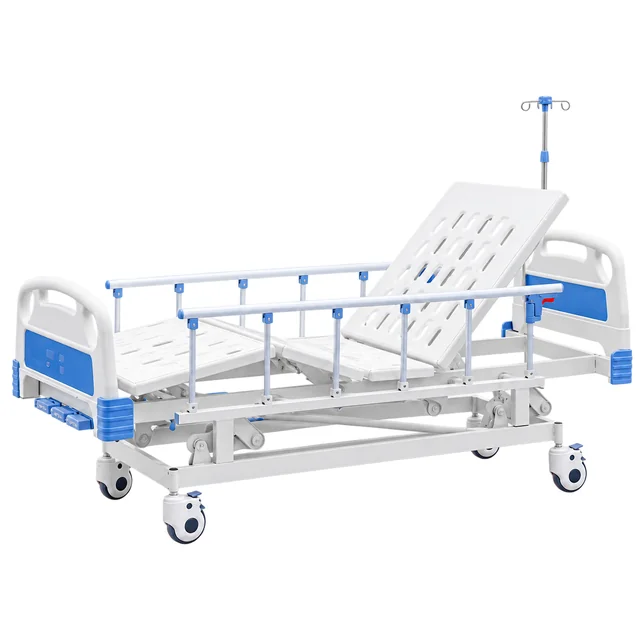
Illustration: AI-generated image for explanation only; it does not show a specific Keling model. See the linked product pages for actual product photos and specifications.
Frequently asked questions
Why is my electric hospital bed not moving?
Check the simple causes first: mains power, the nurse lock, and the handset. If only one function fails, the actuator may have tripped its thermal cut-out after heavy use, so let it cool for about 20 minutes. Then reseat the actuator plug or swap plugs between actuators to isolate the fault before replacing an actuator or control box.
How often should hospital beds be serviced?
Follow the manufacturer's instructions for each model. A common framework is quick checks between patients, a monthly functional check, a technician service every six months and an annual inspection with electrical safety testing for electric beds. UK MHRA guidance notes that device service intervals generally range from one month to two years.
Can I use any remote control on a hospital bed?
No. A hospital bed remote control replacement must match the bed's control box connector, function layout and lockout logic. A handset from another system may plug in but operate the wrong actuators or bypass the nurse lock. Quote the bed model and the label on the old handset when ordering, and test every function after fitting.
Which hospital bed parts should I keep in stock?
Keep model-matched handsets, one actuator of each type, a control box, castors with and without brakes, crank handles for manual beds, side-rail latch kits, pivot pins and fasteners, and mattress covers. Order them with the beds so they ship in the same container, and record part numbers so the same parts can be re-ordered.
How do I replace hospital bed casters?
Match the wheel diameter, the mounting stem type and size, the brake type and the rated load to the original castor. Raise the bed safely, remove the old castor, fit the new one and check that every brake holds before returning the bed to service. Keling's KL-CA011 range covers 100 mm and 125 mm castors with and without brakes.
What should I do if a hospital bed crank stops working?
If the crank turns but the section does not move, the usual causes are a sheared pin, a worn nut on the drive screw or a slipped coupling. Take the bed out of service, remove the crank cover and inspect the screw assembly. A bent crank handle can simply be replaced; keep a spare handle for each manual bed model.
About the author
This article was written by the Keling Medical export team, drawing on the engineering data for the 33 bed, cot, mattress and accessory models Keling manufactures at its Yangzhou plant, and checked against the published standards and guidance listed in the sources. Keling Medical has been making medical appliances since 1996 and holds CE, ISO 9001 and ISO 13485 certification. More about Keling.