Hospital Bed Castors: Central Locking, Antistatic Options and Sizing
Choose hospital bed castors by brake function, diameter, mounting fit and rated load. Understand central locking and antistatic options before replacing wheels.
Hospital bed castors affect how a bed moves through corridors, turns into a lift and remains parked during care. A replacement wheel that looks correct may still have the wrong mounting, brake function or load rating. For fleet purchases, specify the complete castor assembly and its relationship with the bed.
Start with the operating requirement: occasional movement within a ward, regular occupied-bed transport, or a particular specialist environment. Then compare diameter, tread, bearings, braking and fit. This approach gives maintenance teams a repeatable specification instead of a photograph-based reorder.
Medical castors and the complete bed
A wheel supports load, but a castor assembly also includes its fork, swivel mechanism, fixing and possibly a brake. The bed manufacturer should approve that assembly for the intended configuration. A furniture wheel with a similar diameter does not establish suitability for patient-carrying equipment.
Ask for the assembly part number, permitted application, rated loading conditions and service instructions. Keep those details alongside the bed's own documentation. The bed's stated safe working load does not, by itself, specify a suitable replacement castor.
Central locking versus individual brakes
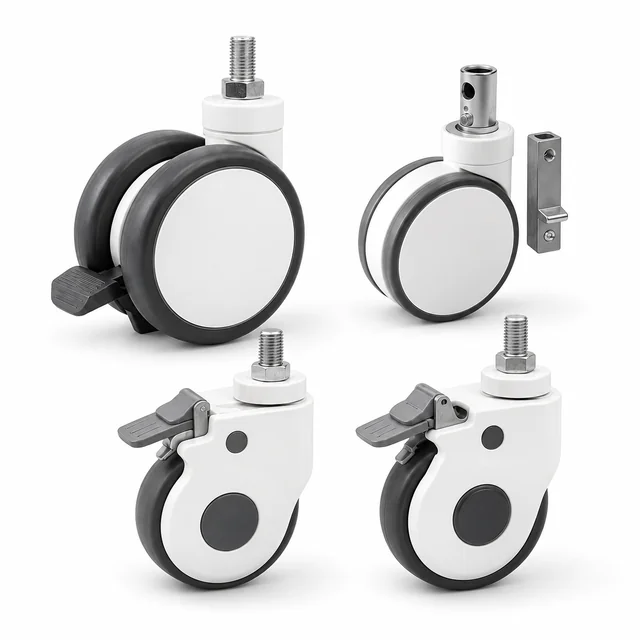
Central locking describes coordinated operation through a linkage or control system. Individual brakes are applied separately at each fitted castor. Also distinguish total lock, which restrains wheel rotation and swivelling, from directional lock, which supports straight travel. These are separate functions, as illustrated in TENTE's medical castor range.
For an existing centrally operated bed, record the actuation interface, linkage geometry and operating positions. A castor with a local brake pedal is not automatically a replacement for one driven by the bed's central mechanism.
During sample assessment, ask staff to demonstrate parking, release and steering. Check whether the controls are accessible with the bed in its intended working positions and whether their state is obvious. The maintenance handover should explain how brake operation is checked and adjusted according to the manufacturer's instructions.
Diameter and load capacity
Changing wheel diameter can change overall bed height, under-bed clearance and the relationship with accessories. Compare the complete installed height, not just the nominal wheel diameter. A proposed upgrade to a larger wheel therefore needs a fit review.
For load selection, include the bed's own weight and all permitted carried load. The number of supporting castors and the operating conditions affect the required rating; simply dividing by four can overlook unequal support and service conditions. Blickle's load-capacity guide explains this distinction. Have the bed or castor manufacturer confirm the suitable rating rather than choosing a safety factor without an engineering basis.
Bariatric Hospital Beds: Width, Safe Working Load and Patient Fit explains why load suitability must also be assessed at the complete bed level. Higher-rated wheels alone do not upgrade the frame, lifting system, brakes or patient capacity.
Antistatic and conductive options
Antistatic and electrically conductive castors are specified for defined electrical-resistance requirements. They should not be treated as interchangeable labels or assumed to be mandatory in every ward. Blickle identifies both categories within its ESD range.
If the project requires controlled electrical resistance, ask the facility's engineering team to define the criterion and verification method for the installed system. Request supporting documentation for the exact wheel compound and assembly. Colour, a dark tread or a general “medical grade” description does not establish the required property.
Tread, floor condition and steering
Test the proposed castor on representative flooring, including joints and thresholds along the actual route. Evaluate starting effort, turning, vibration, noise and visible floor marking using an agreed demonstration method. Compare beds with the same representative load so the assessment is meaningful.

Record the cleaning process as well. Hair and debris around axles, damaged tread and inaccessible surfaces can create maintenance problems even when the new castor initially rolls well. Ask how the assembly is inspected and which parts can be replaced.
Replacement information to collect
| Item | What the supplier needs |
|---|---|
| Bed identity | Manufacturer, model and production reference |
| Castor identity | Original part number and photographs |
| Mounting | Stem or plate dimensions, fixing method and installed height |
| Brake system | Individual or central operation; required locking positions |
| Operating requirement | Load, transport route, floor condition and environment |
| Service requirement | Cleaning method, spare parts and installation instructions |
Do not mix different assemblies across the same bed without approval. A wheel that is taller or actuates differently can affect bed behaviour. After replacement, use the manufacturer's inspection procedure before returning the bed to service.
Keling castor options
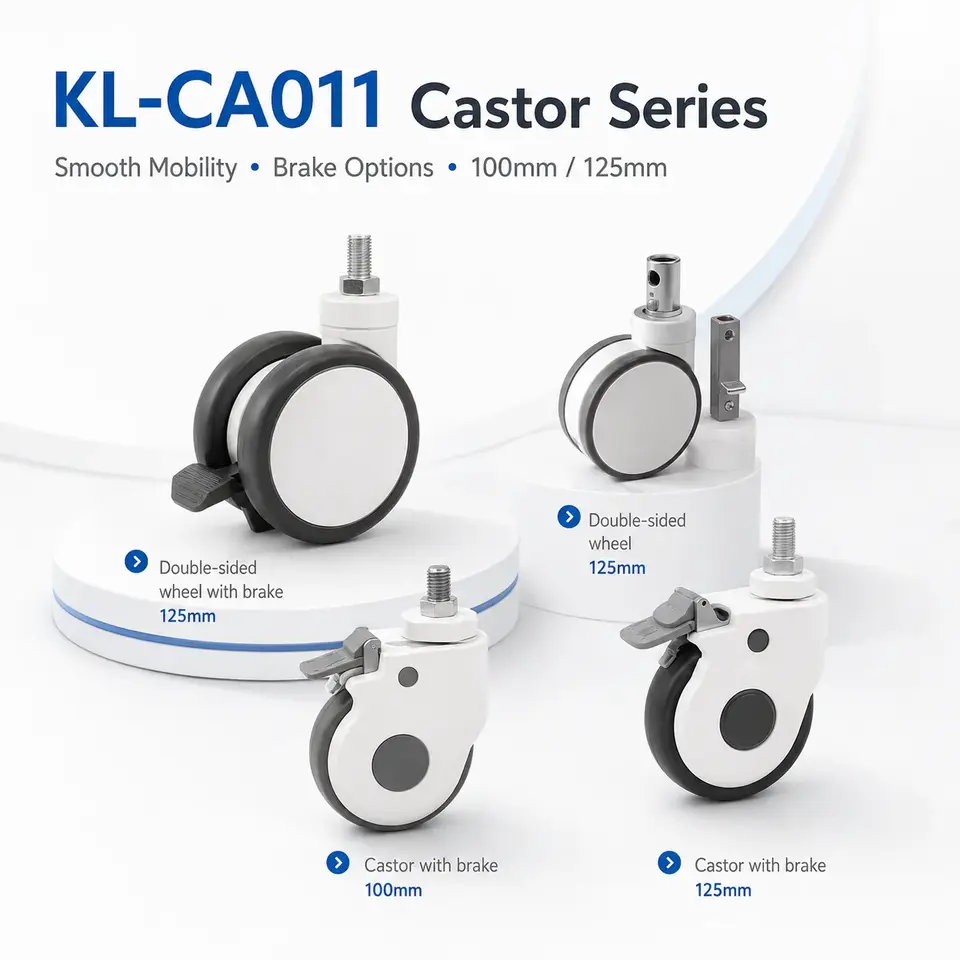
The KL-CA011 castor range lists four configurations: 125 mm double-sided wheels with or without a brake, plus braked castors in 100 mm and 125 mm sizes. These descriptions do not establish central-linkage compatibility, electrical resistance or a load rating for a particular bed. Request those details for the proposed variant.
For a distributor supply programme, keep each approved configuration under a distinct stock reference. Pair castor stock planning with Hospital Bed Head and Foot Boards: Materials, Detachable Designs and Hygiene so replacement components can be identified consistently across the fleet.
Frequently asked questions
Is 125 mm the right size for every hospital bed?
No. Confirm the approved wheel diameter, installed height and mounting for that bed. Diameter alone does not establish compatibility.
Can individual brakes be converted to central locking?
Only through an approved design that accounts for the linkage, actuators, mountings and castor functions. Replacing the wheels alone may not provide the required system.
Do higher-capacity castors increase the bed's safe working load?
No. The complete bed rating remains controlling unless the manufacturer formally approves and documents a revised system.
Are antistatic castors included in the standard price?
Confirm this explicitly. Require the relevant property and evidence to appear in the quotation for the selected variant.
Next step
Send Keling the castor reference, mounting details and bed configuration to request a replacement or fleet-order quotation.
About the author
This article was written by the Keling Medical export team, drawing on the engineering data for the 33 bed, cot, mattress and accessory models Keling manufactures at its Yangzhou plant. Keling Medical has been making medical appliances since 1996 and holds CE, ISO 9001 and ISO 13485 certification. More about Keling.