How electric hospital beds work: actuators, control boxes, handsets and batteries
Motors, a control box, a lockable handset, a CPR release and a backup battery: what each part of an electric hospital bed does, and what to check on the datasheet.

Short answer
An electric hospital bed works by using low-voltage DC linear actuators — small motors driving threaded spindles — to move the backrest, knee-rest and platform height. A control box converts mains power to low voltage and coordinates the actuators, a handset with nurse lock sends commands, a CPR release flattens the backrest without power, and an optional battery keeps the bed moving during power cuts.
An electric hospital bed looks simple from the outside: press a button and part of the bed moves. Inside, it is a small, safety-critical electromechanical system — motors, a control box, a handset with lockouts, an emergency release and often a battery — built to a dedicated medical bed standard. Knowing how those parts work is the quickest way to write a better specification, train staff properly and diagnose problems when something stops moving.
This guide explains the drive system component by component. If you are still deciding how many functions you need, start with our guide on what each hospital bed function does; if you are choosing between drive types, see full-electric vs semi-electric vs manual beds.
What is an electric hospital bed?
An electric hospital bed is a medical bed in which built-in electric motors, operated from a handset or control panel, change the bed's height and the contour of the mattress platform. US federal regulations describe exactly this: an AC-powered adjustable hospital bed has "a built-in electric motor and remote controls" and is a Class II medical device (21 CFR 880.5100), whereas a manual bed adjusted by crank is Class I.
The term covers several configurations:
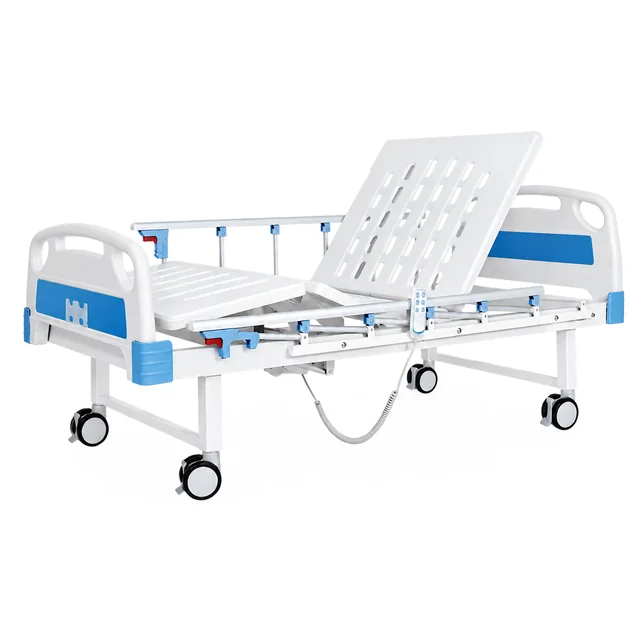
- Semi electric hospital bed — backrest and knee-rest are motorised; height is fixed or adjusted by crank. Our KL-BC105 is a two-function electric bed with a fixed 450 mm height.
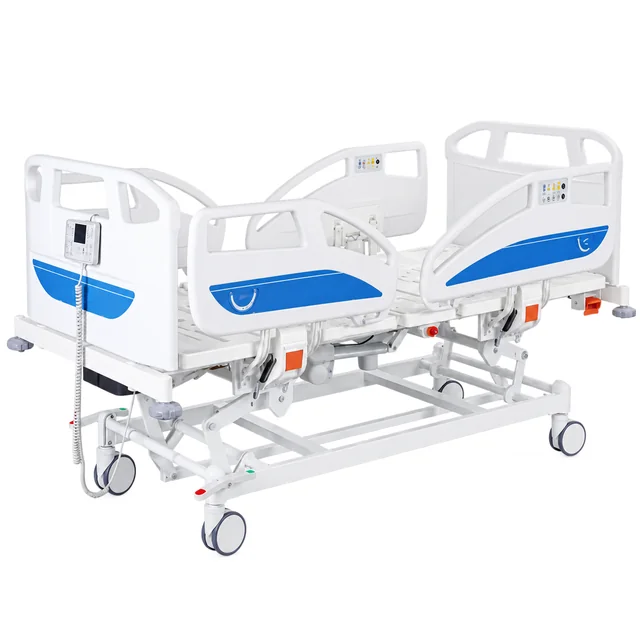
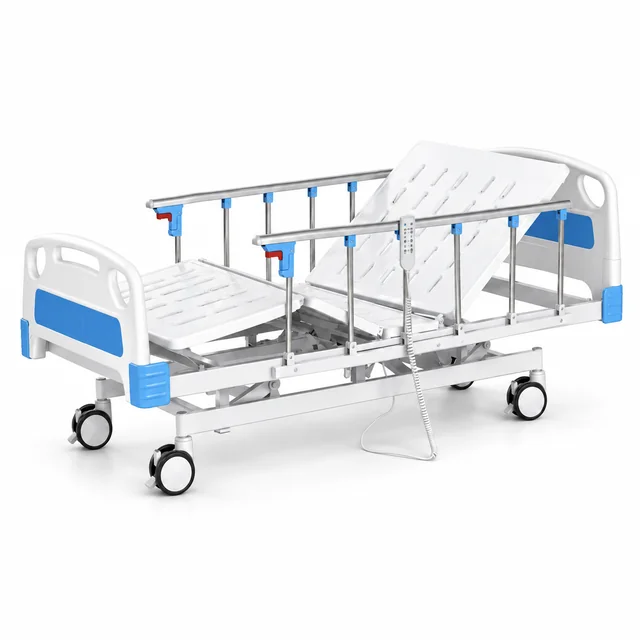
- Full electric hospital bed — backrest, knee-rest and height are all motorised, as on the three-function KL-BC104 (450–760 mm).
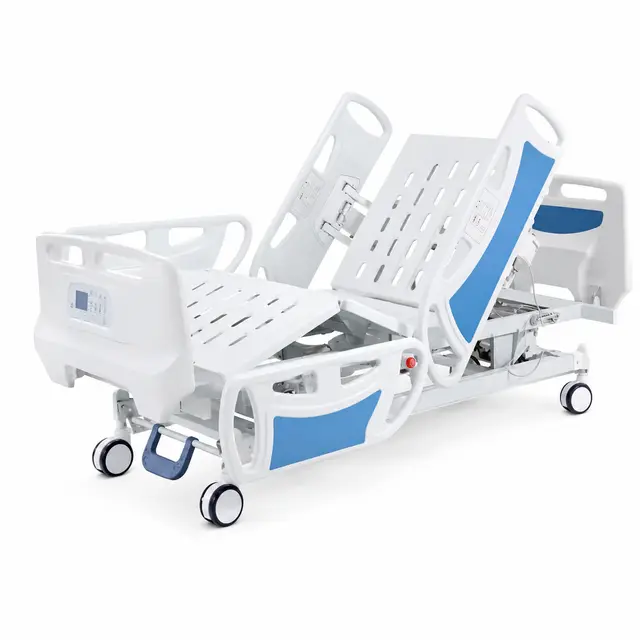
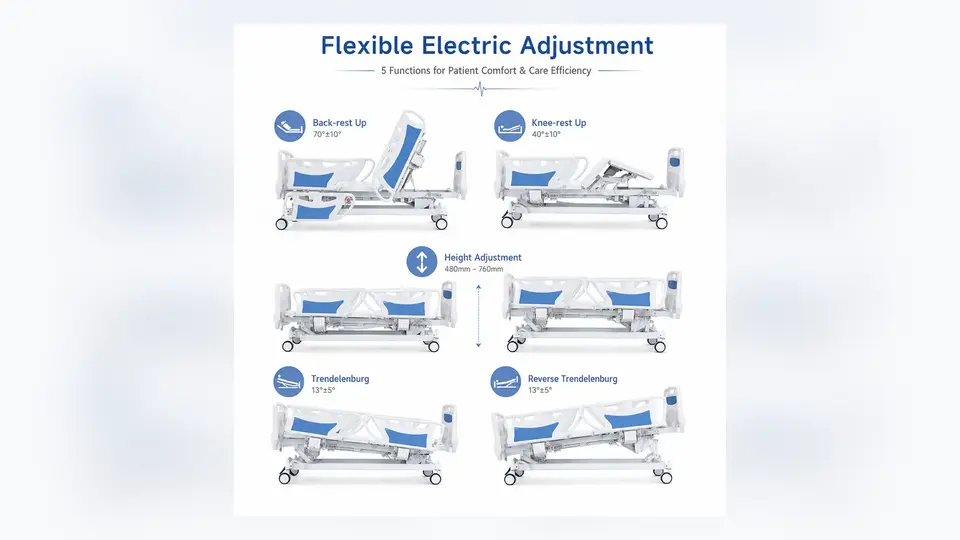
- Five-function full electric medical bed — adds Trendelenburg and reverse Trendelenburg tilt, as on the KL-BC101 and KL-BC102.
Whatever the configuration, the same building blocks appear: actuators, a control box, controls and a set of safety features.
Linear actuators: the motors that move the bed
A linear actuator is a sealed unit that turns the rotation of a small DC motor into a straight push or pull. Every powered movement on an electric bed is made by one or more actuators.
Inside the housing, the motor drives a worm gear, which turns a threaded spindle. A nut on the spindle is fixed to an inner tube (the piston rod), so as the spindle turns the rod extends or retracts. The rod is pinned to a lever on the bed frame, and the lever lifts the backrest, the knee section or the height linkage. Limit switches stop the motor at each end of travel.
Two properties matter to a buyer:
- Self-locking. The spindle and gear are chosen so that load on the bed cannot back-drive the motor. When power is removed, the section stays where it is — the backrest does not fall because a plug was pulled.
- Thrust rating. Each actuator is rated for a maximum push or pull force. The bed manufacturer sizes actuators against the bed's safe working load plus the geometry of the lever, which is why actuators should only be replaced with parts of the same specification.
How many actuators a bed has follows from its functions:
| Function | Typical actuator arrangement | What to check on a datasheet |
|---|---|---|
| Backrest | One actuator under the head section | Angle range (e.g. 0–70°), angle indicator, CPR release |
| Knee-rest | One actuator under the thigh section | Angle range (e.g. 0–30° or 0–40°) |
| Height (hi-lo) | Usually two actuators, head end and foot end | Minimum and maximum platform height in mm |
| Trendelenburg / reverse | The two height actuators driven in opposite directions | Tilt angle in degrees (e.g. 12° or 13°) |
| Auto-contour / chair positions | Combined movements of the actuators above, run by the control box | Which preset positions the handset offers |
This is why a five-function bed does not need five motors: on most designs, Trendelenburg is simply the head-end and foot-end height actuators running in opposite directions.
The control box and power supply
The control box is the bed's brain and power converter. Mains power (typically 100–240 V AC, depending on market) enters the control box, which converts it to low-voltage DC — commonly 24 V DC — for the actuators and handset. Keeping the motors and controls at low voltage reduces the electrical risk close to the patient and the carer.
The control box also:
- receives commands from the handset and attendant panel and switches the correct actuators;
- synchronises the two height actuators so that the platform rises level, and runs them in opposition for tilt;
- applies current limits and thermal protection so an overloaded or overheated motor stops rather than burns out;
- hosts the battery connection where a backup battery is fitted.
For buyers, the practical points are voltage and plug type for your country, the length and routing of the mains cable (it must not be pinched by the moving frame), and whether the control box is a separately replaceable module. A modular system keeps repairs and spare parts simple: a technician swaps the failed unit rather than rewiring the bed.
Handset, attendant controls and nurse lock
The handset is the patient's and carer's interface; the nurse lock decides which of its buttons actually work. On most beds the handset hangs on the side rail by a hook and connects to the control box by a coiled cable.
A well-designed control layout includes:
- Patient handset with large, clearly symbolised buttons for each movement. Movements run only while a button is held (hold-to-run), so the bed stops the moment it is released.
- Attendant control panel on the footboard or side rail on higher-specification beds, giving staff full control and access to tilt functions without reaching for the handset.
- Nurse lock (function lockout) — a key, switch or code that disables some or all handset functions. Staff use it to stop a confused patient raising the bed to a dangerous height, tilting the bed or moving it during a procedure.
The KL-BC101 and KL-BC102 both have a nurse lock. If a bed will be used by patients with cognitive impairment, or in a home where children are present, treat function lockout as a requirement rather than an option.
CPR release, emergency lowering and battery backup
A CPR release is a mechanical or electrical function that brings the backrest to flat within seconds so that chest compressions can start on a firm, horizontal surface. On many beds it is a red handle on one or both sides of the backrest.
A mechanical CPR release disengages the backrest actuator from its mounting (or releases a clutch), so the backrest drops under its own weight and the patient's. Good designs damp the descent so the section lands without a jolt. Because it is mechanical, it works with the power off and the battery flat — the scenario you most need to plan for.
Two related features are worth asking about:
- Controlled return. The KL-BC102 has a dual return mechanism that controls the rate at which the backrest returns to flat, giving a smooth, damped movement rather than a sudden drop.
- Emergency lowering. Some beds can lower the platform without mains power, using the battery or a manual release. Ask how the bed is brought down if the power fails with the patient at maximum height.
CPR release handles should be tested as part of routine checks and must be clearly visible; staff need to find them without looking.
Battery backup: what it does and what it does not
A backup battery is a rechargeable pack, connected to the control box, that lets the bed move when mains power is unavailable. It is an optional accessory on the KL-BC101, KL-BC102 and the KL-BC110 birth bed.
It is useful in three situations: during a power cut, while the bed is being moved between rooms with the plug disconnected, and when the patient needs to be lowered or repositioned before the bed can be plugged in again. It is not intended to run a bed for days. The battery recharges from the mains whenever the bed is plugged in, and — like any rechargeable battery — loses capacity with age, so it should be treated as a consumable with a planned replacement interval set by the manufacturer's instructions.
Specify a battery where power is unreliable, where beds are moved frequently with patients in them, or where emergency lowering without mains power is part of your risk assessment.
What does duty cycle mean on an electric bed?
Duty cycle is the proportion of time an actuator can run before it needs to rest and cool. Bed actuators are designed for intermittent use; a rating of 10% is common, often expressed as a maximum of 2 minutes of continuous running followed by 18 minutes of rest.
In normal nursing use this is never a constraint: a full height travel takes well under a minute, and a bed is adjusted a handful of times an hour at most. It becomes relevant in three cases:
- Demonstrations and acceptance testing, where someone runs the bed up and down repeatedly. Thermal protection may stop the motor; it will work again once cool. This is not a fault.
- Heavy patients. A bariatric electric hospital bed runs its actuators closer to their rated load, which generates more heat. Use a bed rated for the patient, not a standard bed at its limit.
- Misuse, such as a patient repeatedly cycling the bed. Nurse lock solves this.
Always check the duty cycle stated in the instructions for use for the specific bed rather than assuming a figure.
IP ratings, cleaning and electrical safety
An IP rating (defined in IEC 60529) states how well an enclosure resists solids and water; for a bed, the second digit — water — is the one that matters. It decides how the bed can be cleaned.
- IPX4 — protected against splashing water from any direction. Suitable for wipe-down cleaning with a damp cloth and disinfectant.
- IPX6 — protected against powerful water jets. Needed if beds will go through a wash bay or be hosed down.
The rating applies to each component — actuators, control box, handset — and the whole system is only as good as its weakest part. Match the rating to your cleaning protocol, never use a pressure washer on a bed not rated for it, and check cables and handset housings for cracks during maintenance, because a damaged seal lets fluid reach the electronics.
Which standards apply to electric hospital beds?
Electric hospital beds are tested to the general medical electrical safety standard plus a particular standard for medical beds.
- IEC 60601-1 — general requirements for basic safety and essential performance of medical electrical equipment (electrical insulation, leakage current, mechanical hazards).
- IEC 60601-1-2 — electromagnetic compatibility, so the bed neither disturbs nor is disturbed by nearby equipment.
- IEC 60601-2-52 — particular requirements for medical beds, including side-rail dimensions, entrapment gaps, safe working load testing and the application environments a bed is designed for, from intensive care (1) and acute care (2) to long-term care (3), domestic home care (4) and outpatient care (5). It has now been superseded by IEC 80601-2-52:2026, which extends coverage to settings such as mental-health care; confirm which edition your market and tender reference.
In Europe a bed is placed on the market with CE marking under the Medical Device Regulation; in the US, under FDA rules. Keling beds are CE marked and manufactured under ISO 9001 and ISO 13485.
Semi electric vs full electric hospital bed: what changes mechanically?
The difference is the height drive. A semi electric bed has actuators for the backrest and knee-rest only; a full electric hospital bed adds powered height (and, on five-function beds, tilt). Mechanically, that means two more actuators and a control box able to synchronise them.
The height actuators — the part that makes it an electric lift bed — are what make a high low electric hospital bed useful for carers: platform height can be dropped for safe transfers and raised to working height for care. They are also the most heavily loaded actuators on the bed. For electric beds for elderly patients and electric hospital bed home use, height adjustment is usually the function that makes the biggest difference to carers — see our guide to choosing a hospital bed for home use. Electric hospital bed price rises with each actuator and with options such as battery, nurse lock and weighing system.
Specification checklist for the drive system
Use this list when comparing an electric hospital bed for sale from different suppliers, and ask for the instructions for use and test reports — not just the brochure.
- Number of actuators and which functions each drives.
- Supply voltage, plug type and low-voltage DC system voltage.
- Duty cycle and thermal protection of the actuator system.
- IP rating of actuators, control box and handset, matched to your cleaning method.
- Handset type, attendant panel and nurse lock (which functions can be locked).
- CPR release type and whether it works without power.
- Battery backup: optional or standard, and replacement interval.
- Standards listed in the test report (IEC 60601-1, IEC 60601-1-2, IEC 60601-2-52 or IEC 80601-2-52) and the application environment claimed.
- Availability of actuators, control boxes and handsets as spare parts, and a compatible headboard for the electric bed (such as the ABS KL-HL003) if you need replacements.
Specification line: Five-function electric hospital bed; backrest 0–70°, knee-rest 0–30°, height 450–760 mm, Trendelenburg/reverse Trendelenburg 12°; low-voltage DC actuator system with thermal protection; patient handset with nurse lock; mechanical CPR release operable without power; optional backup battery; safe working load 240 kg; tested to IEC 60601-1 and IEC 60601-2-52 (or IEC 80601-2-52); CE marked; manufacturer certified to ISO 13485.
To compare Keling's electric models side by side, see the hospital beds range or contact our export team for datasheets, wiring diagrams and spare-parts lists.
Sources and further reading
- 21 CFR Part 880 Subpart F — General hospital and personal use therapeutic devices (eCFR) — FDA identification and classification of AC-powered, hydraulic and manual hospital beds.
- EN IEC 80601-2-52:2026 — Medical beds for adults (EVS catalogue) — scope of the new particular standard for medical beds.
- IEC 80601-2-52 and medical bed safety (UL Solutions) — summary of how the 2026 edition replaces IEC 60601-2-52:2009+AMD1:2015.
- Let's get it clear: medical beds (THIIS) — overview of the application environments and side-rail requirements.
- Managing medical devices (MHRA) — UK guidance on acquisition, maintenance and repair of reusable medical devices.
Illustration: AI-generated image for explanation only; it does not show a specific Keling model. See the linked product pages for actual product photos and specifications.
Frequently asked questions
How does an electric hospital bed work?
Each powered movement is made by a linear actuator: a DC motor drives a worm gear and threaded spindle that pushes a rod against a lever on the bed frame. A control box converts mains power to low-voltage DC and switches the actuators in response to the handset. Self-locking gearing holds each section in place when the motor stops or power is removed.
What is the difference between a semi electric and a full electric hospital bed?
A semi electric hospital bed has motorised backrest and knee-rest, but its height is fixed or adjusted by hand crank. A full electric hospital bed also has motorised height adjustment, using two additional actuators at the head and foot ends. Five-function full electric beds run those height actuators in opposite directions to provide Trendelenburg and reverse Trendelenburg tilt.
Can an electric hospital bed work during a power cut?
Only if it has a backup battery or a manual emergency function. The actuators are self-locking, so the bed holds its position when power fails, and a mechanical CPR release can still flatten the backrest. A backup battery, optional on models such as the KL-BC101 and KL-BC102, allows limited movement, for example lowering the patient, until mains power returns.
Why does my electric bed stop working after repeated use?
Most likely the actuator's thermal protection has tripped. Bed actuators are rated for intermittent use, commonly a 10% duty cycle such as 2 minutes running followed by 18 minutes rest. Running the bed up and down continuously, as often happens during demonstrations, overheats the motor. Leave it to cool; if it still does not move, check the handset, nurse lock and cables.
What is a nurse lock on a hospital bed?
A nurse lock is a key, switch or code that disables some or all functions on the patient handset. Staff use it to stop a patient raising the bed to an unsafe height, tilting it or moving it during care. It is particularly important for patients with confusion or dementia and in homes where children could reach the handset.
Which standard applies to electric hospital beds?
Electric hospital beds are tested to IEC 60601-1 for general electrical safety, IEC 60601-1-2 for electromagnetic compatibility and IEC 60601-2-52 for medical beds. The particular bed standard has been superseded by IEC 80601-2-52:2026, so check which edition your tender or regulator references and ask suppliers for the matching test reports.
About the author
This article was written by the Keling Medical export team, drawing on the engineering data for the 33 bed, cot, mattress and accessory models Keling manufactures at its Yangzhou plant, and checked against the published standards and guidance listed in the sources. Keling Medical has been making medical appliances since 1996 and holds CE, ISO 9001 and ISO 13485 certification. More about Keling.