Crib dimensions and crib mattress size: standard crib sizes, cot sizes and hospital crib measurements
Standard crib size in the US and Europe, the minimum crib mattress size, how to check fit with the two-finger test, and the dimensions of hospital cribs and bassinets.

Short answer
Standard crib dimensions in the US are fixed for full-size cribs: an interior of 28 ± 5/8 in by 52 3/8 ± 5/8 in (71 × 133 cm) under 16 CFR 1219. The crib mattress must be at least 27 1/4 by 51 5/8 in and, per crib labelling, no more than 6 in thick. European cots are commonly 60 × 120 or 70 × 140 cm, under EN 716.
Crib dimensions look like a simple number, but the answer depends on where the crib will be used and what kind of crib it is. A US full-size crib has a regulated interior size; European cots come in several common sizes within a range set by EN 716; and hospital cribs and bassinets are medical devices built to a different brief altogether.
This guide gives the standard crib size and crib mattress size for each case, explains how to check that a mattress fits, and lists the dimensions of Keling's hospital cribs, bassinets and paediatric cots for buyers who need to plan rooms and order matched mattresses. For mattress materials, firmness and covers, see our separate guide to hospital crib mattresses and infant bed safety.
What are standard crib dimensions?
In the United States, a full-size crib has an interior of 28 ± 5/8 in wide by 52 3/8 ± 5/8 in long (71 ± 1.6 cm by 133 ± 1.6 cm). This is the regulated standard crib size under 16 CFR part 1219, which incorporates ASTM F1169. Every compliant full-size crib sold in the US has the same interior opening, which is why a full-size crib mattress fits any full-size crib.
In feet, the standard crib size is roughly 2.3 ft wide by 4.4 ft long inside. External crib bed measurements are larger and vary with the frame, rails and any drawers, so check the product sheet when planning floor space or doorways.
| Crib type | Interior size | Mattress size | Rule or standard |
|---|---|---|---|
| US full-size crib | 28 ± 5/8 × 52 3/8 ± 5/8 in (71 × 133 cm) | At least 27 1/4 × 51 5/8 in (690 × 1310 mm); no more than 6 in (15 cm) thick per the crib warning label | 16 CFR 1219 (ASTM F1169); mattresses 16 CFR 1241 |
| US non-full-size crib (mini, portable, oversized) | Interior length over 55 in or under 49 3/4 in, or width over 30 5/8 in or under 25 3/8 in | Only the mattress supplied or specified by the crib maker | 16 CFR 1220 (ASTM F406) |
| European cot | Internal length over 900 mm and up to 1400 mm | Commonly 60 × 120 cm or 70 × 140 cm (cot bed) | EN 716-1 and EN 716-2 |
| European crib or cradle | Internal base length up to 900 mm | Specified by the maker | EN 1130 |
| Hospital crib or bassinet | Set by the manufacturer | Model-matched mattress | Medical device rules; see below |
What size is a crib mattress?
A full-size crib mattress must measure at least 27 1/4 in wide and 51 5/8 in long (690 × 1310 mm) under 16 CFR part 1241, the US crib mattress standard. US full-size crib warning labels have long added that the mattress should be no more than 6 in (15 cm) thick, because a thicker mattress reduces the effective height of the crib sides.
The gap between the minimum mattress and the maximum crib interior is deliberately small: at most about 1 3/8 in in width and 1 3/8 in in length when both are at the extremes of their tolerances. A mattress smaller than the minimum, or a crib larger than the tolerance, opens a gap at the edge where an infant's face or body could become wedged.
Non-full-size cribs have no single standard mattress size. A mini crib, portable crib or oversized crib should be used only with the mattress its manufacturer supplies or names, and after-market mattresses for these products have their own requirements in 16 CFR 1241.
European cot sizes and EN 716
In Europe, the regulated range is wider than in the US. EN 716-1 covers children's cots and folding cots for domestic use with an internal length greater than 900 mm and not more than 1400 mm. Smaller cribs and cradles fall under EN 1130.
Within that range, two sizes dominate the market:
- 60 × 120 cm, the common cot size, typically used until about two years of age.
- 70 × 140 cm, the common cot bed size, which converts to a toddler bed.
Because the standard allows a range, European cots are not all the same size, and buyers should order the mattress to the cot's stated internal dimensions. EN 716 also controls the openings around the mattress: accessible gaps must be under 7 mm, between 12 and 25 mm, or between 45 and 65 mm, so that fingers and heads are either kept out or not trapped. Test reports to EN 716 also check that there is no gap of more than 30 mm between the mattress and the sides.
How to check crib mattress fit: the two-finger test
The two-finger test is the simplest field check of mattress fit: push the mattress firmly to one side and try to fit your fingers in the gap on the other side. If more than two fingers fit between the mattress and the crib, the mattress is too small.
- Push the mattress hard against one long side and one end.
- Check the gap on the opposite side and end, including the corners.
- Repeat with the mattress pushed the other way.
- Press down near the edge: a soft edge that compresses away from the side opens a larger gap than the static measurement suggests.
- Check the fitted sheet does not pull the mattress corners up or inwards.
The test is a quick check, not a substitute for buying the specified mattress. CPSC advice is that the mattress should be firm and fit tightly so that a baby cannot become trapped between it and the crib, and the American Academy of Pediatrics adds that a crib mattress should not sag.
Are all cribs the same size?
No. Only US full-size cribs share a single regulated interior size. Mini cribs, portable cribs, play yards, oversized cribs, European cots and hospital cribs all vary, and a mattress that fits one will not necessarily fit another.
The practical rule is the same everywhere: the crib and mattress are a pair. When buying in quantity, for a nursery, daycare centre or hospital ward, order mattresses against the crib model, not against a nominal size, and keep the mattress model on the asset record so replacements match.
Crib height and side height
Crib height matters for two reasons: the height of the sides above the mattress, which keeps a child in, and the height of the mattress above the floor, which affects how easily an adult can lift the baby out.
- Side height (US). The American Academy of Pediatrics advises that the raised sides should be at least 26 in (66 cm) above the mattress support in its lowest position. Lower the mattress as the baby learns to sit and stand.
- When to move on. Long-standing US crib labelling advised moving a child to a youth or regular bed at a height of 35 in (90 cm), or earlier if the child can climb out.
- Side height (Europe). EN 716 test reports check at least 500 mm from the top of the mattress base in its lowest position to the top of the sides, and at least 200 mm with the base in its highest position.
- Working height (hospital). Hospital bassinets put the baby at about adult-bed height for bedside care; Keling models have overall heights between 650 and 990 mm.
Hospital crib and bassinet dimensions
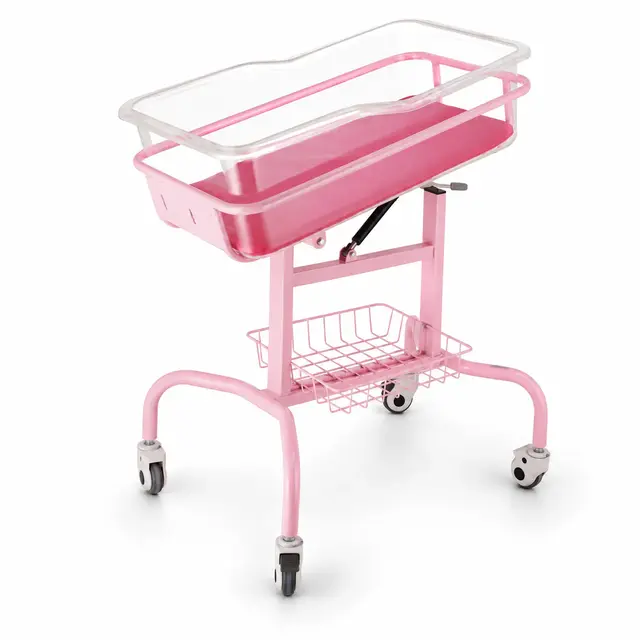
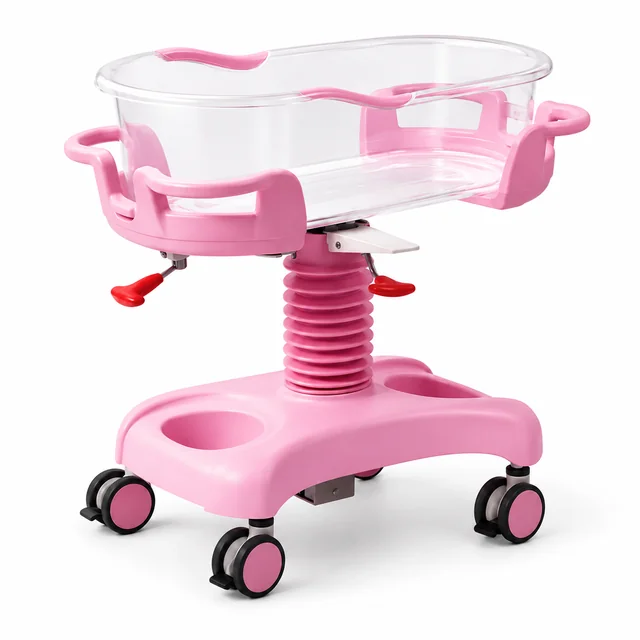
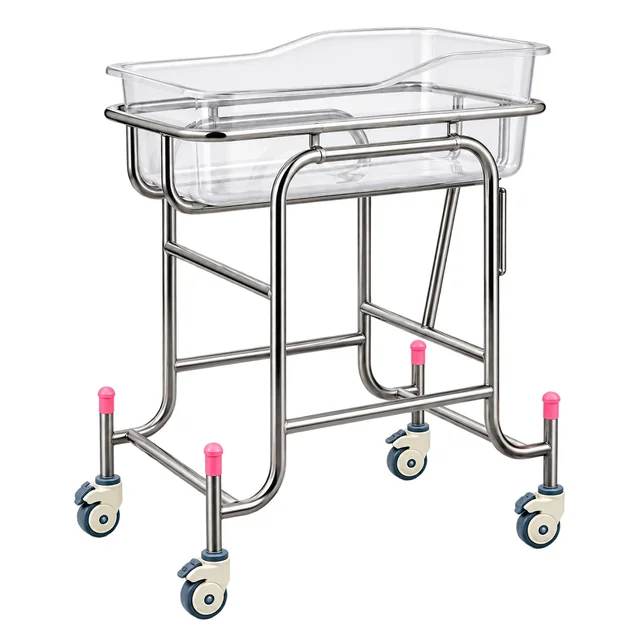
Hospital cribs are sized for clinical work, not for a nursery, so the dimensions are different from a full-size crib. Domestic crib standards such as EN 1130 explicitly exclude cribs used for medical purposes or in hospitals, and in the US a pediatric medical crib is an FDA Class II device. The Keling range covers newborn bassinets, a compact cot and a full-length paediatric bed.
| Model | Type | External size (L × W × H) | Notes |
|---|---|---|---|
| KL-BC116 | Newborn bassinet trolley | 810 × 520 × 990 mm | Transparent basket, 18° tilt, 360° swivel castors, storage basket |
| KL-BC117 | Height-adjustable bassinet | 875 × 525 mm; height 650–900 mm | 0–12° tilt, 20 mm mattress, load capacity under 30 kg |
| KL-BC118 | Stainless steel bassinet | 810 × 520 × 900 mm | Transparent basket, 4 castors, 2 braked |
| KL-BC115 | Stainless steel child cot | 800 × 500 × 800 mm | Protective side rails, 4 castors |
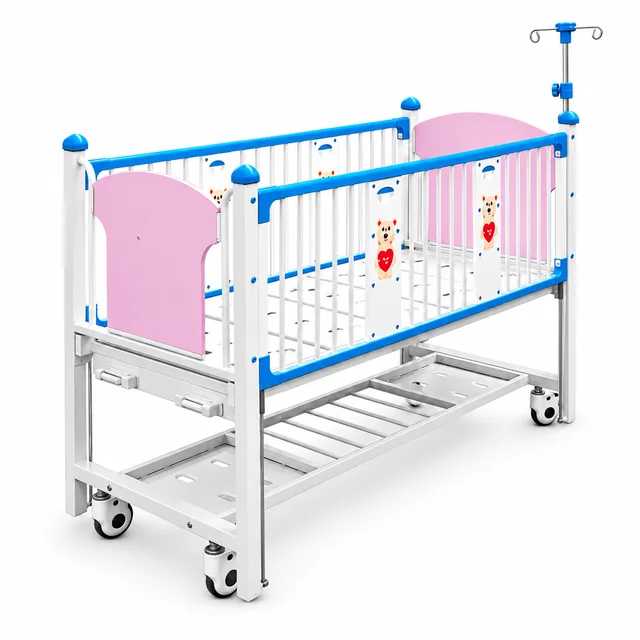
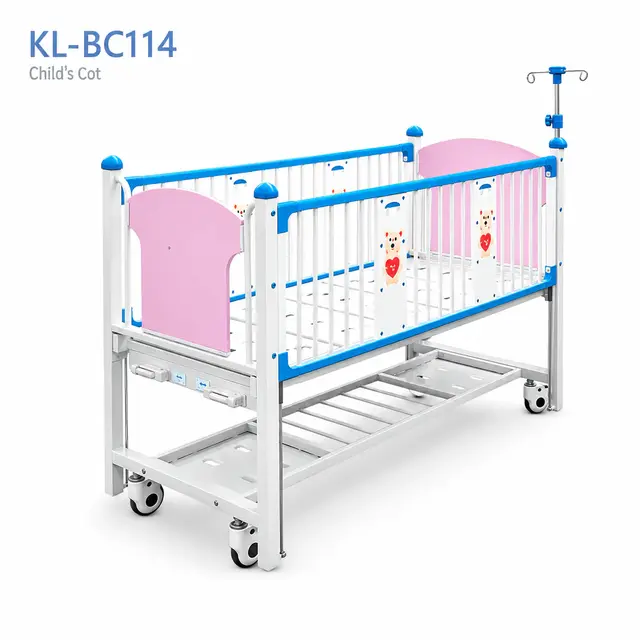
| KL-BC114 | Paediatric hospital bed | 1880 × 900 × 1260 mm | Mattress platform 1770 × 720 mm, bed height 585 mm, full-length rails |
External dimensions are what matter for room planning, lifts and doorways. For mattresses, ask for the internal basket or platform size of the exact model and order the mattress made for it. Our guide to neonatal cribs, isolettes and hospital bassinets explains which type suits which ward, and paediatric hospital beds and cots covers sizing for older children.
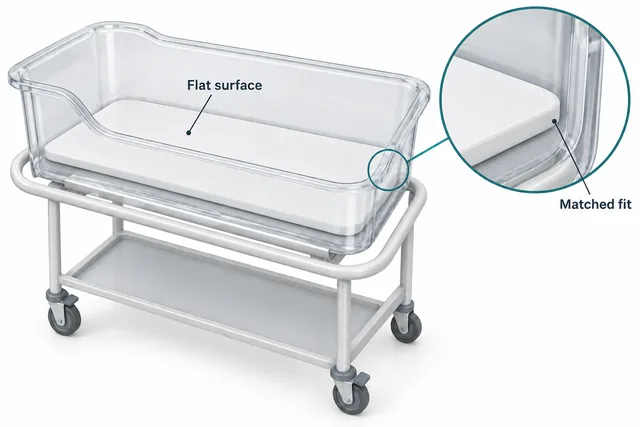
Specification line: Hospital bassinet, external size approx. 810 × 520 × 900–990 mm, transparent basket for observation, castors with at least two brakes; mattress supplied by the bassinet manufacturer to fit the basket with no edge gap; spare mattresses ordered against the same model code.
Adult-size cribs and oversized cribs
An "adult size crib" usually means an enclosed bed for an older child or adult with special needs, often with high sides or a canopy. These are medical devices and are sized like single beds rather than cribs. Keling does not make enclosed adult beds; for older children the nearest Keling product is the full-length KL-BC114 with a 1770 × 720 mm platform and full-length side rails. For adults, see our guide to bed rails for seniors and entrapment zones, because the same gap principles apply.
Oversized consumer cribs, for twins for example, are non-full-size cribs under US rules and must be used only with their own mattress.
Crib size checklist for nurseries, daycare and hospitals
- Confirm which standard applies: US full-size, non-full-size, EN 716 cot, EN 1130 crib, or medical device.
- Record the interior size of each crib model and order mattresses to that size.
- Check mattress thickness against side height (6 in maximum for US full-size cribs).
- Run the two-finger test at delivery and after every mattress change.
- For hospitals, plan room space on external dimensions and include castor turning space.
- Keep mattress model numbers on the asset register so replacements match.
For full crib safety requirements, including slat spacing and drop-side rules, read our guide to crib safety standards. To request drawings or a quotation for hospital cribs and matched mattresses, ask for a quote.
Sources and further reading
- CPSC: Full-size baby cribs business guidance — 16 CFR 1219 and the full-size interior dimensions.
- eCFR: 16 CFR part 1241, Safety Standard for Crib Mattresses — minimum full-size crib mattress dimensions.
- CEN: EN 716-1 Children's cots and folding cots for domestic use — scope and opening limits.
- EN 1130:2019 Children's furniture — Cribs — scope, including the exclusion of hospital cribs.
- American Academy of Pediatrics: Choosing a crib — side height, slat spacing and mattress guidance.
- Nationwide Children's Hospital: Cribs, playpens and bassinets — the two-finger mattress test.
Illustration: AI-generated image for explanation only; it does not show a specific Keling model. See the linked product pages for actual product photos and specifications.
Frequently asked questions
What are the standard crib dimensions?
A US full-size crib has an interior of 28 ± 5/8 in wide by 52 3/8 ± 5/8 in long (about 71 × 133 cm), set by 16 CFR 1219. External sizes vary with the frame. European cots are commonly 60 × 120 cm or 70 × 140 cm internally, within the 900–1400 mm range covered by EN 716.
What size is a standard crib mattress?
A US full-size crib mattress must be at least 27 1/4 in by 51 5/8 in (690 × 1310 mm) under 16 CFR 1241, and crib labelling has long specified a thickness of no more than 6 in (15 cm). In Europe, buy the mattress to the cot's stated internal size, commonly 60 × 120 cm or 70 × 140 cm.
Are all cribs the same size?
No. Only US full-size cribs share one regulated interior size. Mini cribs, portable cribs, oversized cribs, European cots and hospital cribs vary, so each must be used with the mattress its manufacturer specifies. When buying in bulk, order mattresses against the crib model rather than a nominal size.
What is the standard crib size in feet?
The interior of a US full-size crib is about 2.3 ft wide by 4.4 ft long (28 by 52 3/8 in). With the frame, a full-size crib typically takes up a little more floor space than that; check the external dimensions on the product sheet before planning a room layout or doorway clearance.
How do you know if a crib mattress fits?
Push the mattress firmly to one side and end, then check the gap on the opposite side. If you can fit more than two fingers between the mattress and the crib, the mattress is too small. Also press the edge down: a soft edge that pulls away from the side creates a larger gap.
How big is a hospital crib or bassinet?
Hospital bassinets are smaller than full-size cribs and stand at bedside height. Keling's KL-BC116 measures 810 × 520 × 990 mm, the KL-BC118 810 × 520 × 900 mm, and the height-adjustable KL-BC117 875 × 525 mm with a 650–900 mm height range. Always use the mattress made for the model.
About the author
This article was written by the Keling Medical export team, drawing on the engineering data for the 33 bed, cot, mattress and accessory models Keling manufactures at its Yangzhou plant, and checked against the published standards and guidance listed in the sources. Keling Medical has been making medical appliances since 1996 and holds CE, ISO 9001 and ISO 13485 certification. More about Keling.