How to choose an electric hospital bed: a buyer's specification guide
Function count, height range, tilt, load rating, rails and castors — the seven specification decisions that determine whether an electric hospital bed fits the ward, and how to avoid paying for capability nobody will use.

Short answer
Choose an electric hospital bed by starting with the ward, not the catalogue. Decide the function count first (two-function for general wards, three-function where transfers matter, five-function for ICU and high-dependency), then confirm the height range, the safe working load with a margin over your heaviest expected patient, the tilt angles if postural drainage or anti-shock positioning is clinically required, and the rail and castor type. Most hospitals over-specify function count and under-specify load rating and castor quality.
Buying hospital beds is one of those purchases where the specification sheet is easy to read and hard to interpret. Two beds can list the same seven parameters and behave completely differently on a ward. This guide goes through the decisions in the order they actually matter, using the engineering data from beds we build ourselves.
Start with the ward, not the catalogue
The single most common procurement mistake is choosing a bed and then working out where it goes. It produces two symptoms: ICU-grade beds sitting in rehabilitation wards where nobody uses the tilt, and basic beds in high-dependency rooms where staff needed height adjustment and did not get it.
Work the other way. For each ward, write down four things:
- What happens to patients here? Are they ventilated? Recovering from surgery? Long-stay and mobile? Is cardiac arrest a realistic event?
- Who moves the patient, and how often? Transfers and repositioning are what drive height adjustment and rail requirements.
- What is the heaviest patient you realistically admit?
- What is the maintenance reality? Is there a biomedical engineering team, a reliable mains supply, a spare-parts budget?
Those four answers determine most of the specification before you look at a single product page.
Decision 1: function count
"Functions" counts the powered adjustment axes. The industry convention is consistent enough to rely on:
| Functions | Powered axes | Typical use |
|---|---|---|
| 1 | Backrest only | Basic clinics, nursing homes, observation |
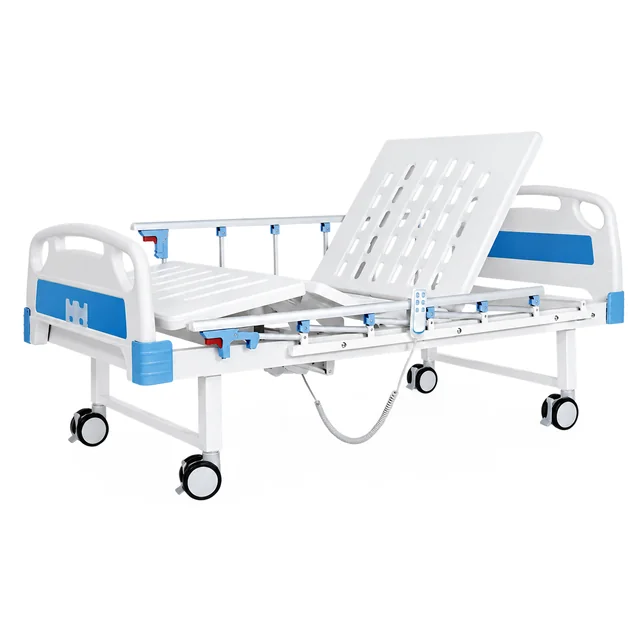
| 2 | Backrest, knee-rest | General medical wards |
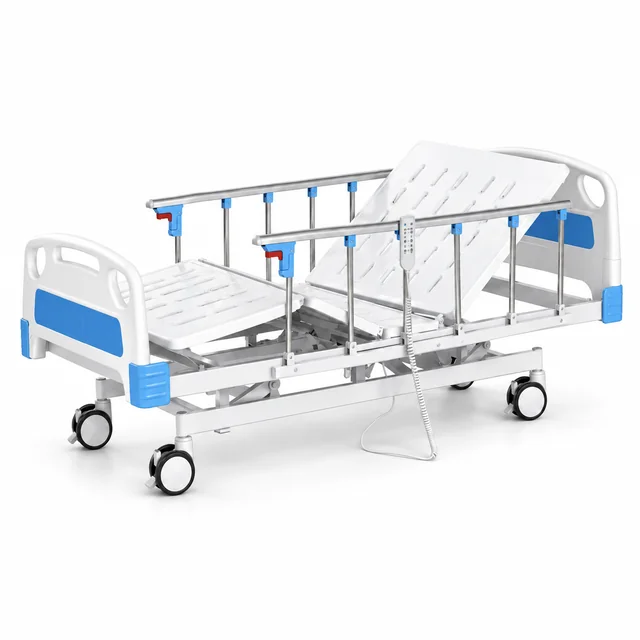
| 3 | Backrest, knee-rest, height | General wards where staff transfer patients frequently |
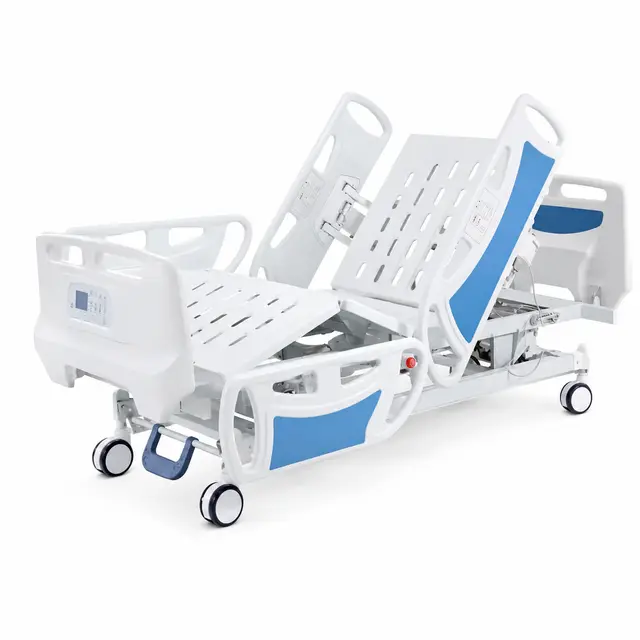
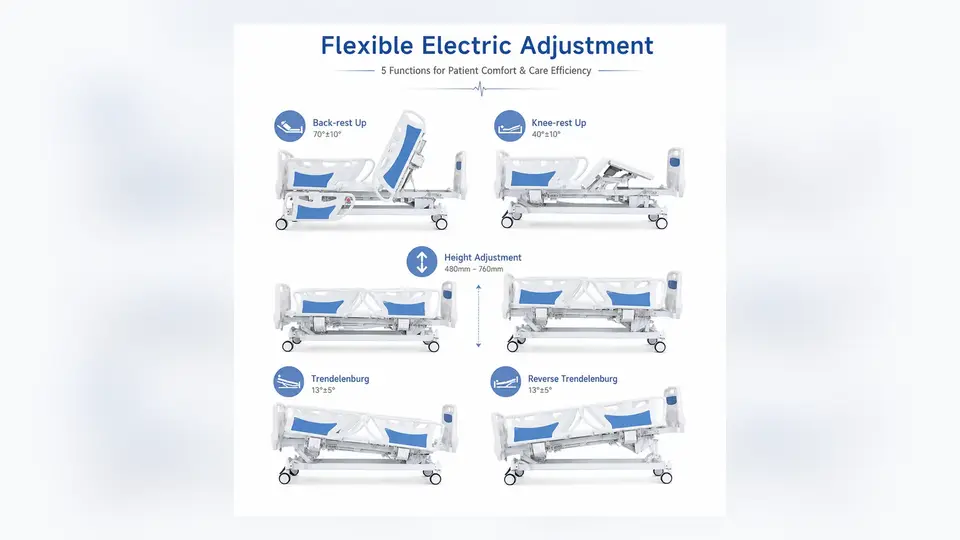
| 5 | Backrest, knee-rest, height, Trendelenburg, reverse Trendelenburg | ICU, HDU, CCU, surgical recovery, emergency |
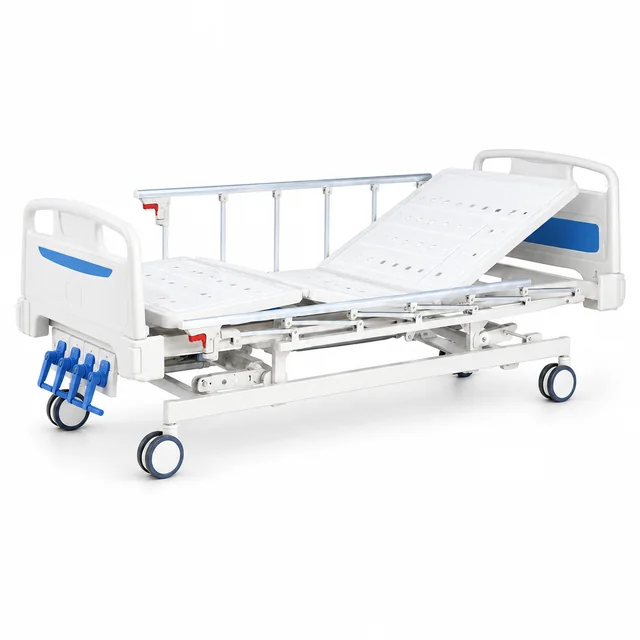
There is no four-function convention in common use; a bed advertised as "four-function" usually means three powered axes plus a manual one, and is worth questioning.
The jump that buys the most clinical value per unit of cost is two to three functions — that is, adding electric height adjustment. Height adjustment is the function that prevents nursing back injuries, and injured staff cost more than beds. The jump from three to five is a genuine clinical capability (postural drainage, anti-shock positioning, surgical prep) but only pays for itself where those positions are actually used.
For reference, in our own range the KL-BC105 is a two-function bed, the KL-BC104 is three-function, and the KL-BC101 is a five-function ICU platform.
Decision 2: height range
Height adjustment is specified as a range, and both ends matter for different reasons.
The low end is a patient-safety figure. A bed that descends to around 480 mm lets an average adult sit on the edge with feet flat on the floor — which is what makes an unassisted transfer safe and what reduces the injury severity if a patient rolls out. A bed whose minimum is 600 mm is a normal-height bed, not a low bed, and will not deliver that.
The high end is a staff-safety figure. Around 760 mm brings the patient surface to a working height where a nurse can wash, dress a wound or change bedding without bending. Note that the working height is the bed surface plus the mattress, so a 100 mm mattress effectively adds 100 mm to both ends of the range.
A 480–760 mm range, as on the KL-BC101 and KL-BC104, covers both requirements. If a tender specifies a narrower range, check which end has been sacrificed.
Decision 3: safe working load
Safe working load (SWL) is the total the bed is rated to carry: patient, mattress, bedding, and anything resting on the bed. It is not a patient weight limit, although it is very often read as one.
Two figures dominate the market: 200 kg and 240 kg. The arithmetic is worth doing explicitly. A 150 kg patient plus a 15 kg mattress plus bedding, plus a member of staff kneeling on the bed during CPR, is already close to 200 kg. On any ward that might admit bariatric patients, specify 240 kg and treat it as headroom rather than as a target.
There is more on this in our separate article on what safe working load actually means.
Decision 4: tilt
Trendelenburg (head down) and reverse Trendelenburg (head up) are whole-bed tilts, distinct from backrest elevation. Typical hospital beds offer around 13°, which is enough for postural drainage, anti-shock positioning and surgical preparation but is not the steep tilt of an operating table.
Tilt is the clearest example of a function that is either clinically required or pure cost. In ICU, HDU, emergency and surgical recovery, specify it. In general medical, rehabilitation and long-term care wards it will almost never be used, and the money is better spent on height adjustment or a better mattress.
Decision 5: CPR release, nurse lock and angle indicator
Three features that cost little individually and are worth checking are genuinely present rather than implied:
- CPR instant release drops the backrest flat in a single action. In a cardiac arrest this saves seconds that matter. Ask how it is actuated — a lever that a nurse can hit with one hand while already starting compressions is not the same as a sequence on a handset.
- Nurse lock disables the patient-side controls. On confused, sedated or paediatric patients this is a safety feature, not a convenience. Check which axes the lock covers and whether it can be locked selectively.
- Angle indicator — a mechanical readout, typically 0–90°, showing backrest angle. It matters more than it looks: ventilator-associated pneumonia prevention protocols specify a backrest angle (commonly 30–45°), and "looks about right" is not a measurement.
Decision 6: side rails
Side rails are the most-handled part of a hospital bed and the most frequently damaged. The material choice is a real decision:
- Aluminium alloy and stainless steel rails are the durable option, and hold up to heavy use and aggressive disinfection. See the KL-HL001 rail range.
- ABS rails are lighter, quieter to operate, warmer to the touch and cheaper to replace when broken. See KL-HL002.
Neither is simply better. The question is which failure mode you would rather have: a metal rail that survives the trolley impact and transmits the damage to the frame, or an ABS rail that cracks and is replaced for a small fraction of the bed's cost. For wards with high trolley traffic, ABS plus a stock of spares is often the cheaper ten-year decision.
Also check the split: full-length rails versus two- or four-section rails. Sectioned rails allow a patient to exit the bed midway without dropping a full rail, which matters in rehabilitation.
Decision 7: castors
Castors are where cheap beds are cheapest, and where the cost surfaces later. Specify:
- Diameter — larger castors roll over thresholds and lift edges that stop small ones.
- Braking — central braking (one pedal locks all four) is far safer than four individual brakes, because a bed with three brakes applied is a bed that moves during a transfer.
- A directional lock on at least one castor, which is what makes a bed steerable down a corridor instead of crabbing.
- Tread material compatible with your floors, and non-marking if you have vinyl.
Our KL-CA011 castor range is catalogued separately precisely because castors are a consumable, not a permanent part of the bed.
Decision 8: the mattress is part of the bed
A bed and a mattress are one system and should be bought as one. Two specific traps:
- A flat mattress on an articulating bed bridges the joints when the backrest rises, which both reduces the effective angle and creates shear against the patient's skin. A segmented three-section mattress follows the bed surface.
- Size mismatch. The bed surface figure — commonly 1930 × 900 mm — is the dimension the mattress must match. A mattress 40 mm short leaves a gap at the head or foot that is an entrapment risk.
Where pressure-injury prevention is a clinical requirement, an alternating-pressure air mattress belongs in the specification from the start rather than as a later purchase.
A worked example
A 120-bed district hospital with a 12-bed ICU, a 10-bed surgical recovery unit and the remainder general medical and surgical:
- ICU and recovery (22 beds) — five-function electric, 240 kg SWL, CPR instant release, nurse lock, angle indicator, tilt both ways, central-brake castors, alternating-pressure air mattresses.
- General wards (98 beds) — three-function electric, 200 kg SWL for most, a small number at 240 kg for bariatric admissions, ABS rails with spares, segmented foam mattresses.
- Spares — castors, ABS rails and headboards for roughly 5% of the fleet, purchased with the beds.
The common error would be buying 120 five-function beds "for flexibility". That spends a large amount of money on tilt mechanisms that 98 wards will never actuate, and typically forces a compromise on mattresses — which is the component the patient is actually lying on.
Before you issue the order
Ask your supplier for four things, in writing, and be wary if any of them is hard to get:
- A signed datasheet for the exact configuration, with tolerances stated.
- The CE certificate and ISO 13485 certificate, current and dated.
- Packing dimensions, gross weight and units per container, because on a high-volume, low-value product the loading figure moves landed cost more than the unit price.
- A spare-parts price list for castors, rails, headboards, handsets and actuators.
If you want a second opinion on a specification you have been sent, send it to our engineers — we will tell you what it means, including where a competitor's bed is the better fit.
Frequently asked questions
How many functions does a general ward bed need?
For most general medical and surgical wards a two- or three-function electric bed is sufficient. Two-function gives powered backrest and knee-rest; three-function adds electric height adjustment, which is the function that protects nursing staff backs during transfers and washing. Five-function beds add Trendelenburg and reverse Trendelenburg tilt, which are only clinically necessary in ICU, high-dependency, surgical recovery and emergency settings.
What height range should a hospital bed have?
A range of roughly 480 to 760 mm covers both ends of the requirement: the low position allows a patient to sit on the edge of the bed with feet flat on the floor, reducing fall risk, and the high position brings the patient to a comfortable working height for nursing staff. A bed that only descends to 600 mm is not a low bed, whatever the brochure calls it.
Is CPR instant release necessary on every bed?
No. CPR instant release drops the backrest to flat in one action and is essential wherever cardiac arrest is a realistic event — ICU, HDU, CCU, surgical recovery and emergency. On a rehabilitation or long-term care ward it adds cost without adding clinical value. Specify it where resuscitation is planned for, not across the whole estate.
How much safe working load do we need?
Take your heaviest realistically expected patient, add the weight of the mattress, bedding and any equipment resting on the bed, and add a margin. A 200 kg safe working load suits most general wards; 240 kg gives real headroom and is what we would specify for any ward admitting bariatric patients. Safe working load is a total, not a patient weight.
Should we buy electric or manual beds?
Electric where the clinical case or staff safety requires it; manual where power is unreliable or technical maintenance is thin. A five-function manual bed delivers the same patient positioning as a five-function electric bed with none of the electrical failure modes. The honest answer for many general wards in power-constrained settings is manual beds plus a smaller number of electric beds in the higher-dependency rooms.
About the author
This article was written by the Keling Medical export team, drawing on the engineering data for the 33 bed, cot, mattress and accessory models Keling manufactures at its Yangzhou plant. Keling Medical has been making medical appliances since 1996 and holds CE, ISO 9001 and ISO 13485 certification. More about Keling.