Crib safety standards explained: slat spacing, rails, mattress fit and certification
The mandatory US and European crib rules, what JPMA and GREENGUARD labels mean, and what hospitals, daycare and childcare centres should check before buying cribs.

Short answer
Crib safety standards in the US are mandatory: full-size cribs must meet 16 CFR 1219 and non-full-size cribs 16 CFR 1220, in force since June 2011. They require slats no more than 2 3/8 in (6 cm) apart, ban drop sides, and demand stronger hardware and third-party testing. Europe uses EN 716 for cots; hospital cribs are regulated as medical devices.
Crib safety standards are some of the most detailed product rules in any market, because the failures they prevent are so severe: an infant trapped between slats, under a loose mattress or behind a detached drop side. Since 2011, every baby crib sold in the US, and every crib used in a US child care centre, has had to meet the same mandatory rules.
This guide explains those rules and their European equivalents, what the voluntary certifications on crib listings mean, and what hospitals, daycare and childcare centres should check before buying or re-using cribs. It complements our guides to paediatric cots and infant cribs, which covers which bed suits which ward, and crib dimensions and crib mattress size.
What are the crib safety standards?
Crib safety standards are the mandatory rules a crib must meet before it can be sold or used in regulated settings. Which one applies depends on the market and on whether the crib is a consumer product or a medical device.
| Product | United States | Europe |
|---|---|---|
| Full-size baby crib | 16 CFR 1219, incorporating ASTM F1169 (F1169-19 for cribs made from 28 October 2019) | EN 716-1 and EN 716-2 (cots, internal length over 900 mm up to 1400 mm) |
| Non-full-size crib, mini crib, play yard crib | 16 CFR 1220, incorporating ASTM F406 | EN 716 or EN 12227 (playpens), depending on design |
| Small crib or cradle | 16 CFR 1218 (bassinets and cradles) | EN 1130 (internal base length up to 900 mm) |
| Crib mattress | 16 CFR 1241, incorporating ASTM F2933 | Mattress fit checked within EN 716 |
| Hospital crib (pediatric medical crib) | FDA, 21 CFR 880.5140, Class II prescription device | Medical device regulation; EN IEC 80601-2-89 (formerly EN 50637) for medical beds for children |
The US rules took effect on 28 June 2011. They stopped the manufacture and sale of traditional drop-side cribs, strengthened slats and mattress supports, required more durable hardware and introduced more rigorous testing. Manufacturers and importers must certify compliance with a Children's Product Certificate based on testing by a CPSC-accepted third-party laboratory.
Crib slat spacing and openings
Crib slats must be no more than 2 3/8 in (6 cm) apart, about the width of a soda can. This is the single most quoted crib safety rule, because a wider gap lets an infant's body pass through while the head is trapped.
CPSC's crib safety tips add related checks on the structure:
- Missing or cracked slats must be replaced before the crib is used again.
- Corner posts should be no higher than 1/16 in, so clothing cannot catch.
- Headboards and footboards should have no cutouts in which a head could be trapped.
- Mesh-sided cribs and play yards need mesh openings smaller than 1/4 in, with no tears or loose threads.
The European cot standard EN 716 takes a different approach to the same hazard: accessible holes, gaps and openings must be under 7 mm, between 12 and 25 mm, or between 45 and 65 mm, so that small fingers cannot be trapped and heads cannot pass.
Drop-side cribs and cribs with lowering sides
Traditional drop-side cribs can no longer be made or sold in the US. CPSC's 2011 rules ended them after hardware failures allowed a side to detach partly, creating a gap between the side and the mattress in which infants were trapped. Any drop-side crib still in use should be replaced, even if it seems sound.
Searches for "cribs with lowering sides" or a "crib with drop down side" usually come from parents or carers who want easier access. The compliant alternatives are an adjustable mattress height, a lower overall crib, or, for hospital use, a medical crib.
Hospital cribs are a different category. The FDA defines a pediatric medical crib as a prescription device for use with a pediatric patient, with fixed end rails and movable side rails that latch, and classifies it as Class II with special controls. Movable rails are part of the clinical design, because nurses need side access for examinations and procedures. That is also why hospital cribs belong in hospitals: they are designed, labelled and maintained for supervised clinical use, not for the nursery at home.
Mattress fit, side height and crib height
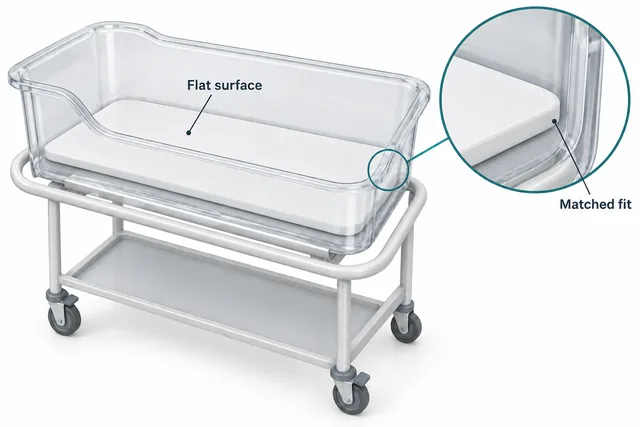
A safe crib needs a mattress that fits it exactly. In the US, a full-size crib mattress must be at least 27 1/4 by 51 5/8 in (690 × 1310 mm) under 16 CFR 1241, and crib labelling specifies a thickness of no more than 6 in (15 cm). If more than two fingers fit between the mattress and the crib side, the mattress is too small.
- Firmness. The mattress should be firm and should not sag; the American Academy of Pediatrics and CPSC both stress a firm, tight-fitting mattress with only a fitted sheet.
- Side height. The raised sides should be at least 26 in (66 cm) above the mattress support in its lowest position, according to the AAP.
- Crib height by age. Lower the mattress as the baby learns to sit and then stand; remove mobiles once the baby can get onto hands and knees.
- Moving on. Move the child to a bed when they can climb out or reach the height given in the crib's instructions.
For hospital cribs and bassinets, the equivalent rule is to use only the mattress made for that model. Our guide to hospital crib mattresses covers firmness and covers for clinical use.
What JPMA and GREENGUARD certification mean
JPMA and GREENGUARD certifications are voluntary programmes that sit on top of the mandatory rules. Neither is required by law, and neither replaces the mandatory crib standards that every crib sold in the US must already meet.
- JPMA certification is a voluntary programme run by the juvenile products industry association. Its protocols draw on ASTM standards plus federal and state requirements and specify tests to be carried out by a third-party laboratory. For cribs, it largely confirms what the mandatory rules already require.
- GREENGUARD and GREENGUARD Gold certify chemical emissions, not structural safety. Products are tested for volatile organic compounds (VOCs) released into indoor air under UL 2818. The Gold tier sets lower limits on more than 360 VOCs and total chemical emissions and is aimed at sensitive groups such as children, with schools and healthcare settings named as intended uses.
So a "safest crib" is not defined by a label. It is a crib that meets the mandatory standard for its market, is assembled correctly, is in good condition and is used with a matching mattress and a bare sleep space. Low-emission certification is a reasonable extra requirement for nurseries and wards, provided it is not mistaken for a structural safety claim.
What hospitals should check in a hospital crib or cot
A hospital crib or medical cot should be bought as a medical device, with the same documentation and acceptance checks as an adult hospital bed. In Europe, medical beds for children have their own standard, EN IEC 80601-2-89 (which replaces EN 50637:2017), covering beds with an internal length up to 180 cm; domestic cot and crib standards such as EN 716 and EN 1130 do not apply to hospital cribs.
- Regulatory status and documents. Ask for the device classification, declaration of conformity and quality system certificate. Our guide to CE marking and ISO 13485 explains what each document proves.
- Rails and latches. Side rails should latch securely in the raised position and should not be released by the child from inside. Gaps between bars and between rail and mattress should be suitable for the smallest intended patient.
- Mattress compatibility. Order the manufacturer's mattress for that model and record it on the asset register.
- Mobility and brakes. Castors should lock, and the crib should stay stable when a rail is lowered and an adult leans on it.
- Cleaning. Frames and baskets should tolerate the unit's disinfectants; stainless steel and transparent baskets help.
- Inspection. Include cribs in planned maintenance: latches, fixings, castors and any tilt or height mechanism.
| Keling model | Type | Size | Safety-relevant features |
|---|---|---|---|
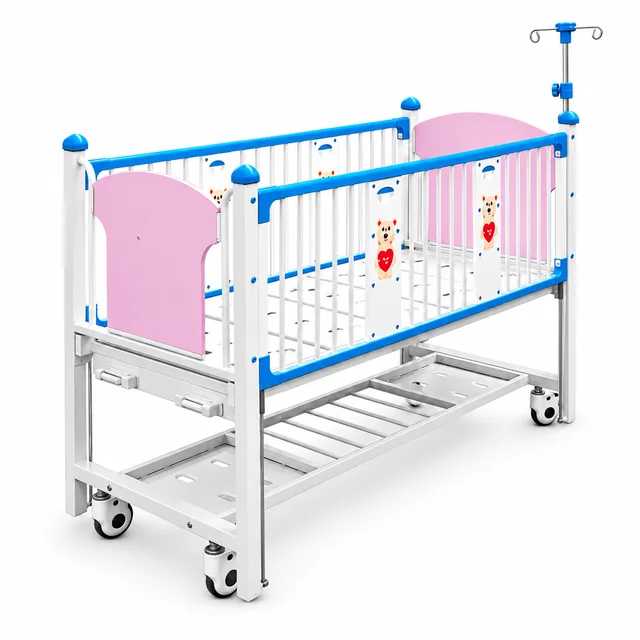
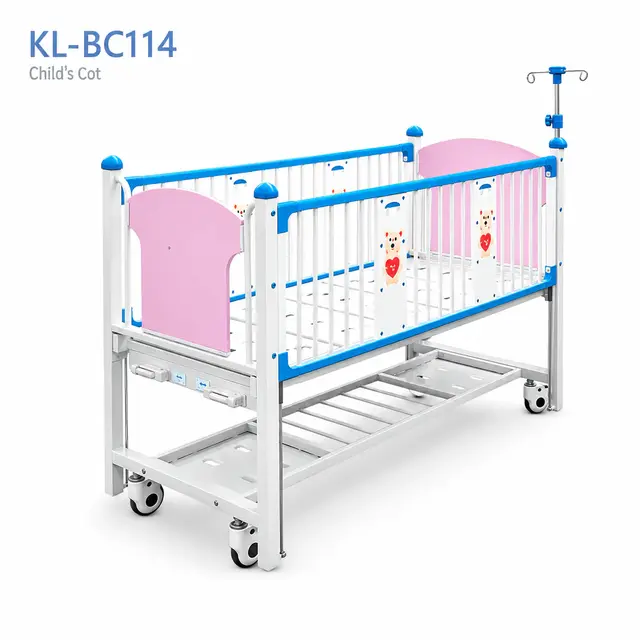
| KL-BC114 | Paediatric hospital bed (child's cot) | 1880 × 900 × 1260 mm; platform 1770 × 720 mm | Full-length side rails with child-safe spacing, backrest 70±10°, IV pole |
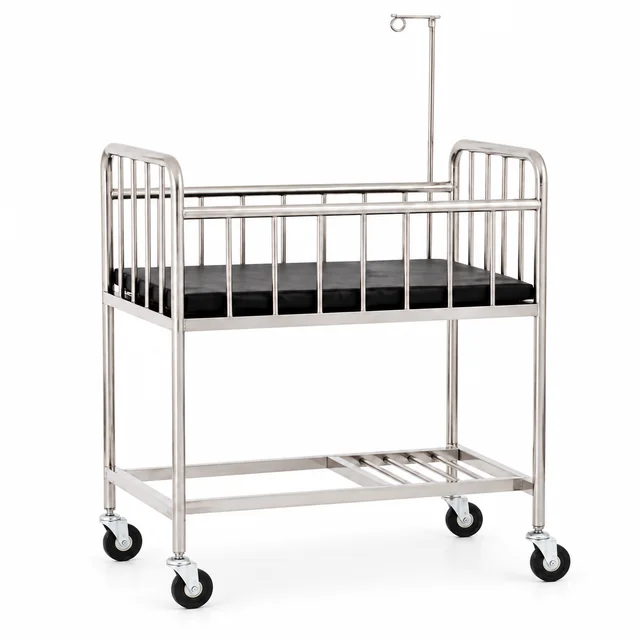
| KL-BC115 | Stainless steel child cot | 800 × 500 × 800 mm | Protective full-length side rails, stainless frame, 4 castors |
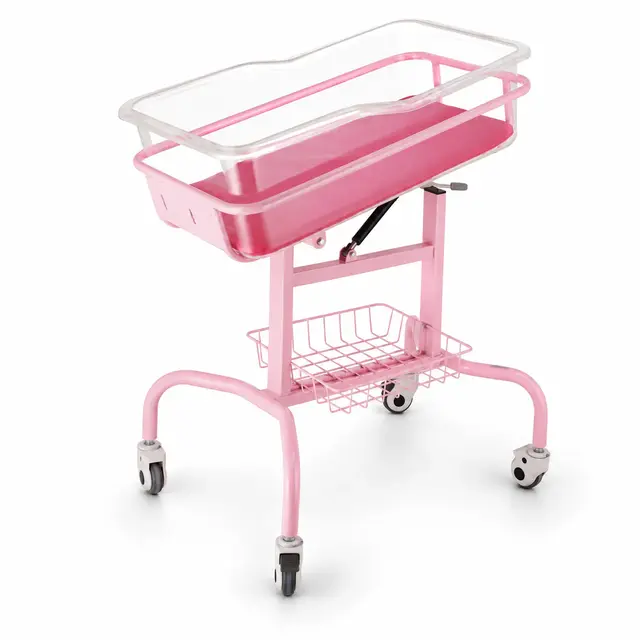
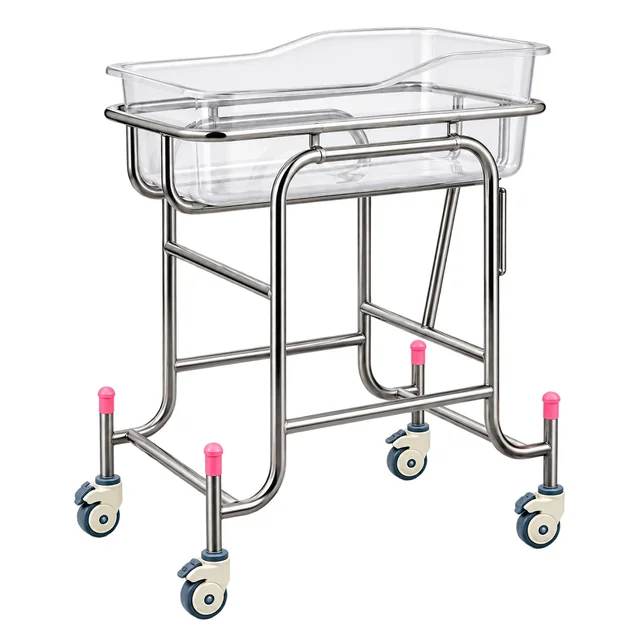
| KL-BC116 / KL-BC117 / KL-BC118 | Newborn bassinets | 810–875 × 520–525 mm | Transparent baskets for observation, braked castors |
Specification line: Paediatric hospital cot, medical device, full-length latching side rails with child-safe bar spacing, manufacturer-matched mattress, lockable castors, frame compatible with hospital disinfectants; supplier to provide declaration of conformity, ISO 13485 certificate and rail gap test evidence.
Daycare cribs and childcare centres
Daycare cribs in the US must meet the same federal crib standards as cribs sold to parents. Child care facilities, family child care homes and infant Head Start centres had to use only compliant cribs from 28 December 2012, as did hotels and rental companies.
For childcare centres, the practical checks are:
- Keep proof of compliance (the crib's tracking label and certificate information) on file for each crib.
- Remove any drop-side, damaged or second-hand crib of unknown history; check recalls before using any crib.
- Use one infant per crib, a fitted sheet only and nothing soft in the crib.
- Inspect hardware and slats on a schedule and after every move or reassembly.
- Check state licensing rules, which may add requirements such as crib spacing in the room or an evacuation plan; some centres use evacuation cribs designed to move several infants in an emergency.
Keling makes hospital cribs and cots rather than consumer daycare cribs; childcare buyers should source products certified to the consumer crib standard of their market.
Crib vs cot: what is the difference?
A crib and a cot are the same thing in most of the world: "crib" is the US term and "cot" the British and Commonwealth term for a baby bed with high sides. In the US, "cot" usually means a folding camp bed. In hospitals, "cot" often refers to a paediatric bed with rails for older infants and children, such as the KL-BC114, while "crib" or "bassinet" refers to newborn beds.
Crib safety checklist
- Crib certified to the mandatory standard for its market (16 CFR 1219/1220, EN 716, or medical device rules for hospital cribs).
- No drop sides on consumer cribs; latching side rails only on medical cribs.
- Slats no more than 2 3/8 in (6 cm) apart; none missing or cracked.
- Corner posts no higher than 1/16 in; no cutouts in end panels.
- Mattress made for the crib, firm, no more than two fingers' gap.
- Side height at least 26 in above the lowest mattress support position.
- Hardware tight and complete; inspected on a schedule.
- Bare sleep space: fitted sheet only.
For hospital crib and paediatric cot specifications, drawings or a project quotation, contact our export team. Our article on bassinet safety and weight limits covers the newborn stage.
Sources and further reading
- CPSC: Full-size baby cribs business guidance — 16 CFR 1219, ASTM F1169 versions and certification.
- CPSC: New crib standards take effect (2011) — drop-side ban and compliance dates for child care facilities.
- CPSC: Crib safety tips — slat spacing, corner posts, mattress fit and mesh openings.
- eCFR: 21 CFR 880.5140, Pediatric medical crib — FDA definition and Class II classification.
- JPMA: Certification programme — scope of the voluntary juvenile products certification.
- UL: GREENGUARD certification programme — what chemical emissions certification covers.
Illustration: AI-generated image for explanation only; it does not show a specific Keling model. See the linked product pages for actual product photos and specifications.
Frequently asked questions
What are the crib safety standards in the US?
Full-size cribs must meet 16 CFR 1219 (ASTM F1169) and non-full-size cribs 16 CFR 1220 (ASTM F406). The rules took effect on 28 June 2011, ended drop-side cribs, strengthened slats and mattress supports and require third-party testing. Crib mattresses must meet 16 CFR 1241.
How far apart should crib slats be?
Crib slats should be no more than 2 3/8 in (6 cm) apart, about the width of a soda can. Wider gaps can let an infant's body slip through while the head is trapped. Replace any crib with missing or cracked slats. In Europe, EN 716 requires openings of 45–65 mm or smaller defined ranges.
Are drop-side cribs still allowed?
No. Since 28 June 2011, traditional drop-side cribs cannot be made or sold in the US, and child care facilities had to replace them by 28 December 2012. Hospital pediatric medical cribs with latching movable side rails are a separate, FDA-regulated category intended for supervised clinical use.
What does JPMA certified mean for a crib?
JPMA certification is a voluntary programme run by the juvenile products industry association, with testing by a third-party laboratory against ASTM standards and federal and state requirements. It is not required by law and does not replace the mandatory US crib standards that every crib sold must already meet.
What is a GREENGUARD certified crib?
A GREENGUARD certified crib has been tested for chemical emissions, meaning volatile organic compounds released into indoor air. The Gold tier sets stricter limits for products used by sensitive groups such as children. It says nothing about structural safety, which is covered by the mandatory crib standards.
What crib requirements apply to daycare centers?
In the US, daycare cribs must meet the same federal standards as consumer cribs, and child care facilities had to use only compliant cribs from 28 December 2012. Centres should keep compliance records, remove drop-side and damaged cribs, check recalls and follow state licensing rules on crib spacing and evacuation.
What is the difference between a crib and a cot?
In most English-speaking countries, a cot is the same as a crib: a baby bed with high sides. In the US, a cot usually means a folding camp bed. In hospitals, cot often means a paediatric bed with rails for older infants and children, while crib or bassinet refers to a newborn bed.
About the author
This article was written by the Keling Medical export team, drawing on the engineering data for the 33 bed, cot, mattress and accessory models Keling manufactures at its Yangzhou plant, and checked against the published standards and guidance listed in the sources. Keling Medical has been making medical appliances since 1996 and holds CE, ISO 9001 and ISO 13485 certification. More about Keling.