Baby bassinet safety: standards, weight limits and hospital vs bedside bassinets
Which standards cover freestanding, bedside and hospital bassinets, what a bassinet weight limit means, safe newborn sleep and when to move from bassinet to crib.

Short answer
A baby bassinet is a small bed for infants up to about 5 months or until they push up on hands and knees. In the US it must meet 16 CFR 1218 (ASTM F2194), with bedside bassinets under 16 CFR 1222; in Europe, EN 1130 applies. There is no single legal weight limit: follow the labelled maximum, commonly 15–20 lb, or the developmental milestone, whichever comes first.
A baby bassinet is the first bed most newborns sleep in, at home and in hospital. It is also one of the most varied products in the nursery market: freestanding bassinets, bedside bassinets that attach to the parents' bed, portable and folding bassinets, motorised "smart" bassinets and hospital bassinets on trolleys all go by similar names but sit under different rules.
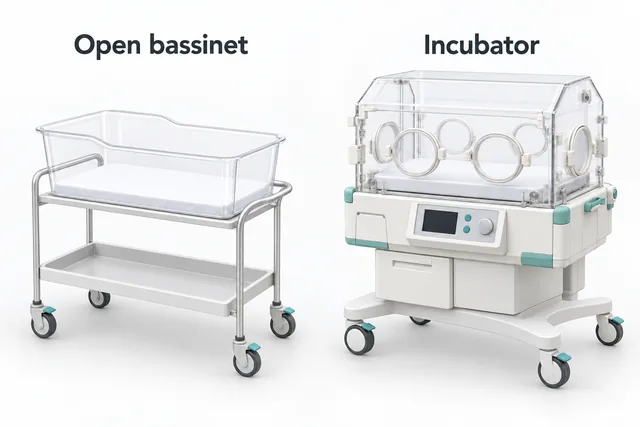
This guide explains the safety standards that apply to each type, what the bassinet weight limit really means, when to move a baby from bassinet to crib, and what maternity units should specify in a hospital bassinet for rooming-in. For a comparison of bassinets with neonatal cribs and incubators, see our guide to neonatal cribs, isolettes and hospital bassinets.
What is a baby bassinet?
A baby bassinet is a small bed designed to provide sleeping accommodation for infants, standing on legs, a fixed base, wheels or a rocking or swinging base. In the US standard ASTM F2194, its sleep surface must be at or below 10° from horizontal in the rest position, and it is intended for infants up to about 5 months old or until they begin to push up on their hands and knees, whichever comes first.
The main types, and the rules that cover them, are:
| Type | Description | US rule | European standard |
|---|---|---|---|
| Freestanding bassinet or cradle | Standalone small bed on legs, base or wheels | 16 CFR 1218 (ASTM F2194) | EN 1130 |
| Bedside bassinet (bedside sleeper) | Attaches to the side of the adult bed, often with a drop-down side | 16 CFR 1222 (ASTM F2906) | EN 1130 |
| Play yard or crib bassinet accessory | Bassinet insert in a play yard or non-full-size crib | Bassinet rule plus the play yard or crib rule | EN 1130 / EN 12227 |
| In-bed sleeper and other sleep products | Products placed in the adult bed or not covered elsewhere | 16 CFR 1236 (infant sleep products) | Depends on product |
| Hospital bassinet | Mobile trolley with a basket, used in maternity and newborn units | Medical device regulation | Medical device regulation |
Bassinet safety standards in the US and Europe
In the US, bassinets and cradles must meet 16 CFR part 1218, which incorporates ASTM F2194. The ASTM F2194-13 version applied to products made or imported from 23 April 2014; ASTM F2194-25 applies from 21 February 2026, with CPSC exercising enforcement discretion until 30 June 2026. Manufacturers must issue a Children's Product Certificate based on third-party testing and attach permanent tracking labels.
The CPSC lists the main areas the standard covers:
- Stability, so a bassinet does not tip when a child moves or an adult leans on it.
- Mattress flatness, including a test for segmented mattresses, and limits on pad thickness. In ASTM F2194-13, fabric or mesh-sided products are limited to a total pad thickness of 1 1/2 in (38 mm).
- Side height: in F2194-13, the mattress surface must sit at least 7.5 in (191 mm) below the top of the lowest side.
- Spacing of rigid components and openings in mesh or fabric sides.
- Head-to-toe and lateral sleep surface angles, unintentional folding, scissoring and pinching.
- Warnings and labelling, including the stop-use warning.
Bedside sleepers have their own rule, 16 CFR 1222, updated to ASTM F2906-23 in 2023, which deals with the attachment to the adult bed and the side next to it. In Europe, EN 1130:2019 covers cribs, cradles, suspended cribs and bedside sleepers with an internal base length of up to 900 mm, for infants until they can sit unaided or push themselves up on hands and knees. EN 1130 explicitly excludes cribs used for medical purposes or in hospitals.
What is the weight limit for a bassinet?
There is no single legal bassinet weight limit. Each manufacturer sets a maximum weight and must print it on the stop-use warning, and the developmental limit applies alongside it: stop using the bassinet when the baby begins to push up on hands and knees or reaches the labelled weight, whichever comes first.
On consumer bassinets the labelled limit is commonly in the region of 15–20 lb (about 7–9 kg), and many manufacturers also say to stop when the baby can roll over. In practice, most babies reach a developmental limit before the weight limit, often around 4 to 6 months.
Do not confuse the infant weight limit with a structural load figure. Keling's KL-BC117 hospital bassinet, for example, has a load capacity of under 30 kg. That number describes what the structure is designed to carry, including mattress and bedding, not how big a baby may be. Our article on safe working load explains the same distinction for adult beds.
Specification line: Bassinet labelled with maximum occupant weight and stop-use developmental milestone; structural load capacity stated separately; mattress supplied by the bassinet manufacturer.
Safe newborn sleep in a bassinet
The American Academy of Pediatrics' 2022 safe sleep recommendations apply to every bassinet, at home or in hospital. In brief:
- Place the baby on the back for every sleep.
- Use a firm, flat, non-inclined surface that meets federal safety standards, with only a fitted sheet.
- Room-share without bed-sharing, preferably for at least the first six months.
- Keep pillows, quilts, bumpers and soft toys out of the bassinet; do not use weighted swaddles or weighted sleep products.
- Do not use car seats, swings, strollers or slings for routine sleep, in hospital or at home.
- Do not rely on products or monitors marketed to reduce sudden infant death; the AAP does not recommend them.
These points also apply to smart or automatic bassinets that rock or respond to crying: the motion does not change the need for a flat surface and a clear sleep space. Clinical decisions about an individual newborn's positioning follow the unit's protocols and the treating clinician.
Are bedside bassinets safe?
A bedside bassinet that meets 16 CFR 1222 (or EN 1130 in Europe) and is fitted exactly as instructed provides a separate sleep surface next to the parent, which is consistent with AAP advice to room-share without bed-sharing. The hazards are specific to the attachment.
- Gaps between the bedside sleeper and the adult mattress, where a baby could become trapped. Use the attachment straps or brackets every time.
- Height mismatch: the sleeper mattress should sit at the height the instructions specify relative to the adult mattress.
- The lowered side: when the bedside sleeper is detached from the bed, the side must be raised so it functions as a freestanding bassinet.
- In-bed sleepers placed on the adult mattress are a different product. Since 2022, CPSC's infant sleep products rule (16 CFR 1236) has required such products to meet bassinet-level requirements, including a sleep surface angle of no more than 10°.
Hospital bassinets for maternity rooming-in
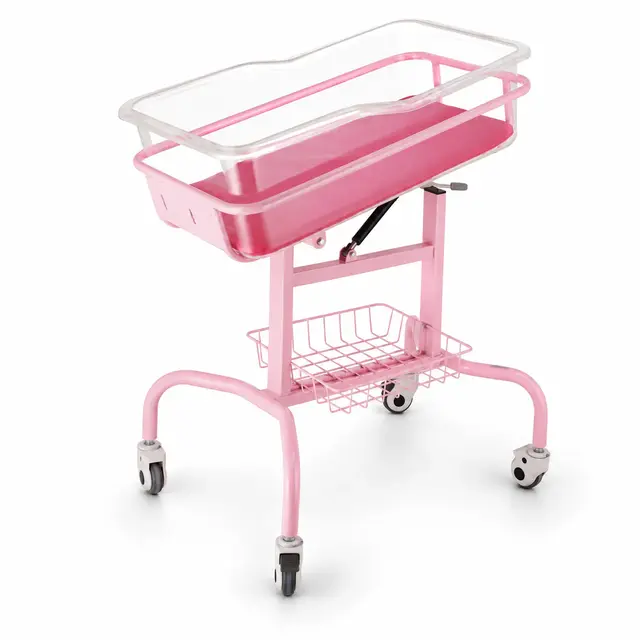
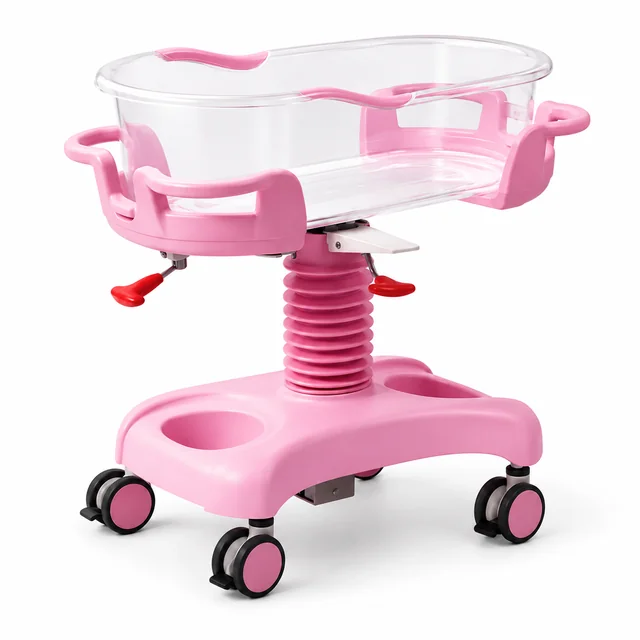
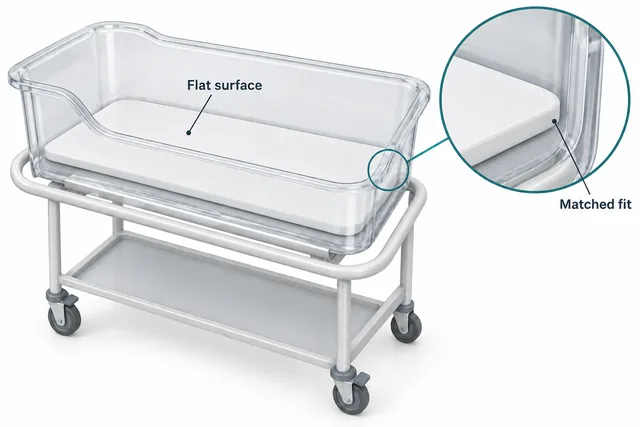
A hospital bassinet is a medical bassinet on a mobile trolley that keeps the newborn beside the mother's bed while allowing staff to observe, examine and move the baby. Domestic standards such as EN 1130 exclude hospital cribs, so a hospital bassinet is specified as a medical device, with infection control and ward handling in mind.
What separates a hospital bassinet from a consumer baby bassinet:
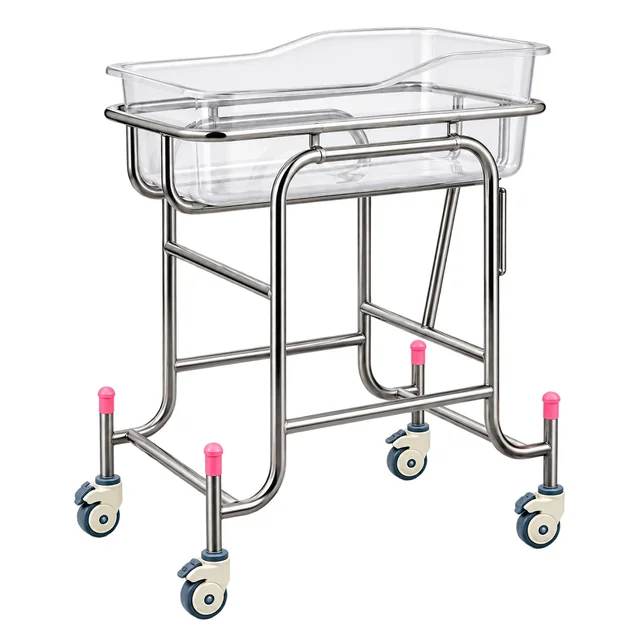
- A transparent basket, so the baby's colour and breathing can be seen from the bedside or the nursing station.
- A trolley frame with castors and brakes, so the baby can be moved with the mother or to examination without being lifted out.
- Bedside height, so the mother can see and reach the baby from a hospital bed.
- Cleanable materials, such as stainless steel frames that tolerate hospital disinfectants.
- Tilt, on some models, for clinician-directed positioning. Under AAP guidance, routine sleep should be on a flat, non-inclined surface, so tilt should be returned to level for sleep unless a clinician directs otherwise.
| Keling model | Size | Key features |
|---|---|---|
| KL-BC116 | 810 × 520 × 990 mm | Transparent basket, 18° Trendelenburg tilt, 360° swivel castors, lower storage basket |
| KL-BC117 | 875 × 525 mm, height 650–900 mm | Height adjustment to match the mother's bed, 0–12° tilt, 20 mm mattress, silent castors, load capacity under 30 kg |
| KL-BC118 | 810 × 520 × 900 mm | Transparent basket, stainless steel frame, 4 castors with 2 braked |
The height-adjustable KL-BC117 is the natural choice where the basket must line up with an adult bed that itself moves up and down; the fixed-height KL-BC118 suits wards that prioritise a simple stainless frame. Our illustrative maternity rooming-in project shows how an adult electric bed and a separate bassinet are planned as a pair.
When to move from bassinet to crib
Move a baby from bassinet to crib as soon as the first of these happens: the baby starts to push up on hands and knees, rolls over (if the manufacturer's warning says so), reaches the labelled weight limit, or no longer fits comfortably with space at the head and feet. For many babies this is around 4 to 6 months.
The next bed should be a crib that meets the full-size or non-full-size crib rules, with a mattress that fits. Our guides to crib dimensions and crib mattress size and crib safety standards cover what to check.
Hospital bassinet buying checklist
- Basket fully transparent on all sides, with no sharp edges or pinch points around the basket mount.
- Mattress supplied by the bassinet manufacturer and fitting the basket with no edge gap; spares ordered by model. See our guide to hospital crib mattresses.
- Castors with at least two brakes, and a stable base when the basket is tilted.
- Height range compatible with the adult beds on the ward.
- Tilt range, if any, documented with a clear level position.
- Frame and basket materials compatible with the unit's disinfectants.
- Labelled load capacity and instructions in the language of the destination market.
To request specifications, drawings or a quotation for hospital bassinets and matched mattresses, ask for a quote.
Sources and further reading
- CPSC: Bassinets and cradles business guidance — 16 CFR 1218, ASTM F2194 versions and effective dates.
- ASTM F2194-13 (as incorporated by reference) — scope, side height, pad thickness and stop-use warning.
- Eurofins: CPSC updates safety standard for bedside sleepers — 16 CFR 1222 and ASTM F2906-23.
- eCFR: 16 CFR part 1236, Infant Sleep Products — scope and 10° sleep surface limit.
- EN 1130:2019 Children's furniture — Cribs — European scope, including bedside sleepers and the hospital exclusion.
- American Academy of Pediatrics: 2022 safe sleep recommendations — back sleeping, flat surfaces and room-sharing.
Illustration: AI-generated image for explanation only; it does not show a specific Keling model. See the linked product pages for actual product photos and specifications.
Frequently asked questions
What is the weight limit for a bassinet?
There is no single legal bassinet weight limit. Each manufacturer sets one and prints it on the warning label; consumer bassinets are commonly limited to around 15–20 lb (7–9 kg). Stop using the bassinet when the baby reaches that weight or starts to push up on hands and knees, whichever comes first.
Are bedside bassinets safe?
A bedside bassinet that meets the US bedside sleeper rule (16 CFR 1222) or EN 1130 and is attached exactly as instructed gives the baby a separate sleep surface next to the parent. The main risks are gaps between the sleeper and the adult mattress and using it detached with the side lowered.
How long can a baby sleep in a bassinet?
Bassinets are intended for infants up to about 5 months old, or until the baby begins to push up on hands and knees, whichever comes first. Many babies reach that stage at around 4 to 6 months. Also stop at the labelled weight limit or when the baby no longer fits comfortably.
What safety standard applies to bassinets?
In the US, bassinets and cradles must meet 16 CFR part 1218, which incorporates ASTM F2194; ASTM F2194-25 applies to products made from 21 February 2026. Bedside sleepers follow 16 CFR 1222. In Europe, EN 1130 covers cribs, cradles and bedside sleepers up to 900 mm internal length.
What is a hospital bassinet?
A hospital bassinet is a medical bassinet on a mobile trolley, with a transparent basket so staff and parents can observe the newborn, castors with brakes and a height that suits the mother's bed. It is used in maternity rooming-in and newborn areas and is specified as a medical device rather than a nursery product.
Can a bassinet be inclined for a newborn to sleep?
For routine sleep, no. The AAP recommends a firm, flat, non-inclined surface, and US rules limit bassinet sleep surfaces to 10° or less from horizontal at rest. Hospital bassinets with tilt are for clinician-directed positioning and should be returned to level for sleep unless a clinician directs otherwise.
What size is a bassinet?
Bassinet dimensions vary by model. EN 1130 covers products with an internal base length up to 900 mm. Keling's hospital bassinets measure 810 × 520 × 990 mm (KL-BC116), 810 × 520 × 900 mm (KL-BC118) and 875 × 525 mm with a 650–900 mm height range (KL-BC117).
About the author
This article was written by the Keling Medical export team, drawing on the engineering data for the 33 bed, cot, mattress and accessory models Keling manufactures at its Yangzhou plant, and checked against the published standards and guidance listed in the sources. Keling Medical has been making medical appliances since 1996 and holds CE, ISO 9001 and ISO 13485 certification. More about Keling.