Alternating pressure air mattress pump: settings, alarms, cycle times and troubleshooting
How the pump on a hospital air mattress works and how to run it: pressure by weight, cycle time, static mode, alarms, CPR valve, transport, cleaning and common faults.
Short answer
An alternating pressure air mattress pump inflates and deflates groups of air cells in turn so no area of skin is loaded continuously. Set the comfort or pressure control to the patient's weight and confirm with a hand check for bottoming out, use the cycle time in the instructions or protocol, use static mode for procedures, act on low-pressure and power-failure alarms, and know where the CPR valve is.
An alternating pressure air mattress pump is the part of the system that does the work: it inflates the cells, cycles pressure between them and warns staff when something goes wrong. Most problems reported with hospital air mattresses — a patient "sinking", an alarm nobody can silence, a flat mattress after a power cut — come down to how the air mattress pump is set up and operated rather than to the mattress itself.
This guide explains the controls found on typical hospital air mattress pumps: comfort or pressure setting, cycle time, static mode, alarms, the CPR valve, transport, cleaning and common faults. It is generic: exact settings, ranges and procedures are those in the instructions for use supplied with each pump, and the choice of surface and settings for a patient follows the facility's protocols and the treating clinician.
What does an alternating pressure air mattress pump do?
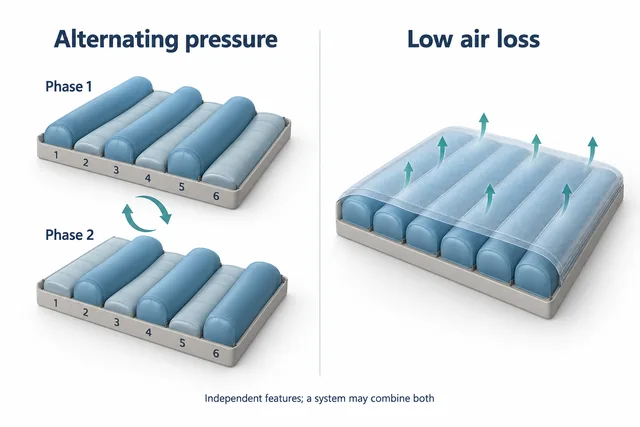
An alternating pressure pump is an electric air mattress pump: a compressor with a valve system that inflates and deflates groups of air cells in turn, so that no area of skin is loaded continuously. The NPIAP Support Surface Standards Initiative defines alternating pressure as a feature that redistributes pressure "via cyclic changes in loading and unloading", characterised by frequency, duration, amplitude and rate of change.
Cells are usually arranged in alternating groups (for example every second or third cell), so that while one group deflates the others carry the patient. A pressure sensor or regulator holds the inflated cells at the selected level — which is why a medical air mattress with pressure sensor control behaves very differently from an adjustable air mattress for home use. This makes it an active support surface — one that changes its load distribution with or without a person on it — as opposed to a reactive foam or static air surface. Older catalogues call smaller overlay versions an alternating pressure pad. The differences between an alternating air mattress and a low air loss mattress are covered in alternating pressure vs low-air-loss mattresses, and bubble-cell versus tubular construction in air mattresses for hospital beds.
| Control or feature | What it does | What to check |
|---|---|---|
| Comfort / pressure setting | Sets the inflation pressure, often marked in weight bands or mmHg | Matches the patient's weight; no bottoming out on a hand check |
| Cycle time | Length of one full inflate–deflate sequence | Fixed or selectable; set per protocol and the pump's instructions |
| Static mode | Holds all cells at equal pressure, no alternation | Used for procedures or transfers, then returned to alternating |
| Low-pressure alarm | Warns that pressure has fallen below the set level | Hoses connected, CPR valve closed, no leaking cells |
| Power-failure alarm | Warns that mains power has been lost | Plug, socket, switch and fuse; patient checked first |
| CPR valve | Rapidly deflates the mattress for resuscitation | Location known to all staff; closed after use |
| Transport function | Seals air in the cells when the pump is disconnected | Used only for short moves; reconnected promptly |
| Panel lock | Prevents accidental changes to settings | Engaged after setting; staff know how to unlock |
Can a battery-powered or manual air mattress pump be used instead?
No. A battery powered air mattress pump, rechargeable air mattress pump, air mattress hand pump or foot pump sold for camping or guest beds only fills a mattress once; it does not alternate, regulate pressure or raise alarms. A medical alternating pressure mattress must be run with the pump it was designed and tested with — hose connectors, cell layout and pressure control are system-specific. Ask the supplier for a spare pump of the same model rather than substituting.
Setting up the mattress and pump on a hospital bed
Set-up determines whether the pump can work as intended. A typical sequence:
- Decide replacement or overlay. A replacement hospital inflatable mattress sits directly on the bed platform; an air mattress overlay sits on top of an existing foam mattress. Overlays raise the patient, and UK MHRA guidance warns that air and dynamic surfaces reduce the effective height of side rails, so check rail height and entrapment gaps.
- Position and secure. Lay the mattress with the hose end at the foot, and fasten its straps to the movable bed sections — not to the side rails — so it follows the backrest and knee-rest.
- Hang the pump on the footboard, or place it on a level surface, where it cannot fall or be covered by bedding.
- Connect the hoses without kinks or twists, routed away from the patient. A hose under the body can itself cause a device-related pressure injury.
- Close the CPR valve, switch on and wait for full inflation before the patient lies on it. First inflation can take tens of minutes; the pump's instructions give the time.
- Make the bed loosely with a single sheet, so it does not "hammock" over the cells, and keep extra layers between patient and surface to a minimum.
How to set the pressure (comfort) setting by patient weight
Set the comfort or pressure control to the patient's body weight using the scale on the pump, then confirm with a hand check. Too low and the patient bottoms out on the bed platform; too high and the surface becomes firm, reducing immersion and the benefit of alternation.
- Start from weight. Many pumps mark the dial in weight bands; digital controllers may display a pressure value in mmHg. Use the scale for that model only.
- Do a hand check. With the patient lying flat, slide a hand palm-up under the mattress beneath the lowest bony point (usually the sacrum). If you can feel the bone through the surface, increase the setting. The NSW Agency for Clinical Innovation recommends checking under the lowest point of the body both lying and sitting.
- Re-check when position changes. Raising the backrest concentrates weight over the sacrum; some pumps have a seat-inflate or firmer function for this, others need a higher setting.
- Record the setting in the care record, so the next shift does not change it by guesswork. A digital controller such as the one supplied with the KL-P004 makes the set value easy to read and document.
For context on what a powered surface should achieve, the US Medicare policy for powered pressure-reducing mattresses requires an inflated air-cell height of 5 inches (127 mm) or more, and cell height, cycling frequency and pressure that "prevent bottoming out". That is a reimbursement definition, not a universal standard, but it is a useful benchmark in tenders.
What cycle time should an alternating pressure mattress use?
Cycle time is the time a pump takes to complete one full sequence of inflating and deflating each cell group. Basic pumps often have a fixed cycle; digital pumps commonly offer several selectable times, for example in steps between about 10 and 25 minutes.
There is no single correct cycle time for every patient. Shorter cycles shorten the time any area is loaded; some patients find frequent movement uncomfortable or disturbing to sleep. Where the pump allows a choice, use the default in the manufacturer's instructions unless the facility's protocol or the clinical team specifies otherwise, and record any change.
When to use static mode
Static mode stops the alternation and holds all cells at the same pressure, turning the system into a static air mattress. It is useful for:
- nursing procedures that need a stable surface, such as wound dressing or catheter care;
- helping a patient get in or out of bed, or sitting on the edge;
- patients who cannot tolerate the alternating motion, as decided by the clinical team.
Static mode is not a long-term setting for a high-risk patient unless that is the clinical plan. Some pumps return to alternating automatically after a set period; others stay static until changed, so make returning to alternating part of the procedure. Some pumps also have a maximum-inflate function that firms the mattress for transfers or repositioning for a limited time.
Alarms, power cuts and transport
The two alarms found on most hospital air mattress pumps are low pressure and power failure. Treat both as patient-safety alarms: check the patient first, then the equipment.
Low-pressure alarm
A low-pressure alarm means the system cannot hold the set pressure. Common causes are a disconnected or kinked hose, a CPR valve left open, a leaking or detached cell, or a new mattress that has not yet reached full inflation. Check the hand test immediately: a patient lying on the bed platform needs action now, even if that means moving them to another surface while the fault is found.
Power-failure alarm
A power-failure alarm sounds when mains power is lost — an unplugged lead, a switched-off socket, a blown fuse or a building outage. Many pumps restart automatically when power returns, but cells may have lost air in the meantime. Plug pumps directly into a suitable outlet, keep leads away from bed wheels and moving parts, and include air mattresses in the ward's plan for power interruptions; in areas with unreliable supply, the ACI suggests considering an uninterruptible power supply.
Transport
For moving a patient to imaging or another ward, many systems have a transport function or cap that seals air in the cells after the pump is disconnected. This is for short periods only. Reconnect and switch on as soon as the bed arrives, and check that the mattress has not softened during the move.
Muting an alarm without fixing its cause is the most common avoidable failure. Pumps are medical electrical equipment, typically built to the IEC 60601-1 family of safety standards, and their alarms exist for a reason.
CPR valve: emergency deflation for resuscitation
The CPR valve rapidly releases air from the mattress so that chest compressions are delivered against a firm base rather than a soft air surface. It is usually a clearly marked pull tab or valve near the head end or hose connection.
- Every member of staff who works with the bed should know where the CPR valve is before it is needed.
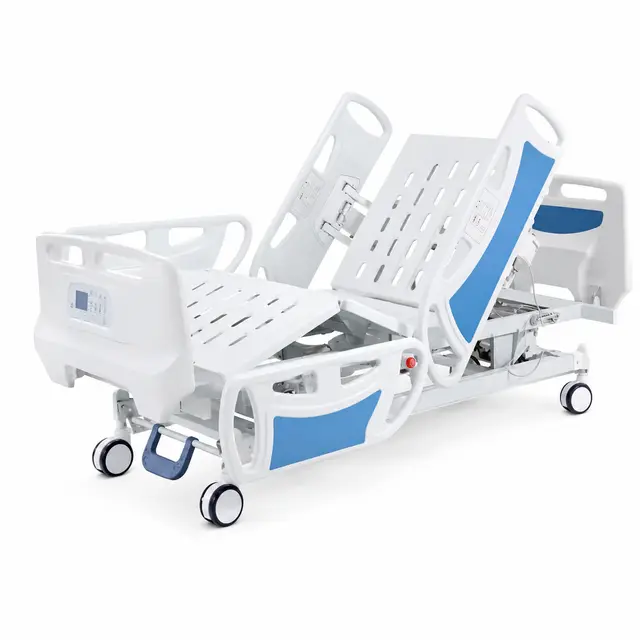
- Combine it with the bed's own emergency function: beds such as the KL-BC101 and KL-BC102 have a CPR quick release that drops the backrest flat.
- Follow the facility's resuscitation protocol, including use of a CPR board where specified.
- After the event, close the valve and re-inflate — an open CPR valve is a frequent cause of later low-pressure alarms.
Cleaning, inspection and maintenance
Clean the pump casing, hoses and mattress cover between patients and as part of routine care, using agents the manufacturer approves. Never immerse the pump in water. The US FDA advises facilities to inspect mattress covers regularly for cuts, tears, pinholes and stains, to check the inside of covers and the core for fluid ingress, to replace damaged covers immediately, and not to stick needles into a mattress through its cover.
A practical maintenance routine for an air mattress fleet:
- check and clean or replace the pump's air filter at the interval in the instructions;
- inspect cells, connectors and hoses for leaks, cracks and worn clips;
- run electrical safety testing on pumps according to the facility's medical equipment programme;
- label each pump and mattress as a matched pair with an asset number, so faults can be traced.
Common air mattress pump faults and fixes
Most faults can be traced with a short check of hoses, valves and power before calling service.
| Symptom | Likely cause | First check |
|---|---|---|
| Low-pressure alarm soon after set-up | Mattress not fully inflated yet; CPR valve open | Close valve; allow the stated inflation time |
| Low-pressure alarm during use | Hose disconnected or kinked; cell detached or punctured | Reconnect hose; inspect each cell and connector |
| Patient feels the bed platform | Comfort setting too low for weight; head of bed raised | Hand check; raise setting; review backrest angle |
| Mattress feels hard, patient uncomfortable | Setting too high; maximum-inflate left on | Return to weight-based setting |
| No alternation felt | Static mode selected; valve fault | Check mode; contact service if alternating is selected |
| Power-failure alarm | Unplugged, socket off, blown fuse, outage | Restore power; check the patient and mattress firmness |
| Pump noisy or hot | Blocked filter; pump covered by bedding | Clean filter; clear ventilation |
Keling KL-P003 and KL-P004: what is supplied
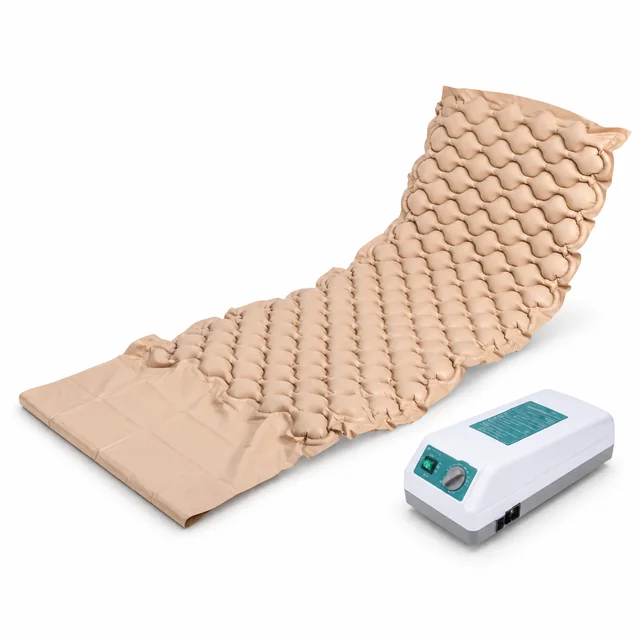
Keling manufactures two air mattresses for hospital beds — each a hospital bed air mattress with pump included — both 1900 × 900 mm and both supplied with an electric pump:
- KL-P004 — tubular air-cell alternating pressure mattress with an electric pump featuring a digital control panel for setting and monitoring inflation pressure.
- KL-P003 — bubble-cell air mattress with an electric pump for inflation and pressure control.
Pump specifications such as cycle options, alarm set and power supply should be confirmed against the current datasheet and instructions for use when you order; ask for them with your quotation, along with spare pumps, hoses and covers for the fleet. For the wider choice of surfaces, see our hospital bed mattress buying guide.
Specification line: Alternating pressure air mattress for hospital bed, 1900 × 900 mm, tubular air cells, supplied with electric pump with digital control panel; weight-based pressure adjustment; static mode; low-pressure and power-failure alarms; CPR rapid-deflation valve; transport function; removable cleanable cover; instructions for use in English.
To confirm the current pump specification or quote air mattresses with matching beds, contact Keling's export team or request a quotation.
Sources and further reading
- NPUAP Support Surface Standards Initiative: Terms and definitions — alternating pressure, active and reactive surfaces, overlays.
- International Guideline (EPUAP/NPIAP/PPPIA): Full body support surfaces — when active surfaces are considered.
- NSW Agency for Clinical Innovation: Mattresses — hand check for bottoming out, power supply considerations.
- CMS: Pressure Reducing Support Surfaces – Group 2 policy article — Medicare definition of powered pressure-reducing mattresses.
- FDA: Covers for hospital bed mattresses — inspection, replacement and cleaning of mattress covers.
- MHRA: Bed rails – management and safe use — effect of air and dynamic mattresses on rail height.
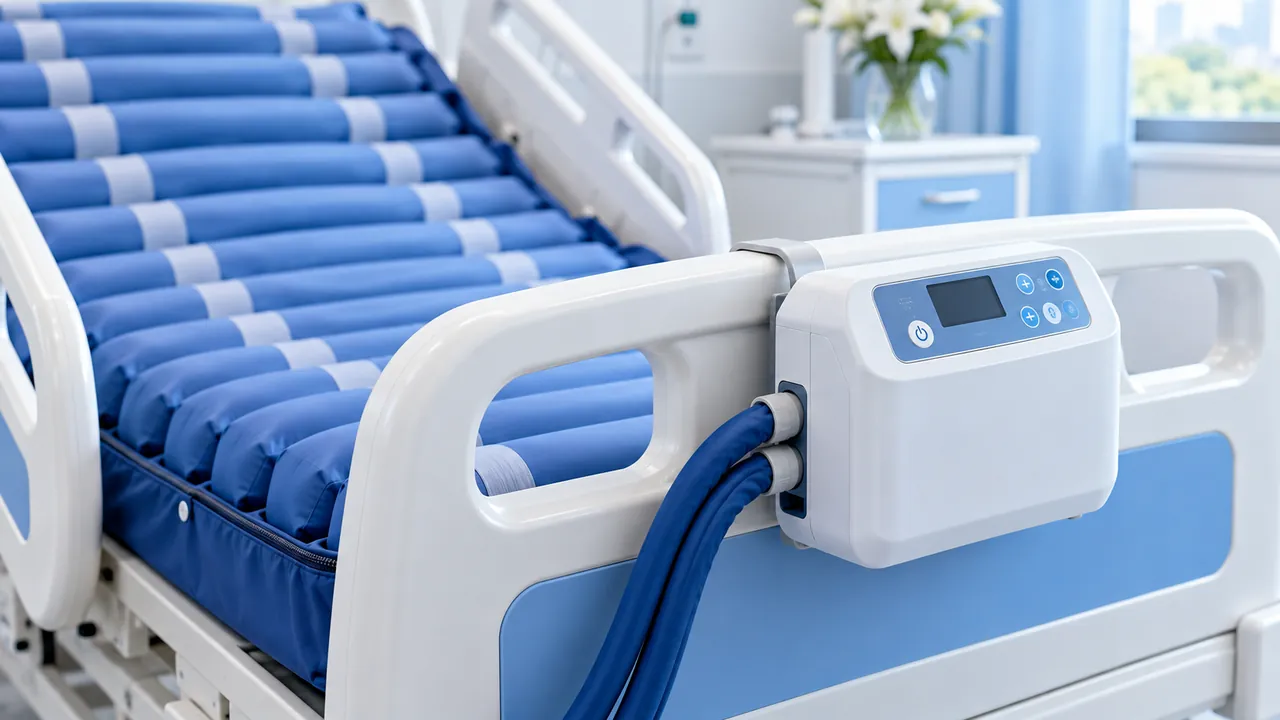
Illustration: AI-generated image for explanation only; it does not show a specific Keling model. See the linked product pages for actual product photos and specifications.
Frequently asked questions
How do I set an alternating pressure mattress pump for a patient's weight?
Turn the comfort or pressure control to the patient's weight on the pump's own scale, wait for the mattress to settle, then slide a hand palm-up under the mattress beneath the lowest bony point. If you can feel the bone, increase the setting. Re-check after raising the backrest and record the setting in the care record.
Why does my air mattress pump keep alarming?
A low-pressure alarm is usually caused by a disconnected or kinked hose, an open CPR valve, a leaking or detached cell, or a new mattress still inflating. A power-failure alarm means mains power has been lost. Check the patient first, then the hoses, valve and power, and contact service if the alarm persists.
What is static mode on an air mattress?
Static mode stops the alternating cycle and holds all cells at the same pressure. It provides a stable surface for nursing procedures, transfers and getting in or out of bed. Return the pump to alternating mode afterwards unless the clinical team has decided otherwise, because some pumps do not switch back automatically.
Can I use a battery-powered or manual pump with a hospital air mattress?
No. Battery-powered, rechargeable, hand or foot pumps made for camping or guest air beds only inflate a mattress; they do not alternate pressure, regulate it or provide alarms. A medical alternating pressure mattress must be used with the pump designed and supplied for that system.
What does the CPR valve on an air mattress do?
The CPR valve rapidly deflates the mattress so chest compressions can be delivered on a firm base. Staff should know its location in advance, use it together with the bed's CPR release and the facility's resuscitation protocol, and close it afterwards so the mattress can re-inflate.
Does a Keling air mattress come with a pump?
Yes. Both Keling hospital air mattresses, the KL-P004 tubular alternating pressure mattress and the KL-P003 bubble-cell mattress, measure 1900 x 900 mm and are supplied with an electric pump. The KL-P004 pump has a digital control panel. Confirm detailed pump specifications with the current datasheet when ordering.
About the author
This article was written by the Keling Medical export team, drawing on the engineering data for the 33 bed, cot, mattress and accessory models Keling manufactures at its Yangzhou plant, and checked against the published standards and guidance listed in the sources. Keling Medical has been making medical appliances since 1996 and holds CE, ISO 9001 and ISO 13485 certification. More about Keling.