How to Vet a Chinese Hospital Bed Manufacturer Before You Order
Audit a hospital bed manufacturer using model-specific documents, samples, factory checks and service evidence. Includes a downloadable procurement checklist.
Vetting a hospital bed manufacturer means establishing who is responsible for the product, whether the offered model meets the purchasing requirements, and how the supplier will support it after delivery. A factory video, certificate image or attractive sample provides only part of that evidence.
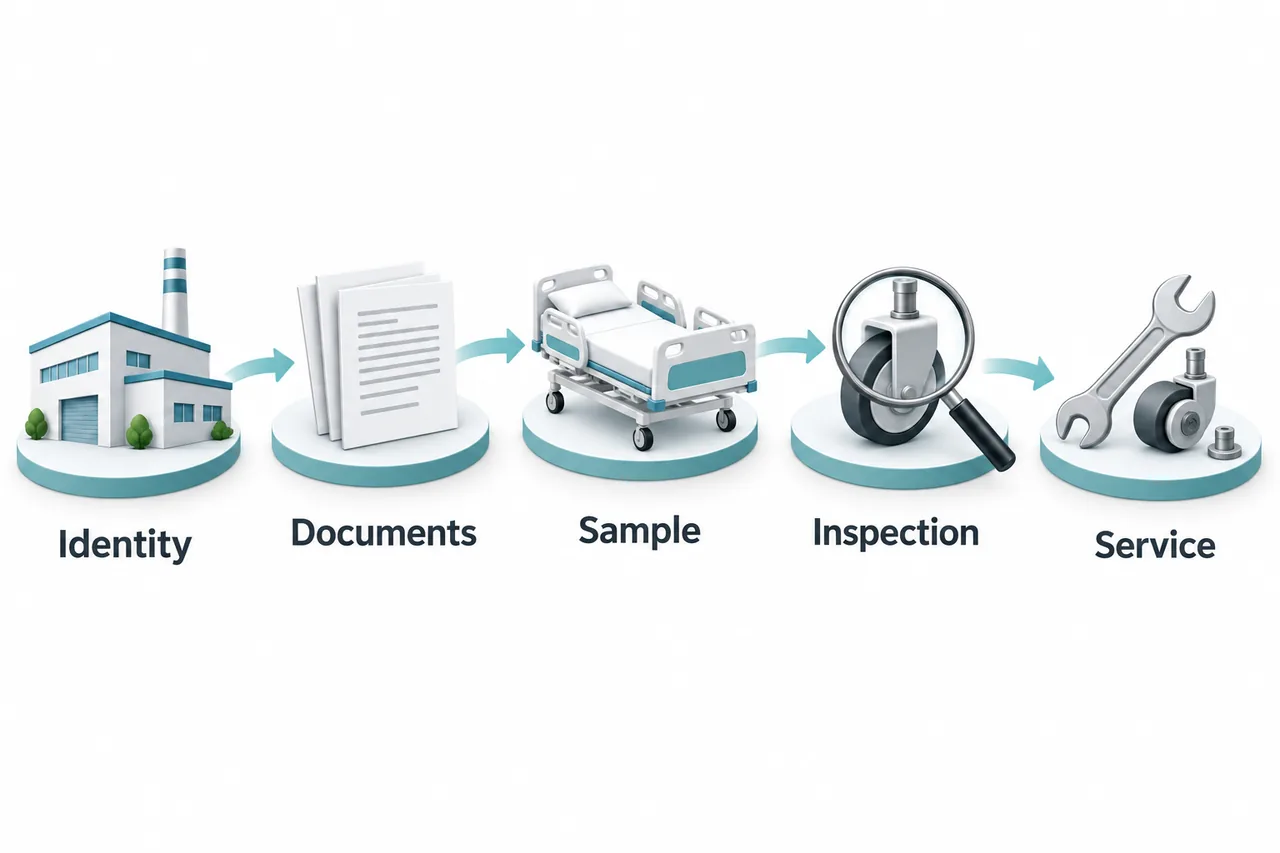
The most useful review follows the order from supplier identity through production, documentation, inspection and service. Each stage should produce a record tied to the actual model and configuration. This guide is intended for hospitals, distributors and importers preparing a bulk or OEM purchase, with a downloadable checklist for recording the evidence still needed.
Establish who manufactures, sells and supports the beds
Ask for the legal names and addresses of the manufacturer, contracting seller and any export company. These may be different entities for legitimate reasons. The important question is whether their responsibilities and relationship are documented.
Match the names on the quotation, business documents, product label, quality certificate and relevant regulatory documents. Where names differ, ask for an explanation and supporting records. Do not conclude that a trading company is unsuitable simply because it does not operate the factory; evaluate its authority, technical access and service responsibility.
For an audit, identify the production location for the quoted model. A visit to a showroom or another site in the same group does not verify that model's production controls. Agree what operations occur at the factory and what is purchased or subcontracted.
Verify documents by purpose, model and scope
Separate management-system evidence, product testing and market-access documentation. They answer different questions. Build a document register with the issuer, legal entity, site, scope, model, edition, issue date and verification method.
ISO 13485 and CE-related evidence
ISO 13485 concerns quality management for medical devices. When a supplier presents certification, review its scope and covered sites and verify it with the issuing body. It does not establish that every bed has passed a particular product test. ISO 13485 overview.
For EU supply, request the applicable declaration of conformity, classification rationale and supporting documentation for the model. Notified-body involvement depends on the conformity route and device characteristics; a generic “CE certificate” is not a complete evaluation. Where a notified body is involved, verify its designation and relevant scope. European Commission medical-device guidance, European Commission notified-body information.
Check the current medical-bed standard and accepted edition
At the September 2026 review date, IEC 80601-2-52:2026 is the new international adult medical-bed standard; IEC identifies it as the replacement for IEC 60601-2-52:2009. Children's medical beds have IEC 80601-2-89:2025, within its stated scope. IEC adult medical-bed standard, IEC replacement notice, IEC children's medical-bed standard.
Do not assume publication immediately changes every country's accepted edition. Have the importer or regulatory reviewer establish the destination's applicable requirements and transition arrangements. Ask the supplier to identify the exact report edition, laboratory, tested models and configuration. An older report needs a documented acceptance basis; a newer standard number in a brochure is not proof of testing.
Also distinguish a full system assessment from certificates for individual motors or control units. Component documentation can support the technical file, but it does not by itself establish the safety of the assembled bed with its mattress and rails.
U.S. supply: do not assume every bed needs a 510(k)
FDA classification lists some ordinary adjustable hospital-bed categories as 510(k)-exempt, subject to the applicable exemption limitations. The correct route depends on intended use, product code and device characteristics. Require either the relevant clearance evidence where needed or a documented exemption assessment, rather than demanding a 510(k) for every bed. FDA device exemptions, FDA hospital-bed classification results.
Registration and listing do not mean FDA approval or clearance, and FDA does not issue device registration certificates. Verify the actual records and applicable obligations. FDA explanation of registration claims.
Audit the controls that affect the delivered product
A factory audit should follow a model through receiving, production, inspection and release. Ask the auditor to trace an identified component batch into production records and a finished unit. This shows how the supplier manages identity and changes, rather than merely confirming that an assembly line exists.
Review how drawings and bills of materials are controlled, how incoming components are accepted and how nonconforming parts are separated. Ask how welding, surface treatment or other outsourced operations are qualified and checked where relevant to the design. The audit should connect each observation to the supplier's actual process.
Look at instrument calibration, final inspection records and corrective-action follow-up. A tidy line is useful but cannot replace evidence that defects are recorded and resolved. Request an example of a closed issue with sensitive customer details removed if necessary.
Treat refusal to identify the manufacturing site, inconsistent model names, unverifiable reports or unexplained component substitutions as unresolved findings. They require explanation before commitment; they should not be hidden by a good overall audit score.
Approve the sample and production configuration together
The sample should match the proposed production specification, including the mattress, sides, controls, castors and accessories. Record the sample identification, photographs and accepted drawings. If the supplier later proposes a change, assess its effect before accepting it as equivalent.

Have clinical users and maintenance staff review operation, access, cleaning and routine servicing. Any technical safety testing should use qualified personnel, appropriate methods and the applicable requirements. Do not improvise destructive load tests or entrapment tests as a substitute for recognised evaluation.
Separate sample approval from production release. A good sample does not prove the remaining units were built identically. Require a final production inspection covering identity, quantity, specification, agreed functional checks, visible condition and packaging. Define the sampling plan and defect treatment contractually, including how safety-related findings are escalated.
If inspection finds deviations, document corrective action and the evidence needed for release. Do not assume a supplier's promise to repair after shipment is equivalent to receiving conforming goods. The buyer should know who has authority to approve release and what information that decision requires.
OEM and private-label supply need change control
For a private-label hospital bed, distinguish branding from product redesign. A logo or carton artwork has a different impact from changing dimensions, controls, actuators or intended use. Define which changes are requested and which require updated technical or regulatory assessment.
Agree who approves artwork, owns drawings and maintains the technical documentation. Clarify the legal manufacturer and each party's obligations in the destination market; applying a private label does not automatically transfer every responsibility to the factory.
An OEM specification should include accepted component references, label content, manuals, packaging and the process for changes after approval. Keep the OEM private-label programme discussion tied to those records, rather than treating custom colour as evidence of broad engineering capability.
Check service before negotiating the final order
Request a model-specific parts list, identification drawings and service instructions for work the local team is authorised to perform. Ask about availability, ordering references and replacement compatibility. An assurance that spare parts are available is more useful when accompanied by a practical ordering process.
Read warranty terms alongside the proposed service arrangement. Establish the treatment of parts, labour, freight, diagnosis and site visits. Ask what happens if a component is discontinued and whether replacements require additional instructions or approval.
Plan staff handover and commissioning. The receiving team should know how equipment is assembled if necessary, checked, labelled and released for use. Keep these responsibilities visible in the purchase agreement and in the project budget described in What Drives Hospital Bed Price: The Factors Behind a Bulk Export Quote.
Download and use the procurement checklist
Download the hospital bed manufacturer vetting checklist. The editable CSV provides review items and blank fields for evidence, reviewer, findings and follow-up. It contains no prefilled compliance result and does not certify a supplier.
| Review stage | Minimum useful output | Decision supported |
|---|---|---|
| Identity | Documented manufacturer, seller and production site | Whether responsibilities are clear |
| Regulatory review | Model-specific requirements and verified evidence | Whether the offered product can meet the destination brief |
| Factory audit | Findings linked to production controls | Whether unresolved supply risks remain |
| Sample review | Accepted configuration and recorded deviations | What production is authorised to build |
| Shipment review | Inspection record and resolved findings | Whether the order is ready for release |
| Service review | Parts, warranty and handover arrangement | How the equipment will be supported |
Use the checklist as a live procurement record. Add the destination's specific requirements and retain evidence references so another reviewer can reproduce the decision. An item marked not applicable should include the reason, rather than disappearing from the file.
Applying the same review to Keling
Start with a selected model from Keling's hospital-bed catalogue and request the documents listed on the certifications page. Ask the export team to connect the quoted configuration, legal entities, manufacturing site and service package in one response.
Public product pages provide a starting point, but they do not replace an independent factory audit, signed specification or verification of the relevant reports. Apply the same acceptance criteria to Keling as to any other hospital bed supplier. For order planning after qualification, refer to the bulk procurement and OEM guide.
Frequently asked questions
Is buying directly from a manufacturer always preferable?
The relevant factors are technical access, documented responsibility, suitable product evidence and dependable service. A distributor or export company can be a valid contracting partner if those arrangements are clear and verifiable.
Does ISO 13485 prove that a bed meets every safety standard?
No. Review the quality-system evidence and the product-specific reports separately. Match both to the entity, site and model being offered.
Should a buyer reject an older test report automatically?
No. Ask the regulatory reviewer to confirm the applicable edition and transition requirements, then assess the report's scope and continued relevance to the offered configuration. Neither age alone nor a familiar standard number settles the question.
Can a video audit replace all other checks?
It can help confirm selected processes and resolve questions, but it cannot answer every document, product or production-consistency issue. Combine the appropriate audit method with sample review, evidence verification and shipment inspection.
Next step
To begin a documented supplier review, contact Keling with the destination, selected models and checklist, and request a configuration-specific evidence package and quotation.
About the author
This article was written by the Keling Medical export team, drawing on the engineering data for the 33 bed, cot, mattress and accessory models Keling manufactures at its Yangzhou plant. Keling Medical has been making medical appliances since 1996 and holds CE, ISO 9001 and ISO 13485 certification. More about Keling.